What's inside
As an Amazon Associate I earn from qualifying purchases. This post may contain affiliate links at no extra cost to you.
Why battery match matters
A cordless saw can fit a battery and still be a poor match for it. A compact pack may run a circular saw for light cuts, but bog down in thick lumber, trip its protection, or heat up during repeated cuts. The difference is not just runtime: the battery must supply enough current without excessive voltage sag or overheating.
Start with the saw’s manual. Look for its recommended battery capacity, compatible voltage platform, and any note that certain packs are required for full performance. If the manufacturer calls for a high-output pack, treat that as a performance requirement, not a sales suggestion. A smaller pack may work, but it can limit cutting speed and trigger more pauses.
Understand voltage and capacity
Voltage is the platform the tool is built for; a battery from a different voltage family will not become compatible through an adapter. Capacity, measured in amp-hours (Ah), describes how much energy a pack stores. A 5 Ah pack holds more energy than a 2 Ah pack on the same platform, but Ah alone does not tell you how much current it can deliver at once.
High-draw saws—especially large circular saws, miter saws, and chainsaws—need both adequate energy and strong current delivery. Pack design matters: cell type, internal resistance, electronics, and cooling all affect output. Two packs with the same voltage and Ah rating can behave differently under a demanding cut.
Compare battery options
| Battery type | Best fit | Trade-off under heavy sawing |
|---|---|---|
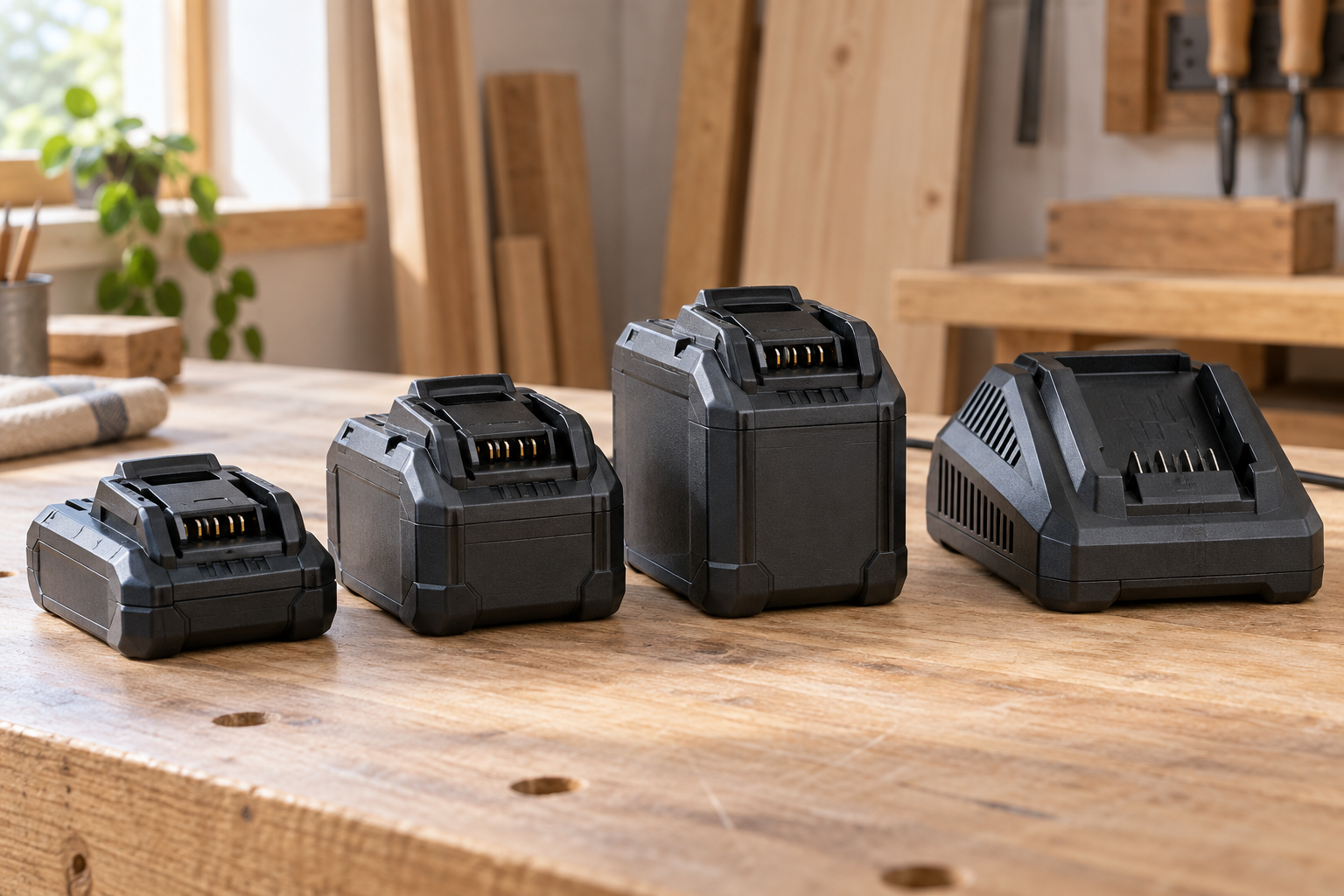
| Compact, lower-capacity pack (about 2–3 Ah) | Light trim, short cuts, occasional use | Low weight, but less runtime and more chance of slowing or overheating in sustained cuts |
| Mid-capacity pack (about 4–6 Ah) | General jobsite and workshop use | Good balance, though performance depends on the pack’s output design |
| High-output pack (often 6 Ah or more) | Repeated cuts, thick stock, high-draw saws | More runtime and often better sustained output, but heavier, bulkier, and more expensive |
| High-capacity pack (often 8 Ah or more) | Long sessions where weight is manageable | Fewer swaps, but extra mass can make handheld saws tiring and does not guarantee higher peak output |
These ranges are practical guides, not universal specifications. Battery designs vary by brand and generation, so compare the specific pack’s stated compatibility and output guidance rather than buying by Ah alone.
Match the pack to the saw and cut
For a compact circular saw making occasional cuts in 1-inch boards, a small pack can be a sensible choice. The saw weighs less, and the battery is less costly. For a full-size circular saw cutting 2-by lumber or sheet goods throughout the day, start with the manufacturer’s recommended high-output pack. That extra capacity can reduce swaps, while a stronger discharge design helps the saw maintain speed under load.
A cordless miter saw often sits on a bench, so battery weight matters less than it does on a handheld saw. A larger pack can be worthwhile for repeated crosscuts, especially if there is no outlet nearby. With a chainsaw, balance matters: a large pack adds weight at the rear and can make an already tiring tool awkward. Match the pack to the saw’s recommendation and the length of your cutting session, rather than choosing the biggest one available.
If you need a replacement or a second pack, look for a high-output battery for your tool platform. Check the platform, voltage, and exact compatibility before ordering; batteries from the same brand are not always interchangeable across voltage families.
Spot the signs of an underpowered pack
Common signs include the blade slowing in a cut, the tool shutting off and restarting after a brief pause, or the battery becoming unusually hot. A compact pack may also run down quickly even though the cut count seems low. Protection circuitry can stop a tool before a battery is damaged; repeated cutouts are a reason to stop and reassess, not to keep cycling the trigger.
These symptoms do not prove the battery is too small. A dull blade, pinched kerf, misaligned guide, or forcing the saw through material can raise current demand. Check the blade, support the work properly, and let the tool reach speed before cutting. If the problem continues with a sharp blade and a suitable pack, inspect the battery and saw according to their manuals.
Manage heat and runtime
Heat is a practical limit. Repeated deep cuts, high ambient temperatures, and rapid recharging can warm a pack; a hot battery may pause charging or reduce output until it cools. Let it cool naturally in a shaded, dry place. Do not chill it in a refrigerator or charge a hot pack just to get back to work.
Runtime depends on material, blade condition, cut depth, and technique, so a single Ah rating cannot predict an exact number of cuts. For a full day of work, two suitable mid- or high-capacity packs may be more useful than one oversized pack: one runs the saw while the other charges. Confirm that the charger supports the battery, and remember that fast charging can add convenience but may increase heat.
Buy for your workload, not the label
If you already own compatible packs, test the saw with them on a representative cut before buying more. Use a sharp blade, the material you actually work with, and a steady feed. If the saw maintains speed and the battery stays within normal operating temperature, a smaller pack may be entirely adequate for your needs.
If you are building a platform around a high-draw saw, compare the cost of the saw, one recommended pack, and a compatible charger—not just the tool’s bare price. A battery-and-charger kit with a high-output pack can cost less than buying each part separately, but check that the included capacity suits the saw. For a handheld saw used overhead or on ladders, prioritize a manageable pack size. For stationary or repeated cutting, favor sustained output and fewer battery changes.
Related guides
- Longest Lasting Lawn Mower Battery: AGM vs Lithium vs Flooded Lifespan and Cost per Season
- Duralast Gold Lawn Mower Battery Review: U1 Fit, CCA and When to Pay for AGM
- Greenworks Pro 80V 21-Inch Mower Review: Runtime Math, Push vs Self-Propelled and Yard Fit
- Bosch High Pressure Washer Gun Replacement: Fittings, Adapters and What Fits Your Model