
What's inside
As an Amazon Associate I earn from qualifying purchases. This post may contain affiliate links at no extra cost to you.
Every woodworker who has run a dull or misapplied band saw blade knows the frustration: ragged cut edges, excessive noise, and a motor straining through what should be a routine resaw. The Lenox band saw blade lineup spans portable bandsaw cuts and stationary resaw work, which means the right choice depends less on brand loyalty and more on matching blade geometry to your specific machine and material.
What separates a well-applied Lenox blade from a poor match is tooth count, set pattern, and whether the blade is sized for your wheels. A portable bandsaw user cutting rebar needs a fundamentally different product than a cabinetmaker resawing walnut planks. This roundup compares published specifications, pack economics, and verified owner feedback to help both groups find the right Lenox blade without guessing.
As an Amazon Associate we earn from qualifying purchases at no extra cost to you. Product prices and availability are accurate as of the date shown and are subject to change.


Quick Picks
| Product | Best for | Price |
|---|---|---|
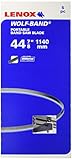
| Wolf-Band 14 TPI 5-Pack | General portable metal cutting | $38.40 |
| Classic Tuff Tooth 18 TPI | Stationary resaw and thick stock | $57.97 |
| Wolf-Band 18 TPI 25-Pack | High-volume portable cutting | $139.22 |
| Classic Tuff Tooth 14 TPI | Medium-density hardwood resaw | $51.70 |
| Wolf-Band Variable 5-Pack | Mixed portable jobs on varying stock | $37.28 |
| Classic Tuff Tooth Vari-Raker | Softwoods and knots in resaw | $50.28 |
| Compact Portable 10/14 TPI | Small portable saws and thin metal | $40.43 |
| Diemaster 2 Vari-Raker | Compact stationary saws with 1/2″ wheels | $30.25 |
How We Picked
Four criteria drove every selection here. First, dimensional fit: a blade must match your saw’s wheel diameter and guide opening, so we separated portable from stationary sizes. Second, tooth count and set pattern relative to intended material—fine teeth clog in resinous wood, while aggressive rakers leave rough surfaces on thin metal. Third, pack economics: a five-pack is fine for occasional use, but a pro cutting all day benefits from bulk pricing. Fourth, bimetal construction quality, which governs how long a blade stays sharp through repeated heat cycles without tooth breakage.
The 8 Best Lenox Band Saw Blades in 2026
Wolf-Band 14 TPI 5-Pack (8010738PW145)
This is the sensible default for homeowners and contractors who cut metal occasionally with a handheld portable saw. The fourteen teeth per inch handle pipe, angle iron, and light structural stock without requiring a blade change between tasks. The half-inch width gives the blade enough rigidity to track straight through a full cut while remaining flexible enough to follow a marked line.
- Pro: Generous five-pack keeps spares on hand without a significant cash outlay.
- Pro: Standard 44-7/8″ length fits the majority of portable saw models in the field.
- Con: The .020″ thickness, while adequate, flexes more than heavier-gauge alternatives on thick-walled pipe.
Skip this blade if you primarily cut very thin sheet metal or tubing under 1/16″; the 14 TPI count will grab and tear rather than slice cleanly.
Classic Tuff Tooth 18 TPI (29232CLB72360)
Aimed at the stationary-saw resaw operator, this bimetal blade pairs an eighteen-tooth count with a positive rake and wavy set. The combination produces smooth surfaces on dense hardwood like hard maple or ipe, reducing secondary sanding. The three-quarter-inch width adds tracking stability on larger wheels, and the 93″ length covers the full size range of common hobby-grade machines.
- Pro: The 18 TPI spacing resists clogging when cutting oily tropical species.
- Pro: Positive rake geometry pulls material through the cut with less forward pressure.
- Con: Higher tooth count slows cutting speed on softwoods or pine compared to a raker blade.
Skip this one if your saw is a compact model with 14″ wheels; the 93″ length and 3/4″ width are sized for larger frames and will not fit.
Wolf-Band 18 TPI 25-Pack (3842538PW18)
This bulk option targets metalworkers, welders, and construction crews who burn through portable blades weekly. Eighteen teeth per inch handles thin-walled tube, rebar, and conduit where a finer tooth produces cleaner burr-free edges. The quarter-inch thickness keeps the cut narrow, saving material on expensive stock like stainless fittings.
- Pro: Twenty-five blades per pack brings per-blade cost well under the five-pack equivalent.
- Pro: The higher TPI excels on thin-wall and non-ferrous metals where tooth count matters most.
- Con: The aggressive tooth count will load up and chatter on thick structural steel.
Skip this blade if you have low annual cutting volume; storing a quarter-box of flexible blades risks kinks and damage before you ever use them.
Classic Tuff Tooth 14 TPI (1770089)
The fourteen-tooth variant of the Classic Tuff Tooth line suits cabinet shops resawing pine, poplar, or red oak where speed matters more than finish. Fewer teeth per inch means larger gullets that clear sawdust from the kerf quickly, keeping the blade cool during long resaw sessions. Owners report noticeably faster feed rates compared to the 18 TPI sibling without sacrificing surface quality on medium-density stock.
- Pro: Excellent dust evacuation prevents heat buildup on continuous resaw cuts.
- Pro: Lower price point than the 18 TPI version while sharing identical construction.
- Con: Surface finish on very hard or figured lumber will require additional passes or hand sanding.
Skip this blade when cutting oily exotics or very hard species where clogging and tooth wear are your primary concerns.
Wolf-Band Variable TPI 5-Pack (8009938PW14185)
The variable 14/18 tooth pattern is designed to eliminate the resonant vibration that causes chatter on portable saws when cutting through varying wall thicknesses. One blade handles a mixed batch of conduit, flat bar, and angle stock without switching. For the job-site welder or pipefitter, this versatility means fewer interruptions to change blades mid-shift.
- Pro: Smooth operation across mixed profiles due to the non-repeating tooth pitch.
- Pro: Lowest per-blade price among all five-pack portable options listed here.
- Con: The compromise pitch means it is never the absolute fastest or cleanest cut for any single material type.
Skip this blade if you exclusively cut one consistent material thickness; a fixed-pitch option will outperform it in that narrow scenario.
Classic Tuff Tooth Vari-Raker 10-14 TPI (CL16031CL7750)
Lenox’s Vari-Raker geometry places raker teeth between cutters to clear wide gullets in softwoods, knots, and resinous pine. This makes it the go-to blade for rough-cut operations in a lumber yard or firewood resaw. The 10-14 TPI range means gullet capacity is enormous, handling the stringy chips that would pack a standard-tooth blade.
- Pro: Aggressively clears sawdust, reducing push force needed during deep resaw.
- Pro: Handles knots and irregular grain without the blade binding or stalling.
- Con: Leaves a noticeably rough surface that requires jointing or planing before use.
Skip this blade when your priority is a ready-to-finish surface; the raker design trades cleanliness for throughput.
Compact Portable 10/14 TPI 5-Pack (1786673)
At 35-3/8″ in length, this blade fits the smaller portable saws found in tight mechanical rooms and field kits. The variable 10/14 tooth count mirrors the chatter-dampening philosophy of the larger Wolf-Band in a shorter format. It is the blade for electricians cutting conduit in a crawl space where a full-size saw would not maneuver.
- Pro: Short length fits compact saws where no other listed blade will seat.
- Pro: Variable pitch cuts smoothly through thin-walled electrical conduit without grabbing.
- Con: Higher per-blade cost relative to standard-length options; shorter blade life per foot of cut.
Skip this blade if your saw takes the standard 44-7/8″ size; you are paying more for less total cutting length.
Diemaster 2 Vari-Raker 10-14 TPI (80162D2B51640)
At 64.5″ long and 1/2″ wide, this blade fills the niche of mid-size stationary saws that cannot accommodate a 93″ Classic Tuff Tooth but need more than a portable blade offers. The Diemaster 2 construction uses a proprietary bimetal alloy that owners in die shops and fabrication environments report lasting noticeably longer in continuous-cycle use than standard bimetal.
- Pro: Lowest price in this entire roundup, making it an affordable first blade for a compact stationary saw.
- Pro: Raker geometry clears softwood chips effectively despite the narrower half-inch width.
- Con: The 1/2″ width tracks less stably than 3/4″ options during very long resaw cuts on 20″ wheels.
Skip this blade if your saw takes the full 93″ length and you want the additional tracking stability a wider blade provides.
Buying Guide
Matching Tooth Count to Material
The rule of thumb is three to six teeth in contact with the material at all times. For portable metal cutting, count wall thickness in fractions of an inch and use that to select TPI: thin conduit gets 18 or 24, heavy angle iron gets 14. For wood, hard maple demands a finer 18 TPI to prevent tearout, while pine benefits from a coarse 10-14 raker blade that clears dust and cuts at speed. A variable-pitch blade bridges these gaps when your job mixes profiles, but it never outperforms a fixed-pitch blade on a single consistent material.
Blade Length and Width for Your Saw
Portable saws universally use 44-7/8″ or 35-3/8″ lengths; measure around your wheel guide to confirm which yours takes. Stationary saws use lengths from 64.5″ (small 14″ wheel machines) up to 93″ (large resaw frames). Width matters for tracking: a 3/4″ blade stays straighter through a thick resaw because the additional cross-sectional rigidity resists deflection. However, a 1/2″ or narrower blade bends around smaller-diameter wheels without setting a new memory. Always check your saw’s manual for the width range before ordering.
Bimetal Construction and Set Pattern
All Lenox blades listed here are bimetal, meaning high-speed steel teeth are welded to a spring-steel backing. This allows the edge to hold hardness while the body flexes without snapping. Beyond construction, the set pattern determines behavior: wavy set produces a slightly wider kerf and reduces binding; raker set clears more material per revolution but leaves ridges on the work surface. Positive rake (forward-leaning teeth) accelerates cutting in soft materials but can dig in on hard or figured wood. Match the pattern to your feed-rate habit and material density.
Our Verdict
The top pick for most stationary resaw work is the Classic Tuff Tooth 14 TPI (1770089): it cuts fast, resists clogging on medium-density hardwoods, and comes in at a price that undercuts the 18 TPI sibling while handling the broader range of common species. For budget-minded portable cutting, the Wolf-Band Variable 5-Pack (8009938PW14185) offers the best value per blade and handles the widest range of metal profiles in one box. If you own a compact stationary saw with 14″ wheels, the Diemaster 2 Vari-Raker at $30.25 is the only option here that will physically fit and deliver respectable throughput.
FAQ
How do I know which Lenox blade length my portable saw takes?
Most handheld portable bandsaws in North America take a 44-7/8″ blade, while smaller 5-amp models take 35-3/8″. The number is usually stamped on the housing near the blade guides or listed on the saw’s spec plate.
Can a 14 TPI portable blade cut wood?
It will, but poorly. The shallow gullets packed with sawdust will overheat the teeth and cause rapid dulling, and the flexible .020″ backing will wander in anything denser than pine. A dedicated wood blade with wider gullets is the correct tool.
What does “positive rake” mean on a Lenox band saw blade?
The tooth face leans forward relative to the blade’s direction of travel, which makes the cutting action more aggressive and reduces the push force required. On hard or figured materials, this can increase tearout risk compared to a neutral or negative rake.
How long should a bimetal Lenox blade last?
Owner reports vary widely by material and feed technique, but a properly sized bimetal Lenox blade in stationary wood-cutting typically lasts three to five times longer than a carbon steel blade before needing replacement. Portable metal cutting depends on whether you use cutting fluid and maintain correct feed pressure.