What's inside
As an Amazon Associate I earn from qualifying purchases. This post may contain affiliate links at no extra cost to you.
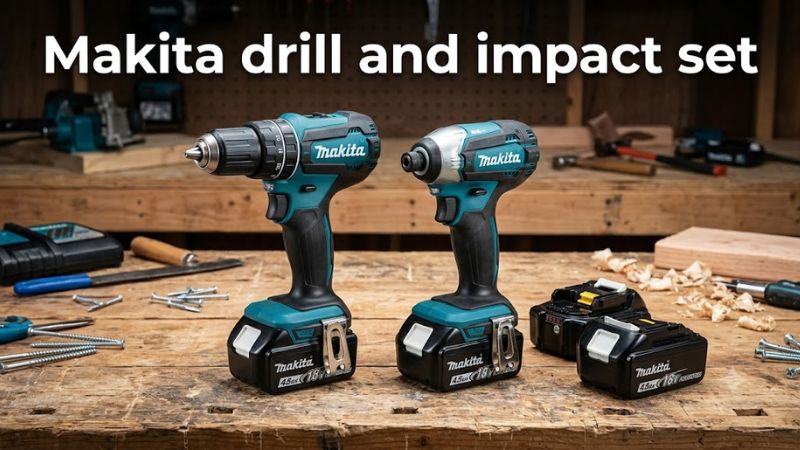
A Makita drill and impact set is a practical choice for DIY projects, home renovations, woodworking, and professional construction because it combines two tools designed for different jobs. The drill-driver handles holes and controlled screw fastening, while the impact driver is designed for driving screws and other compatible fasteners efficiently.
For most buyers starting a cordless tool collection, the key decision is whether to choose a basic 18V LXT combo kit, a brushless kit with larger batteries, or a compact set for working in tight spaces. The right choice depends on workload, included batteries, tool specifications, and the total cost of ownership—not simply the highest advertised torque.
Makita sells several two-tool kits with different model numbers and configurations. For example, the US-market XT299T includes a brushless hammer drill, an impact driver, two 5.0Ah batteries, a charger, and a tool bag. Other kits use different tools and battery capacities, so check the complete kit number before purchasing.
What Is Included in a Makita Drill and Impact Set?
A typical two-piece combo kit contains a drill-driver and an impact driver. Depending on the package, it may also include batteries, a charger, a carrying bag or case, and other accessories.
| Component | Primary purpose | What to check |
| Drill-driver | Drilling holes and controlled screw fastening | Chuck size, speed ranges, clutch settings and torque |
| Hammer drill-driver | Drilling and driving, plus hammer action for suitable masonry work | Hammer mode, impact rate and manufacturer-approved applications |
| Impact driver | Driving compatible screws and fasteners | 1/4-inch hex collet, speed settings and impact rate |
| Batteries | Powering both tools | Voltage platform, Ah capacity and exact compatibility |
| Charger | Charging the included batteries | Supported battery type and regional electrical rating |
| Bag or case | Storage and transport | Whether it is included and whether it fits both tools and accessories |
A kit containing a hammer drill is not the same as a kit containing a standard drill-driver. Hammer action helps with appropriate masonry drilling, but it does not turn a conventional hammer drill into an SDS rotary hammer for demanding concrete work.
Makita Drill and Impact Set Options Compared
The following US-market models illustrate the main differences between compact, general-purpose and higher-specification kits. Specifications are based on manufacturer information; they are not independent performance-test results.
| Kit | Best suited to | Drill specification | Impact driver specification | Included power accessories |
| CT225SYX | Everyday DIY and lighter projects | XFD10Z, 1/2-inch drill-driver, 480 in-lb maximum torque | XDT11Z, 1,460 in-lb maximum torque | Two 1.5Ah batteries, charger and tool bag |
| XT297T | Frequent renovation and demanding drilling | XPH14Z brushless hammer drill, 1,250 in-lb maximum torque | XDT20Z brushless, four-speed impact driver, 1,590 in-lb maximum torque | Two 5.0Ah batteries, charger and tool bag |
| XT299T | Users wanting a brushless hammer drill and impact driver with a high-capacity battery kit | XPH16Z brushless hammer drill, 970 in-lb maximum torque | XDT21Z brushless, four-speed impact driver, 1,860 in-lb maximum torque | Two 5.0Ah batteries, charger and tool bag |
Sources: Makita USA product specifications for CT225SYX, XT297T and XT299T. Maximum torque figures are manufacturer ratings, not directly comparable independent measurements. Kit contents and model availability should be confirmed before purchase.
1. CT225SYX: A Compact Kit for Everyday Projects
The Makita CT225SYX combines the XFD10Z drill-driver and XDT11Z impact driver in the 18V LXT platform. Its two 1.5Ah batteries keep the package oriented toward lighter work and users who value a compact setup.
The drill-driver has two speed ranges of 0–600 and 0–1,900 RPM and a 1/2-inch chuck. The impact driver is rated at up to 1,460 in-lb of maximum torque, with speeds up to 2,900 RPM and an impact rate up to 3,500 impacts per minute.
Advantages
- Provides two complementary tools in one package.
- Includes two batteries, a charger and a tool bag.
- Offers a conventional drill chuck for a broad range of compatible drill bits.
Limitations
- The included 1.5Ah batteries have less energy capacity per charge than 4.0Ah or 5.0Ah packs.
- The drill motor is brushed rather than brushless.
- It is not a substitute for a dedicated rotary hammer when drilling concrete regularly.
Choose it if: your work consists mainly of furniture assembly, shelves, household repairs and occasional woodworking.
Consider another kit if: you regularly drill large holes, drive long fasteners throughout the day or need the additional features of a brushless platform configuration.
2. XT297T: A Brushless Kit for More Demanding Work
The XT297T pairs the XPH14Z brushless hammer drill with the XDT20Z brushless impact driver. It includes two 18V LXT 5.0Ah batteries, a charger and a tool bag.
Makita specifies up to 1,250 in-lb of maximum torque for the hammer drill and up to 1,590 in-lb for the impact driver. The hammer drill also offers two speed ranges, up to 2,100 RPM, and a hammer-drilling rate up to 31,500 blows per minute.
The impact driver’s four-speed settings let users select a more appropriate operating speed for different fastening jobs. Its electronic modes provide additional control for certain applications, although correct bit selection and trigger control remain essential.
Advantages
- Brushless motors in both tools.
- Two 5.0Ah batteries for greater nominal energy capacity per pack than 1.5Ah batteries.
- Hammer-drilling capability for suitable masonry applications.
- Multiple impact-driver settings for controlled fastening.
Limitations
- The larger batteries add weight compared with compact battery packs.
- Maximum torque ratings alone do not establish how quickly a tool will complete a particular job.
- A hammer drill is not the ideal tool for regular heavy-duty concrete drilling or chiseling.
Choose it if: you frequently undertake renovations, woodworking, framing-related fastening and occasional masonry drilling.
Consider another kit if: you mostly complete light household repairs or prioritize the smallest, lightest setup possible.
3. XT299T: A Brushless Kit with a Different Power Balance
The XT299T also includes a brushless hammer drill, an impact driver, two 5.0Ah batteries, a charger and a tool bag. However, it uses the XPH16Z hammer drill and XDT21Z impact driver rather than the XT297T’s tool models.
Makita lists the hammer drill at up to 970 in-lb of maximum torque, with speed ranges of 0–550 and 0–1,800 RPM. The impact driver offers four speed settings, with a maximum listed speed of 3,700 RPM and an impact rate up to 4,400 IPM. Its advertised maximum torque is 1,860 in-lb.
The XT299T’s higher advertised impact-driver torque does not automatically make it better for every fastening job. The XT297T’s drill has a higher published maximum torque rating, and the practical result depends on the material, fastener, bit, selected mode and operating conditions.
Advantages
- Brushless drill and impact driver.
- Two 5.0Ah batteries for sustained work between battery changes.
- Four-speed impact-driver control.
- Both tools feature Makita’s XPT design for increased dust and water resistance.
Limitations
- The kit’s drill and impact driver have different published specifications from the XT297T.
- The higher impact-driver torque rating is not a guarantee of faster fastening or better screw control.
- The kit may be more than occasional DIY users need.
Choose it if: you want a brushless two-tool kit with high-capacity batteries and multiple impact-driver speed settings.
Consider another kit if: the XT297T’s drill specifications or another kit’s lighter batteries better fit your workload.
Drill-Driver vs. Impact Driver: Which Tool Should You Use?
The primary reason to buy a two-tool set is that the tools complement each other. Although both can drive screws, they deliver rotation differently and accept accessories differently.
| Task | Better choice | Why |
| Drilling holes in wood | Drill-driver | Holds conventional drill bits and offers controlled rotation |
| Drilling metal | Drill-driver | Provides a suitable chuck and variable-speed control |
| Installing cabinet screws | Drill-driver | Adjustable clutch helps limit over-tightening |
| Driving long screws into lumber | Impact driver | Repeated rotational impacts assist with demanding fastening |
| Driving many compatible fasteners | Impact driver | Quick bit changes and impact action suit repetitive fastening |
| Drilling suitable masonry holes | Hammer drill-driver | Adds hammer action to rotation |
| Drilling concrete for repeated heavy-duty work | SDS rotary hammer | Designed for demanding masonry and concrete applications |
An impact driver is not automatically the best tool for every screw. Its impact mechanism can make delicate fastening more difficult without careful trigger control, especially in soft wood or around small fasteners.
A drill-driver’s adjustable clutch is useful when repeatable screw depth matters. For accurate drilling, select the correct bit, speed and drilling mode for the material.
How to Choose the Right Makita Combo Kit
1. Match the kit to your workload
Start with the tasks you perform most frequently.
- Occasional home repairs: A compact kit with smaller batteries may be sufficient.
- Furniture, cabinetry and woodworking: Prioritize clutch control, variable speed, suitable drill bits and manageable tool weight.
- Decking, framing and renovation: Consider brushless tools, larger batteries and an impact driver with multiple speed settings.
- Frequent masonry drilling: Choose a hammer-drill kit if it suits the hole sizes and materials involved. For regular heavy-duty concrete drilling, evaluate an SDS rotary hammer instead.
Do not pay for maximum torque you rarely need. Control, accessory compatibility and ergonomics can matter more for routine jobs.
2. Understand Makita’s battery platforms
Makita’s 18V LXT tools use the LXT battery platform. A kit’s battery capacity is expressed in amp-hours (Ah), which describes electrical charge capacity; it is not a direct measurement of power or guaranteed runtime.
| Battery capacity | Practical consideration |
| 1.5Ah | Smaller capacity per pack; useful when compactness and lighter-duty tasks are priorities |
| 2.0Ah | A middle option for compact setups and intermittent use |
| 4.0Ah | More nominal energy per pack than 2.0Ah at the same nominal voltage |
| 5.0Ah | Higher nominal energy capacity for longer work sessions between changes |
Actual runtime varies with workload, tool efficiency, material, accessories, battery condition and operating conditions.
Before buying, check the exact tool model and battery compatibility. Do not assume that all Makita batteries fit every Makita cordless tool: CXT, LXT and XGT are distinct platforms. Use genuine batteries and chargers approved for the tool and battery configuration.
3. Decide whether brushless motors are worth it
Brushless motors eliminate the carbon brushes used in conventional brushed motors. Makita describes its brushless designs as optimizing battery energy use, and some models offer additional electronic control features.
For frequent use, a brushless combo may justify a higher purchase price through its combination of efficiency, performance and reduced brush-related maintenance. However, motor type alone cannot establish the expected service life of a complete tool.
For occasional DIY, a lower-cost brushed kit may still meet your needs.
4. Check the chuck and accessory requirements
A drill-driver commonly uses a 1/2-inch chuck, which grips compatible round-shank and hex-shank bits within the chuck’s rated capacity. An impact driver commonly uses a 1/4-inch hex quick-change holder.
Before purchasing drill bits or driver bits, verify:
- Shank type and dimensions.
- The accessory’s intended material and application.
- The tool’s speed and operating limitations.
- Whether the accessory is approved for impact-driver use.
- Any specific manufacturer restrictions.
Do not use ordinary drill bits in an impact driver’s hex holder unless the bit is specifically designed for that application and has the correct compatible shank. For demanding fastening, use impact-rated driver bits.
5. Compare the complete kit price
A lower advertised price is not always the better value. Compare the exact model and package contents rather than the tool’s appearance or a retailer’s abbreviated description.
Check whether the price includes:
- Both tools.
- One or two batteries and their capacities.
- A compatible charger.
- A bag or hard case.
- Any additional accessories you actually need.
If you already own compatible batteries and a charger, a bare-tool purchase may be more economical. If you are entering the LXT system for the first time, a complete kit may reduce the need for separate purchases.
Prices and availability vary by retailer and date. No current price ranking is provided here because a consistent, verified price comparison for these exact kits has not been established.
Safe Use and Maintenance Tips
A drill and impact set can handle many household and construction tasks, but correct setup remains essential.
- Wear suitable protective equipment. Use safety glasses and add hearing protection or respiratory protection when the task and material require it.
- Secure the workpiece. Clamp material where appropriate instead of holding it by hand near the bit.
- Inspect accessories. Replace worn or damaged bits, and verify that the accessory suits the tool and material.
- Select the correct mode. Use hammer mode only for suitable masonry drilling and follow the tool manual’s instructions.
- Control the tool. Maintain a secure grip, use an appropriate speed setting and keep hands away from rotating components.
- Remove the battery before changing accessories or performing adjustments. Follow the model-specific manual.
- Store batteries correctly. Protect battery terminals from metal objects, moisture and damage. Stop using a battery that is cracked, swollen, leaking or unusually hot, and follow the manufacturer’s instructions for safe handling.
Do not force a bit through a material when it binds. Stop the tool, disconnect the battery and inspect the setup before continuing. If the tool has electrical, mechanical or battery faults, use authorized service rather than bypassing protection systems.
Warranty and Support
For US-market Makita products, the manufacturer’s published warranty policy generally provides a three-year limited warranty for covered lithium-ion tools, batteries and chargers, subject to the policy’s conditions, exclusions and applicable terms.
Keep the receipt and confirm that the particular product and purchase qualify. Warranty terms may differ by country, seller and product category, so buyers outside the United States should check their local Makita warranty policy.
For servicing, use the model number on the tool’s identification label and consult the manufacturer’s support documentation. This is especially important when buying used equipment or a kit that may have been separated from its original packaging.
Frequently Asked Questions
Is a Makita drill and impact set worth buying?
Yes, if you regularly drill holes and drive screws because the two tools provide different forms of control and fastening capability. For occasional light repairs, a drill-driver alone may be sufficient.
Can Makita drill and impact sets use the same battery?
Yes, when both tools are compatible with the same battery platform and the specific battery is approved for each model. For example, compatible 18V LXT tools can share supported LXT batteries, but platform compatibility should always be confirmed.
Is a hammer drill better than a regular drill-driver?
A hammer drill is more versatile when you need to drill suitable masonry in addition to wood or metal. For ordinary woodworking, furniture assembly and general screw fastening, hammer action is usually unnecessary.
Should I buy a Makita brushless combo kit?
A brushless kit is worth considering if you use your tools frequently, value battery efficiency or want the features offered by a particular brushless model. For occasional household jobs, a suitable lower-cost kit may provide all the functionality you need.
Final Verdict
The best Makita drill and impact set is the one that matches your workload, battery needs and preferred level of control.
For everyday DIY, the CT225SYX provides a straightforward two-tool package with two 1.5Ah batteries. For more demanding renovation work, the XT297T combines a brushless hammer drill and impact driver with two 5.0Ah batteries. The XT299T is another brushless option, with a different drill and impact-driver specification balance.
Before purchasing, verify the complete kit number, included battery models, charger, warranty terms and local availability. Matching those details to your actual projects will help you avoid paying for features you do not need or buying a kit that lacks essential accessories.