What's inside
As an Amazon Associate I earn from qualifying purchases. This post may contain affiliate links at no extra cost to you.
A cordless drywall sander makes sense when a patch is too large for hand sanding but too small to justify dragging out a corded pole sander. Think repaired anchor holes, a replaced section of drywall, or several patches in one room. For a single spot a few inches wide, a sanding sponge is usually faster, cheaper, and easier to control.
The main buying decision is often not the sander itself but the battery platform. Small repair work rarely demands long runtime, so an existing 18V or 20V tool battery can matter more than a larger battery or a high-powered motor. Before buying, check whether the tool is a compact detail sander or a full-size drywall unit: they serve different jobs.
As an Amazon Associate we earn from qualifying purchases at no extra cost to you.


Match the tool to the patch
Compact cordless sanders are useful for feathering joint compound around a small repair. Their smaller pads are easier to keep flat on a narrow patch and less likely to hit nearby trim or a wall corner. They are not as quick as a large drywall sander on a whole wall, and their smaller dust bags fill fast.
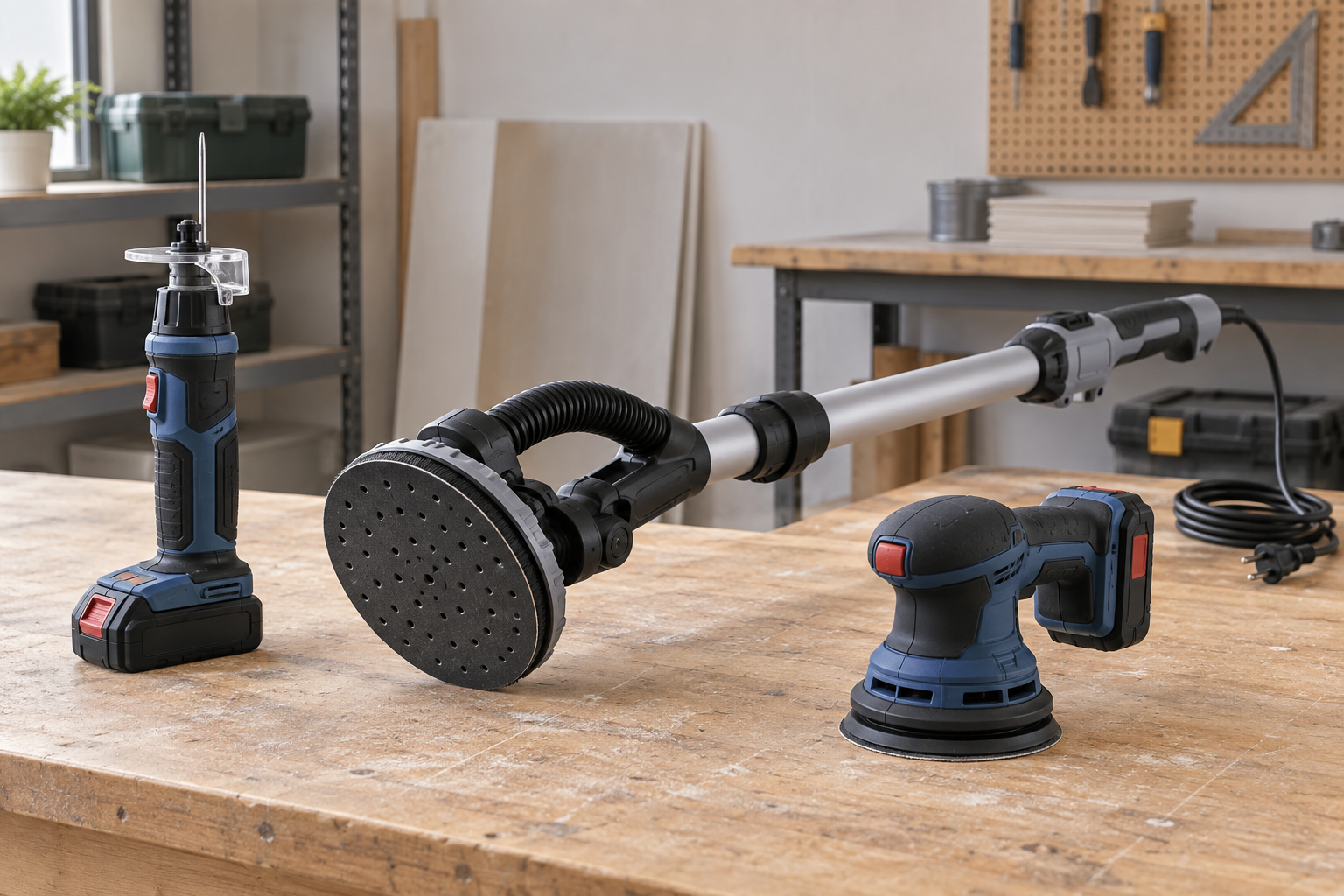
Full-size drywall sanders have a broad head—commonly around 8 or 9 inches—and are meant for larger surfaces. That head can bridge low spots and remove compound quickly, but it is awkward on a patch only 6 inches across. A rotating head may also chew through the paper face if you tilt it or press hard. For small repairs, look for a compact cordless sander with a dust port, or stick with a hand block if the repair is truly minor.
If you need a compact tool, compare cordless detail sanders sold as bare tools in the battery family you already own. If the work includes larger patches or repeated rooms, compare cordless drywall sanders, but check head size and weight before choosing one.
Which setup fits your job?
| Option | Best for | Trade-off |
|---|---|---|
| Sanding sponge or hand block | One or two small patches, especially near corners | Slow over broad areas; easy to leave an uneven finish if you use a hard edge |
| Compact cordless detail sander | Several small repairs and feathering compound in open areas | Smaller pad takes longer; dust collection is limited |
| Full-size cordless drywall sander | Large patches, multiple rooms, or regular drywall work | More bulk and expense; oversized for narrow repairs |
| Corded drywall sander | Long sessions on large walls or ceilings | Needs an outlet and cord management; excessive for occasional touch-ups |
Battery platform and runtime
For occasional patch work, start with the batteries you already have. A compatible bare tool avoids paying for another charger and battery, and sanding a few patches usually does not justify buying into a new platform. Verify the exact battery family and voltage; brands sometimes sell tools that look similar but use different battery systems.
A 2.0Ah pack keeps a compact sander lighter and is often enough for a few repairs. A 4.0Ah pack runs longer, but adds weight at the tool and can make overhead sanding tiring. Larger batteries are not automatically better for a small job. If you have no compatible batteries, compare the cost of a kit against a bare tool plus battery and charger; the kit can be better value if you also need a charger or plan to add other cordless tools.
Expect real runtime to vary with grit, pressure, material, and dust buildup. Pressing hard does not make sanding faster: it strains the motor, can stall the pad, and may gouge the compound or expose drywall paper. Let the abrasive do the work and keep the tool moving.
Dust control and abrasive choice
Joint-compound dust is fine enough to spread well beyond the patch. A built-in bag catches some of it, but it is not a substitute for a close-fitting respirator and room containment. Check whether the tool has a standard dust port and whether your vacuum hose fits; an adapter may be needed. Even with a vacuum, expect to wipe nearby surfaces afterward.
Use the abrasive recommended for the tool, and begin with a fine or medium-fine grit rather than an aggressive disc. Around 120 to 150 grit is a practical starting range for cured joint compound; finish with 180 to 220 if the surface needs a smoother paint-ready feel. Very coarse grit can cut through the compound quickly and leave scratches that show under paint. Replace a loaded disc instead of pressing harder—clogged abrasive runs hot and can burnish the surface rather than flatten it.
How to sand a small repair
Let the compound dry fully; damp compound clogs discs and tears instead of sanding cleanly. Inspect with a bright light held at a shallow angle, then mark ridges lightly in pencil. Sand the raised areas with the pad flat, using short overlapping passes. Feather the compound outward rather than digging into the center of the patch. Stop when the transition feels smooth to your fingertips and disappears under raking light.
Do not chase every shallow mark with the sander. If you reach drywall paper, stop and seal the damaged spot before recoating; sanding exposed paper further can rough it up and create a fuzzy surface. A thin skim coat is often faster and cleaner than trying to remove a deep hollow by sanding around it. Vacuum the surface and check it again before priming, since dust can hide small ridges.
When the cheaper option wins
For one patch the size of a dinner plate or smaller, a sanding sponge and a few minutes of careful hand work are usually the sensible purchase. A compact cordless sander earns its place when you have several repairs, want to reduce hand fatigue, or already own its batteries. A full-size cordless drywall sander is a specialized buy: choose it for repeated large-area work, not just because the patch is on a wall.
Related guides
- Longest Lasting Lawn Mower Battery: AGM vs Lithium vs Flooded Lifespan and Cost per Season
- Duralast Gold Lawn Mower Battery Review: U1 Fit, CCA and When to Pay for AGM
- Greenworks Pro 80V 21-Inch Mower Review: Runtime Math, Push vs Self-Propelled and Yard Fit
- Bosch High Pressure Washer Gun Replacement: Fittings, Adapters and What Fits Your Model