What's inside
As an Amazon Associate I earn from qualifying purchases. This post may contain affiliate links at no extra cost to you.
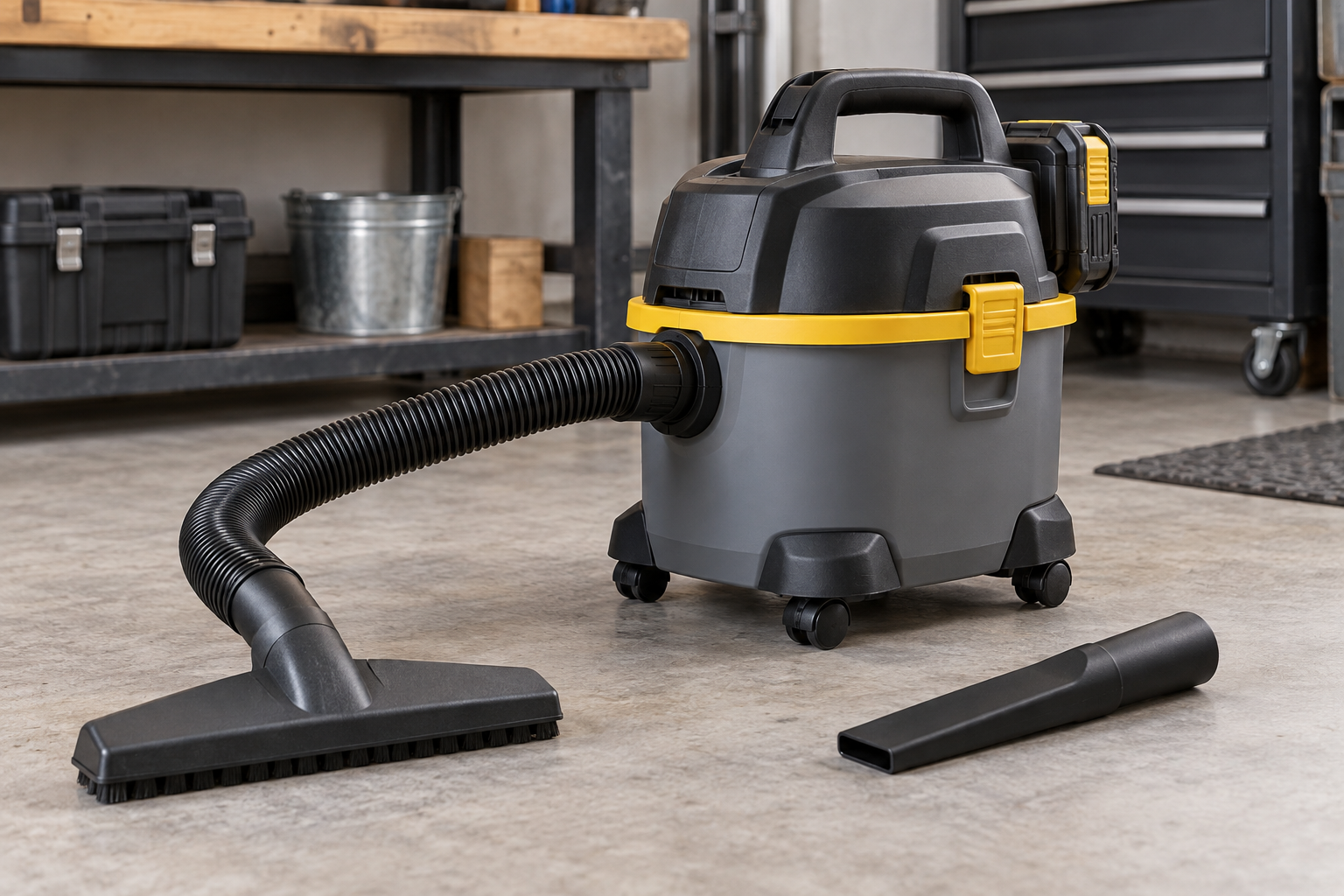
A cordless vacuum extractor is useful when the cleanup is tied to a cordless job: collecting sawdust at a track saw, vacuuming a workbench between cuts, or picking up small debris where a cord would get in the way. It is not automatically a better shop vacuum. Runtime, filter capacity and suction usually favor a corded unit, and many cordless models are meant for dust collection and dry debris rather than wet cleanup.
For a first purchase, start with the battery platform already in your tool collection. A bare tool can cost less than buying a new platform, but a vacuum that needs two batteries or runs through a small pack quickly can make that saving disappear.
As an Amazon Associate we earn from qualifying purchases at no extra cost to you.


Choose by the cleanup, not the headline spec
Compact extractors are handy for benches, vehicles and quick tool cleanup. Look for a hose and adapters that fit your tools, a filter suited to fine dust, and a container you can empty without making a second mess. A small canister fills quickly with planer shavings or heavy debris; it is better suited to intermittent cleanup than clearing a whole shop.
For frequent sanding or cutting, consider a larger cordless extractor with a tool-activated outlet or an automatic-start feature, if available in your platform. It can start with a connected tool and reduce the dust left behind. Check whether that function works with your particular tool and whether it requires a wired connection; “cordless” does not always mean wireless tool control.
Buy a cordless shop vacuum on your battery platform for general pickup and portability. If fine dust is the main problem, compare it with a cordless dust extractor with fine-dust filtration. Do not assume that a “HEPA-style” label means the complete machine is certified to a particular dust-control standard; read the manufacturer’s documentation.
Which type fits the job?
| Type | Best use | Main trade-off |
|---|---|---|
| Compact cordless vacuum | Bench, vehicle, small spills of dry debris | Limited capacity and often short runtime |
| Larger cordless extractor | Repeated cleanup and dust collection at a tool | Heavier, more expensive, still battery-limited |
| Corded shop vacuum | Long sessions and high-volume cleanup | Cord management and dependence on an outlet |
The cheaper compact vacuum is fine if you clean up in short bursts, mostly collect coarse debris, and already own suitable batteries. It is a poor substitute for a corded extractor if you run a sander for hours or need to empty the container only once during a large cleanup. A corded vacuum may also make more sense for a fixed workshop, even if your other tools are cordless.
Budget for batteries and runtime
Runtime varies with the vacuum, selected power setting, filter condition, hose restriction and battery capacity. Treat advertised runtime as a best-case figure, not a promise for continuous high-suction work. A small pack may be enough for a few quick pickups; long cleanup sessions may call for a larger-capacity battery or a spare. Those packs add weight, cost and charging time.
Check whether the vacuum uses one battery or two, and whether batteries are included. Some models in a platform are sold as bare tools, while others come in a kit with a charger and pack. If you already own several charged batteries, a bare tool is often the sensible buy. If you do not, compare the kit price against the cost of buying a compatible battery and charger separately. Avoid choosing a vacuum solely because its platform has the biggest packs: a heavy battery can make a handheld unit tiring to use.
Filters, fine dust and mess control
Fine sanding dust can pass through a basic filter or escape around a poorly sealed lid. Check the specified filter type and whether a dust bag is available. A bag can make emptying cleaner and protect the filter from loading up, but it is an ongoing cost and may be awkward to find locally. For drywall, concrete or other hazardous dust, use equipment and filters rated for the material and follow the dust-control requirements for the job; an ordinary cordless shop vacuum is not a safe stand-in.
Clogging is a common failure mode. Fine dust coats the filter, reducing airflow even though the motor is still running. Clean or replace the filter as directed, and do not wash one unless the manufacturer says it is washable. A clogged hose, full bin or poorly fitted adapter also reduces pickup. If a connected saw produces more chips than the vacuum can move, the hose or inlet may be the bottleneck, not the motor.
Details worth checking before you buy
Measure the hose diameter and compare it with your tool ports. Universal adapters can help, but a loose fit leaks dust; a tight fit can be hard to remove. Check the hose length, whether it stores on the unit, and whether the vacuum has a flat top or a handle that makes carrying practical. A larger bin is useful only if you have room to store and maneuver the machine.
Consider sound and use location, too. A small vacuum can be loud in a garage, and a high setting may be unnecessary for crumbs or coarse chips. If the unit is intended for wet pickup, confirm that it supports liquids and check what must be removed or changed first. Never assume a dry-only vacuum can safely collect a spill.
A practical buying decision
Choose a compact model if portability and quick dry cleanup matter more than capacity. Choose a larger extractor if you regularly connect it to a cordless tool and need better dust control, while accepting higher cost and battery demand. Keep a corded shop vacuum in the running for long sessions, large volumes or a stationary shop. The best match is the one that fits your battery platform, captures the debris you actually make, and does not force constant stops to charge, unclog or empty it.
Related guides
- Longest Lasting Lawn Mower Battery: AGM vs Lithium vs Flooded Lifespan and Cost per Season
- Duralast Gold Lawn Mower Battery Review: U1 Fit, CCA and When to Pay for AGM
- Greenworks Pro 80V 21-Inch Mower Review: Runtime Math, Push vs Self-Propelled and Yard Fit
- Bosch High Pressure Washer Gun Replacement: Fittings, Adapters and What Fits Your Model