What's inside
As an Amazon Associate I earn from qualifying purchases. This post may contain affiliate links at no extra cost to you.
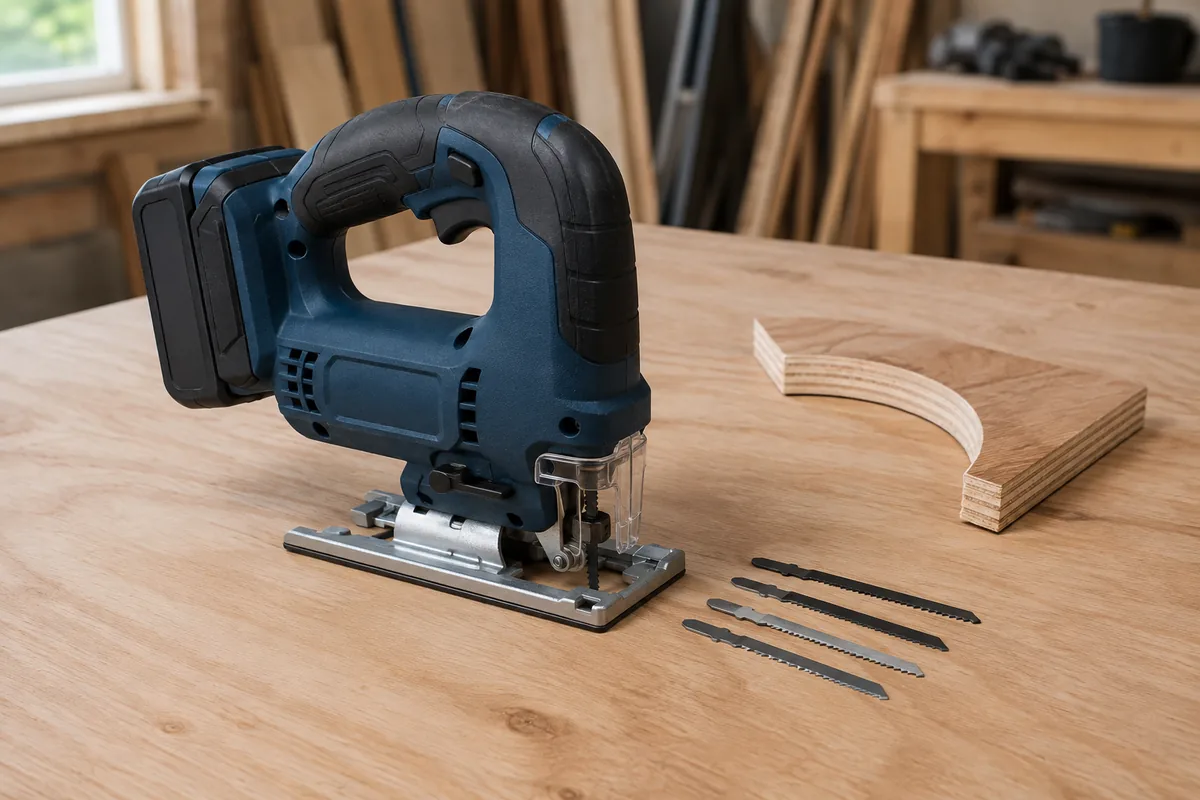
Choosing a Cordless Jigsaw for Plywood
For precise curved cuts in plywood, a cordless jigsaw is most useful when it has a rigid shoe, low blade deflection, a controllable trigger, and a good sightline to the cut. Battery power is not the main limitation. The blade, the way you support the sheet, and how quickly you feed the saw matter more.
A basic 18V or 20V jigsaw can cut plywood accurately, especially for shelves, templates, cabinet parts, and countertop openings. Spend more for better speed control, a cleaner base, lower vibration, and a tool that stays square under load. If you already own batteries from a major platform, staying within that ecosystem is usually cheaper than buying a “better” saw that requires a new charger and battery.
As an Amazon Associate we earn from qualifying purchases at no extra cost to you.



The Best Cordless Jigsaw Types
| Type | Best for | Advantages | Limitations |
|---|---|---|---|
| Compact 12V | Thin plywood, trim, small curves | Light, easy to control, less tiring | Shorter runtime and less capacity in thick stock |
| 18V/20V brushed | General DIY and occasional cabinet work | Lower tool cost and adequate cutting power | More vibration, less refined speed control |
| 18V/20V brushless | Frequent curved cuts and shop use | Better runtime, smoother motor, stronger sustained cutting | Higher bare-tool price |
| Barrel-grip | Detailed cutting and low-profile control | Natural grip and good control around curves | Can be less comfortable for users accustomed to top-handle saws |
For most homeowners, a brushless 18V or 20V cordless jigsaw is the best all-around choice. A compact 12V model is fine for 1/4-inch plywood and occasional scroll-like work, but it may slow noticeably in 3/4-inch hardwood plywood.
Features That Actually Affect Accuracy
Look first for a tool-free blade clamp, variable-speed trigger, and a shoe that locks firmly at 90 degrees. A saw with orbital action should let you turn that action off. Orbital movement makes a blade cut faster, but it also makes the cut more aggressive and can worsen splintering on plywood.
A useful speed range is roughly 500 to 3,000 strokes per minute. Run slower near the start of a curve and faster on a straight section. Do not assume the highest speed is best: thin plywood can vibrate, scorch, or chip when the blade moves too quickly.
LED lights are helpful, but they do not correct a poor sightline. A dust blower, vacuum port, or clear guard can be more valuable. Dust covering the pencil line is a common reason for drifting cuts. Some cordless saws have excellent extraction; others leave a cloud directly in front of the blade.
Variable orbital settings are useful when switching between materials. Use zero orbital action for the cleanest plywood edge. Use a low setting when cutting faster is more important than the edge finish. Maximum orbital action is generally for fast rough cuts, not visible cabinet parts.
Battery Platform, Runtime, and Cost
A 2.0Ah battery keeps the saw light and is usually enough for several feet of plywood cutting. A 4.0Ah or 5.0Ah pack provides more reserve for thick sheets, but the extra weight can make detailed curves harder to control. For overhead or awkward work, the smaller battery is often the better choice.
Runtime depends heavily on blade sharpness and feed pressure. A dull blade forces the motor to work harder and drains the battery faster. If you are starting a cordless tool collection, compare the price of a kit with battery and charger against the bare tool. The battery and charger can cost more than the jigsaw itself.
Common 18V and 20V platforms from major tool brands offer the widest choice of chargers, lights, drills, sanders, and outdoor tools. Voltage labels are not a direct performance comparison; nominal 18V and marketed 20V systems are broadly comparable. Buy into the platform with the other tools you expect to use.
If you already have compatible batteries, a bare-tool cordless jigsaw is usually the sensible purchase. The cheaper brushed version is fine for a few projects each year, provided it has a solid shoe and a usable trigger.
Blades for Clean Plywood Cuts
Blade choice has more effect on the edge than motor branding. Use a fine-tooth down-cut or reverse-tooth blade when the top face must remain clean. A down-cut blade reduces top-face splintering, but it can be harder to steer and may require a higher feed pressure.
Use an up-cut, fine-tooth plywood blade when you need better visibility and a cleaner underside. For general 3/4-inch plywood, a blade in the range of 10 to 14 teeth per inch is a practical starting point. Very fine blades cut cleanly but heat up and wander if forced. Replace a blade when it leaves burn marks, requires unusual pressure, or begins pulling the saw sideways.
For a particularly clean cut, apply low-tack painter’s tape over the line, mark on the tape, and support the sheet close to the cut. This will not fix a damaged blade, but it can reduce surface chipping. A fine-tooth plywood jigsaw blade set is a better upgrade than buying an expensive saw and using one general-purpose blade for everything.
How to Cut Curves Accurately
Support the plywood on sacrificial foam or closely spaced supports so the waste side cannot bounce. Clamp the workpiece, but leave enough room for the saw and battery. Mark the curve with a flexible strip, then cut 1/16 to 1/8 inch outside the final line if you plan to sand to shape.
Start the blade fully clear of the material, then ease into the cut without twisting the tool. Let the teeth do the work. For a tight curve, make relief cuts in the waste area so the offcut can separate without pinching the blade. If the saw starts climbing or the blade bends, stop and back out rather than forcing it around the curve.
Keep the shoe flat. Lifting the rear of the tool changes the blade angle and creates a beveled edge. Check the cut with a square on a straight section and make a test cut in scrap plywood before committing to a cabinet panel.
A Practical Buying Approach
Choose a 12V saw if low weight and small, occasional projects are the priority. Choose a brushed 18V/20V saw when price matters and your cuts are mostly rough or semi-visible. Choose a brushless model when you make repeated curves, cut thicker plywood, or value smoother control and longer service life.
Before buying, verify that the tool accepts common T-shank blades, has a positive shoe lock, offers orbital adjustment, and is sold with a battery size appropriate to the work. For most plywood projects, a midrange cordless jigsaw, a quality fine-tooth blade, and careful support will outperform a premium saw used with a dull blade and an unsupported sheet.
Related guides
- Longest Lasting Lawn Mower Battery: AGM vs Lithium vs Flooded Lifespan and Cost per Season
- Duralast Gold Lawn Mower Battery Review: U1 Fit, CCA and When to Pay for AGM
- Greenworks Pro 80V 21-Inch Mower Review: Runtime Math, Push vs Self-Propelled and Yard Fit
- Bosch High Pressure Washer Gun Replacement: Fittings, Adapters and What Fits Your Model