
What's inside
As an Amazon Associate I earn from qualifying purchases. This post may contain affiliate links at no extra cost to you.
For baseboard and door trim, an 18-gauge cordless finish nailer is usually the right tool. It drives slim nails that hold molding securely without leaving the large holes produced by a framing nailer. Cordless models also avoid dragging an air hose through a finished room, but they cost more and are heavier than pneumatic nailers.
The best choice depends less on peak driving power than on the battery platform already in your shop. A bare tool can be a sensible purchase if you own compatible batteries; starting a new platform just for one trim project often makes the economics poor.
As an Amazon Associate we earn from qualifying purchases at no extra cost to you.
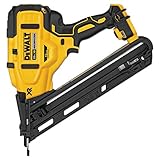


What to Look For in a Cordless Finish Nailer
For typical baseboard and door casing, choose an 18-gauge nailer accepting nails from roughly 5/8 to 2-1/8 inches. A 2-inch nail is normally enough for 5/8-inch casing over drywall, while taller or thicker baseboard may need 2-1/8-inch nails to get adequate purchase in the framing.
Tool-free depth adjustment is essential. Set the nail head just below the surface; too shallow leaves holes that are difficult to fill, while too deep crushes the wood or punches through thin trim. A selectable bump-fire mode is convenient for long baseboard runs, but sequential mode is easier to control around corners and narrow casing.
Look for a dry-fire lockout, a usable belt hook, a narrow nose, and an accessible jam-release mechanism. LED lights are helpful in dark corners but should not outweigh battery cost, balance, or driving consistency. Most cordless nailers weigh about 6 to 8 pounds with a battery, which becomes noticeable when installing several rooms of crown or casing overhead.
Best Cordless Finish Nailers by Battery Platform
| Platform | Best fit | Practical strengths | Main drawback |
|---|---|---|---|
| Milwaukee M18 | Frequent trim work | Strong driving, consistent depth control, good service support | Heavy and expensive as a bare tool |
| DeWalt 20V MAX | Existing DeWalt owners | Good balance, broad battery range, easy controls | Can be bulky in tight corners |
| Ryobi 18V ONE+ | Homeowners and occasional remodelers | Lower platform cost and wide tool selection | More variation in results between wood species and settings |
| Makita 18V LXT | Users who value balance | Refined handling and strong ecosystem | Battery and tool pricing can be high |
Milwaukee M18 18-gauge finish nailer
The Milwaukee M18 18-gauge finish nailer is a strong choice for contractors or anyone already invested in M18 batteries. It has enough power for dense hardwood casing and tall baseboard, and its depth adjustment is predictable once set.
The trade-off is weight. With a larger battery attached, it can feel tiring during a full day of trim installation. It is also overkill for a homeowner installing one room of pine baseboard. Buy the bare tool if you already have M18 batteries; otherwise compare the cost of the kit, charger, and battery with a pneumatic setup.
DeWalt 20V MAX 18-gauge finish nailer
The DeWalt 20V MAX 18-gauge finish nailer fits well in a shop that already uses DeWalt drills, saws, or impact drivers. It offers the capacity and adjustment range needed for normal casing and baseboard, and the platform has batteries from compact packs to high-capacity options.
Use a compact battery when working at shoulder height or in tight door jambs. A larger pack may extend runtime, but the extra weight rarely improves the quality of a trim job. DeWalt’s tool is a practical all-rounder, though it is not necessarily the cheapest way to install a small amount of molding.
Ryobi 18V ONE+ 18-gauge finish nailer
The Ryobi 18V ONE+ 18-gauge finish nailer is the sensible budget option when the work is occasional and you already own ONE+ batteries. It is also attractive for homeowners because the same batteries run a large range of less expensive tools.
It may need more careful depth adjustment in hard oak, dense painted trim, or near the end of a battery charge. That is not a serious problem for pine or finger-jointed primed trim. If a few nails sit proud, increase depth gradually rather than immediately using maximum power. For one or two rooms, the cheaper Ryobi option is often entirely adequate.
Makita 18V LXT 18-gauge finish nailer
Makita’s Makita 18V LXT 18-gauge finish nailer is a good match for users already committed to the LXT system. It has a comfortable, controlled feel and works well for ordinary casing, baseboard, and small built-ins.
Its main disadvantage is platform cost if you are starting from zero. Do not choose it solely because the tool is compact on paper; compare the complete cost of a battery, charger, and nailer. A comfortable tool that uses batteries you already own is usually the better purchase.
Battery and Nail Selection
A 2.0Ah or 3.0Ah battery is usually enough for trim work and keeps the nailer manageable. Expect several hundred nails per charge, but the exact number varies with wood hardness, nail length, and how often the tool cycles. Keep a spare charged battery if you are working through a house rather than one room.
Use galvanized or stainless nails where moisture is possible, and match the nail finish to the trim and paint system. For interior painted casing, standard 18-gauge finish nails are normally sufficient. Avoid mixing brands of nails casually: differences in collation, coating, or head shape can cause jams and inconsistent feeding.
How to Avoid Trim Failures
Test-fire into scrap from the same molding before starting. Set the nailer so the head is slightly below the surface, then fill the holes after installation. Keep nails at least 1/2 inch from trim ends to reduce splitting, and stagger nails rather than placing them in one straight line along narrow casing.
For baseboard, nail into studs where possible, typically every 16 inches, and use shorter nails where only drywall is behind the molding. If the nailer drives but leaves the head high, check depth setting, battery charge, nail length, and whether the nose is fully pressed against the work. If it sinks nails too deeply, reduce the setting immediately; filler will not reliably disguise crushed wood fibers.
For most buyers, the correct decision is simple: buy the nailer matching your existing battery system. Choose Milwaukee or DeWalt for frequent, demanding work, Makita for refined handling within the LXT system, and Ryobi when low entry cost matters more than maximum consistency.
Related guides
- Longest Lasting Lawn Mower Battery: AGM vs Lithium vs Flooded Lifespan and Cost per Season
- Duralast Gold Lawn Mower Battery Review: U1 Fit, CCA and When to Pay for AGM
- Greenworks Pro 80V 21-Inch Mower Review: Runtime Math, Push vs Self-Propelled and Yard Fit
- Bosch High Pressure Washer Gun Replacement: Fittings, Adapters and What Fits Your Model