What's inside
As an Amazon Associate I earn from qualifying purchases. This post may contain affiliate links at no extra cost to you.
For repetitive fastening, the choice between a cordless impact driver and a cordless screwdriver comes down to torque, control, noise, and how many fasteners you install before your hand gets tired. Both can be useful, but they are built for different levels of resistance. A small screwdriver is often the better tool for cabinet hardware and light assembly. An impact driver earns its place when screws are long, numerous, or driven into dense material.
As an Amazon Associate we earn from qualifying purchases at no extra cost to you.



What each tool is designed to do
A cordless screwdriver is a compact, low-torque tool intended for driving small screws into predrilled holes or soft materials. Many use a 1/4-inch hex chuck and have a straight pistol grip or inline body. Some are little more than powered hand screwdrivers, while others resemble compact drill/drivers with adjustable clutches.
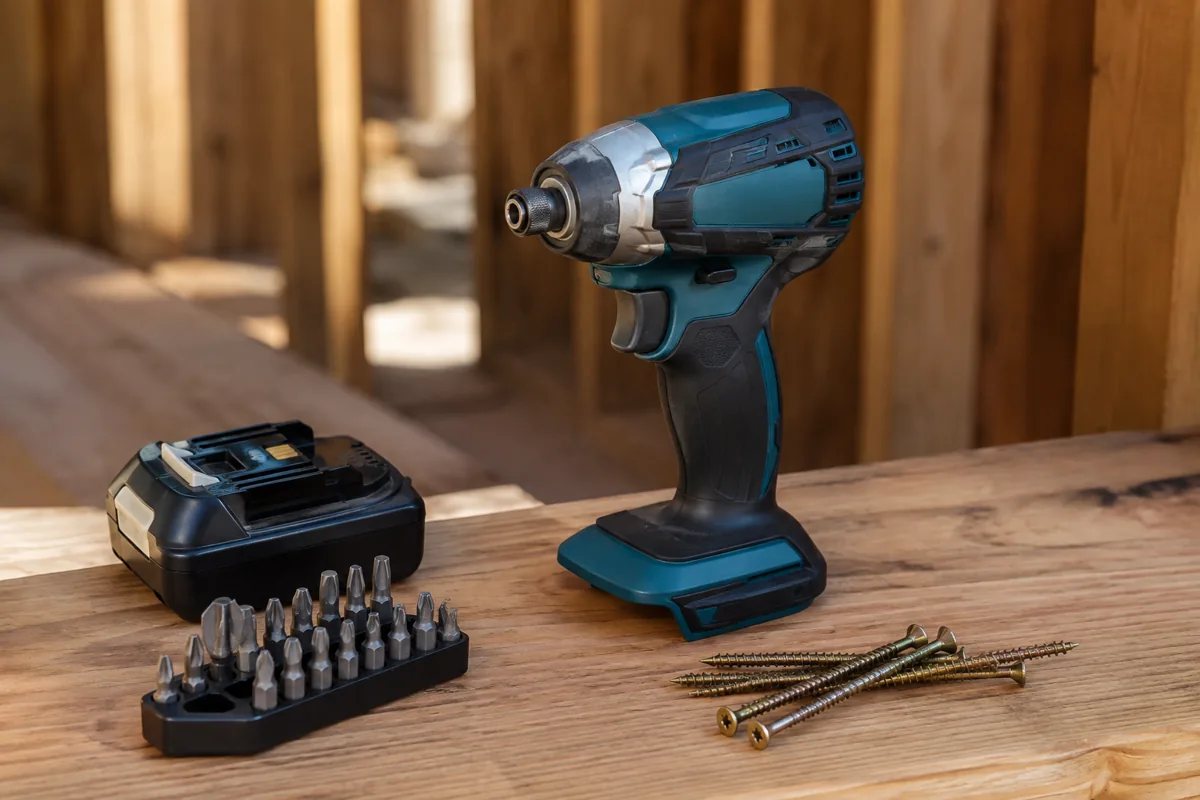
A cordless impact driver also accepts 1/4-inch hex bits, but it adds a hammer-and-anvil mechanism. When the screw resists rotation, the tool delivers rapid rotational impacts. This lets it produce substantially more fastening torque without requiring the motor and gearbox to be as large as those in a conventional drill.
That mechanism is the reason an impact driver can drive a 3-inch construction screw repeatedly with less motor strain. It is also the reason the tool is louder, more abrupt, and less suitable for delicate work.
Comparison at a glance
| Characteristic | Cordless screwdriver | Cordless impact driver |
|---|---|---|
| Best use | Light assembly, cabinet hardware, small screws | Decking, framing, structural and long fasteners |
| Typical torque control | Good, especially with a clutch | Moderate; depends on speed modes and trigger control |
| Noise and vibration | Low | High during impacts |
| Fastener capacity | Small to medium screws | Medium to large screws and lag fasteners |
| Risk of stripping | Lower | Higher if overdriven or used with poor bits |
| Typical battery advantage | Excellent runtime because it uses little power | Strong output, but impacts consume more energy under heavy load |
When a cordless screwdriver is the better buy
Choose a cordless screwdriver with a clutch when most of your work involves 6- to 25-millimeter screws, pilot holes, and repeated assembly. A clutch slips at a selected resistance level, preventing the tool from continuing to tighten once the screw reaches the set torque. That matters for hinges, drawer slides, electrical covers, furniture fasteners, and softwood projects.
For example, installing 40 cabinet hinges can become tiring with a hand screwdriver, but does not require impact-driver power. A low-speed cordless screwdriver lets you seat each screw without burying the head or cracking a melamine panel. The lower noise is also valuable indoors, especially in occupied homes or workshops shared with other people.
The cheaper option is fine if your screws are short, you work in soft material, and you are willing to predrill. A basic 3.6- to 12-volt tool may be all you need for furniture assembly and household repairs. Do not buy a high-output impact driver simply because its torque number is larger; excess torque is not useful when the job requires precision.
When an impact driver pays off
Buy a cordless impact driver kit when you repeatedly drive long screws into framing lumber, hardwood, masonry anchors, or other materials that create substantial resistance. It is particularly useful for fence construction, decking, shed assembly, exterior trim, and installing hundreds of fasteners in a day.
An impact driver reduces wrist twist because the impact mechanism handles much of the reaction force. It also tends to keep driving after a conventional screwdriver has stalled. In repetitive work, that difference adds up: fewer pauses, less pressure against the tool, and less heat buildup in the motor.
However, impacts do not make a driver foolproof. A screw can still strip if the bit is worn, the driver is held at an angle, or the speed is too high. Impact-rated bits are essential. Standard drill bits and ordinary screwdriver bits can twist, chip, or break in the chuck. Keep several fresh bits available; a worn Phillips bit is a common cause of damaged screw heads.
Control, speed, and fastener damage
A screwdriver with a clutch is easier to set for repeatable depth. Start with a low clutch setting and increase it until the fastener seats correctly. On cabinet work, the correct setting may be just enough to close the joint. On construction work, you may need full power, but stop when the head is flush or the washer contacts the surface.
Impact drivers usually offer one to three electronic speed modes. Use the lowest mode for small screws and delicate materials, then increase speed only when the fastener is not seating efficiently. The trigger is another control: pulling it halfway provides much better accuracy than immediately running at full speed.
For repetitive fastening, consistency matters more than maximum torque. If every screw must finish at a specific depth, a clutch-equipped screwdriver or a drill/driver may produce cleaner results. If the material varies and screws frequently stall, the impact driver gives you more reserve power.
Battery platform and runtime
Stay within one cordless battery platform when possible. A shared battery system lets you use the same packs and charger with a drill, light, saw, or oscillating tool. That often matters more than a small difference in tool price. If you already own batteries, buying a bare tool can cut the cost substantially.
For light fastening, a compact 2.0Ah battery is usually easier to carry and provides ample runtime. An impact driver used continuously on long structural screws benefits from a larger 4.0Ah or 5.0Ah pack, although it adds weight at the wrist. A second battery is more useful than an oversized pack if the tool will be used all day.
Check whether the kit includes a charger, battery, belt hook, and suitable bits. Some low-cost kits look inexpensive because they are bare tools, while others include a small battery that charges slowly or has limited capacity. For frequent work, a cordless impact driver kit with two batteries can keep the job moving without waiting for a recharge.
The practical choice
Choose the cordless screwdriver if your priority is quiet, controlled fastening and most screws are small or installed in finished surfaces. Choose the impact driver if you regularly drive long screws, work in dense material, or install enough fasteners that motor strain and wrist fatigue become problems.
If your work genuinely spans both categories, a small screwdriver and a mid-torque impact driver complement each other well. Use the screwdriver for delicate assembly and the impact driver for high-resistance work. That combination prevents you from using a powerful impact tool where precision matters and avoids forcing a low-torque screwdriver through jobs it was never designed to handle.
Related guides
- Longest Lasting Lawn Mower Battery: AGM vs Lithium vs Flooded Lifespan and Cost per Season
- Duralast Gold Lawn Mower Battery Review: U1 Fit, CCA and When to Pay for AGM
- Greenworks Pro 80V 21-Inch Mower Review: Runtime Math, Push vs Self-Propelled and Yard Fit
- Bosch High Pressure Washer Gun Replacement: Fittings, Adapters and What Fits Your Model