What's inside
As an Amazon Associate I earn from qualifying purchases. This post may contain affiliate links at no extra cost to you.
What matters for fastening deck boards
For a deck, a cordless drill driver has to do the same job hundreds of times without tiring your hand, overheating, or stripping screw heads. The useful combination is a comfortable grip, a clutch that releases consistently, a battery with enough capacity for the work, and a chuck that holds the bit securely. Maximum torque and top speed matter less than control.
Most deck screws are driven with a T25 or similar star bit. Use the bit specified for your screws, and keep a spare within reach: a worn bit slips, damages the recess, and can turn an otherwise easy fastening into a slow extraction job. A drill driver is not an impact driver. It is quieter and offers better clutch control, but long screws in dense or wet lumber can make it work hard.
As an Amazon Associate we earn from qualifying purchases at no extra cost to you.


Drill driver or impact driver?
A drill driver is a good choice when you want one tool for pilot holes and screw driving, or when you need to avoid overdriving screws into softer boards. Its clutch can limit how hard it turns after the screw seats. The trade-off is that repeated high-load driving can stall the motor or twist your wrist, especially with long screws.
An impact driver is often faster and less likely to stall on long fasteners, but it is louder and gives less direct feedback as the screw reaches the surface. It can bury screw heads or damage boards if you keep the trigger down. If the deck is small and the screws are moderate in length, a drill driver is usually sufficient. For a large deck or dense hardwood, consider an impact driver for fastening and keep a drill for pilot holes.
If you are buying specifically for repetitive screw driving, compare a cordless drill-driver kit with a cordless impact-driver kit. Check that the kit includes a battery and charger; bare tools are cheaper only if you already own compatible batteries.
Which setup fits the job?
| Setup | Best fit | Main trade-off |
|---|---|---|
| Compact 12V drill driver | Small repairs, short screws, tight spaces | Less reserve for long screws or dense lumber |
| 18V/20V-class drill driver | Most DIY deck builds and general use | Heavier than a compact tool during long sessions |
| Impact driver | Many long screws or hardwood boards | More noise and less feel at final seating |
Voltage labels are not a reliable shortcut to performance: “20V” and “18V” tools often refer to the same nominal battery class. Compare the tool’s weight with battery installed, handle comfort, clutch behavior, and whether the battery platform already serves tools you own.
Battery, weight, and platform
For deck work, a mid-size battery around 2.0 to 4.0 amp-hours is a practical balance. A small pack reduces wrist fatigue and is often enough for a modest repair; a larger pack can extend runtime but adds weight at the handle. If the tool slows, gets unusually hot, or repeatedly trips its protection, pause and let it cool rather than forcing it through the job.
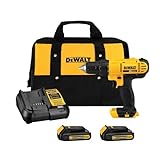
Plan around the cordless platform, not just the drill. Batteries and chargers are usually specific to a brand’s system, and buying into a platform can cost more than buying one tool. If you already own a compatible battery and charger, a bare drill may be the economical choice. Otherwise, a kit is often better value, particularly if it includes a second battery for continuous work. A two-battery drill-driver kit can keep the job moving, though it is unnecessary for a small deck or occasional repairs.
Before buying, hold the tool if possible. Repetitive fastening makes balance more important than a headline torque figure. A heavy battery can pull the wrist downward; a bulky handle may be tiring for smaller hands. A belt hook and a work light are useful conveniences, not reasons on their own to choose a tool.
A repeatable fastening routine
Start with the manufacturer’s spacing and fastener instructions. For many standard deck installations, screws go roughly 1 inch in from each board edge, with two screws at each joist, but board type and screw guidance can change that. Keep fasteners aligned and avoid driving so close to an edge that the board splits.
Set the clutch low, test a screw in a scrap of the same decking, and raise the setting only until the head seats flush. A setting that works in dry softwood may not work in dense material. Keep the drill straight over the screw and ease off as the head approaches the surface. If the screw stalls, do not lean harder until the bit cams out; check for a worn bit, a knot, a misaligned hole, or a screw that is too long for the task.
Pilot holes are useful near board ends, in dense hardwood, or wherever splitting is likely. Use a drill bit sized for the screw’s core and follow the decking or fastener maker’s guidance. Pre-drilling every hole in ordinary softwood can add considerable time, so reserve it for situations where it solves a real problem.
A practical buying choice
For most homeowners fastening ordinary deck boards, choose a comfortable 18V/20V-class drill driver from a battery platform you already use, preferably with a 2.0- to 4.0-Ah battery and a usable clutch. A compact 12V tool is a sensible cheaper choice for short screws, small repairs, and lighter hands; it is not the best bet if it will regularly drive long fasteners into dense lumber. For a large deck, hardwood, or a pace-heavy job, an impact driver may save time, but careful trigger control remains essential.
FAQ
Drill driver or impact driver?
Related guides
- Longest Lasting Lawn Mower Battery: AGM vs Lithium vs Flooded Lifespan and Cost per Season
- Duralast Gold Lawn Mower Battery Review: U1 Fit, CCA and When to Pay for AGM
- Greenworks Pro 80V 21-Inch Mower Review: Runtime Math, Push vs Self-Propelled and Yard Fit
- Bosch High Pressure Washer Gun Replacement: Fittings, Adapters and What Fits Your Model