What's inside
As an Amazon Associate I earn from qualifying purchases. This post may contain affiliate links at no extra cost to you.
What ledger screws demand from an impact driver
Driving structural screws through a ledger board and into framing is harder than ordinary deck fastening. The screw has to pull tight against the board while cutting into the framing, sometimes through treated lumber that is wet, dense, or slightly warped. A capable cordless impact driver makes that work quicker, but raw torque claims alone are a poor way to choose one.
For common ledger screws around 1/4 to 5/16 inch in diameter and 3 to 4 inches long, a modern 18V or 20V-class driver is usually sufficient when the hole and fastener instructions are followed. Long screws, dense lumber, repeated overhead work, and a full day on site favor a brushless model with a larger battery. A compact brushed driver can still be a sensible choice for a short repair or occasional deck project.
As an Amazon Associate we earn from qualifying purchases at no extra cost to you.


How to choose
Look for variable-speed control, a comfortable grip, a belt clip, and a chuck that holds a standard 1/4-inch hex shank. Brushless motors generally run cooler and use battery capacity more efficiently than brushed motors, which matters when driving many fasteners. A three-speed selector or fastening mode is useful: lower speed helps prevent overdriving, while higher speed gets through a run of screws faster.
Battery platform matters as much as the driver. If you already own cordless tools, buying a bare tool in that system is often cheaper and avoids adding another charger and battery type. If you are starting from scratch, compare the price of a kit with two batteries and a charger against a bare tool; the kit may be the better value for a project with lots of screws.
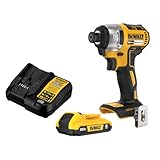
For a first purchase, compare brushless 18V or 20V impact driver kits. For light, occasional use, a compact cordless impact driver kit is often enough. Check that the kit includes batteries, charger, and the right battery platform before comparing prices.
Driver types at a glance
| Type | Best for | Trade-off |
|---|---|---|
| Compact brushed driver | Small repairs and occasional fastening | Typically less efficient during long runs; fewer control features |
| Brushless 18V/20V-class driver | Most deck and ledger-screw work | Costs more, especially as a kit |
| High-output brushless driver | Frequent long screws or daily jobsite use | Can be heavier and easier to overdrive fasteners with |
These are practical categories, not guarantees about a particular screw’s driving time. Wood species, moisture, screw design, pilot holes, and battery charge all affect performance. Manufacturer torque figures also use different test methods, so they are not a reliable head-to-head ranking.
Drive ledger screws without damaging the connection
Use the structural screw specified for the connection, not a drywall screw or a general-purpose deck screw. Follow the fastener maker’s instructions for diameter, spacing, edge distances, and whether a pilot hole is needed. Some structural screws are designed to go in without predrilling; others, and some dense or split-prone framing situations, may call for a pilot hole. Drilling unnecessarily can slow the job, while skipping a required pilot can split wood.
Seat the bit fully in the screw head and keep the driver square to the board. Start at low speed until the screw has established its path, then increase speed if needed. Stop when the head is seated as directed. Driving past that point can crush the ledger surface, strip the screw head, or weaken the connection. If a screw stalls, chatters, or refuses to pull the board tight, stop and inspect alignment, bit engagement, and the hole rather than leaning harder on the tool.
A fresh battery helps maintain speed through a long run, but a bigger battery adds weight. A compact 2.0Ah pack is easier to handle for a small repair; a 4.0Ah or larger pack is more practical for repeated fastening, though it makes a top-heavy driver feel heavier. Keep a spare charged if the project has many screws. For a broader battery-system comparison, consider cordless tool platform kits only if you need more than the driver; buying into a platform for one tool can cost more than the job warrants.
Common buying and jobsite mistakes
Do not choose solely by advertised torque or voltage. Most current tools in this class are sold as 18V or 20V maximum systems; that label does not by itself tell you how well the driver controls a screw near the end of its travel. A powerful driver without a useful low-speed trigger can make a beginner’s first few screws harder, not easier.
Likewise, an impact driver is not a substitute for checking the structure. It does not confirm that the ledger is attached to suitable framing, that flashing is installed correctly, or that fasteners meet local requirements. For a small number of screws into accessible framing, a less expensive driver is fine. Pay extra for brushless efficiency, control modes, or a larger battery when you expect to use those advantages regularly—not just because the package claims the highest number.
Related guides
- Longest Lasting Lawn Mower Battery: AGM vs Lithium vs Flooded Lifespan and Cost per Season
- Duralast Gold Lawn Mower Battery Review: U1 Fit, CCA and When to Pay for AGM
- Greenworks Pro 80V 21-Inch Mower Review: Runtime Math, Push vs Self-Propelled and Yard Fit
- Bosch High Pressure Washer Gun Replacement: Fittings, Adapters and What Fits Your Model