What's inside
As an Amazon Associate I earn from qualifying purchases. This post may contain affiliate links at no extra cost to you.
A reciprocating saw blade is a consumable, but choosing the wrong one can make a cordless saw feel weak, drain a battery quickly, or damage the workpiece. The battery platform matters mainly because it determines how much power and runtime the saw can deliver. The blade still controls how efficiently that power reaches the cut.
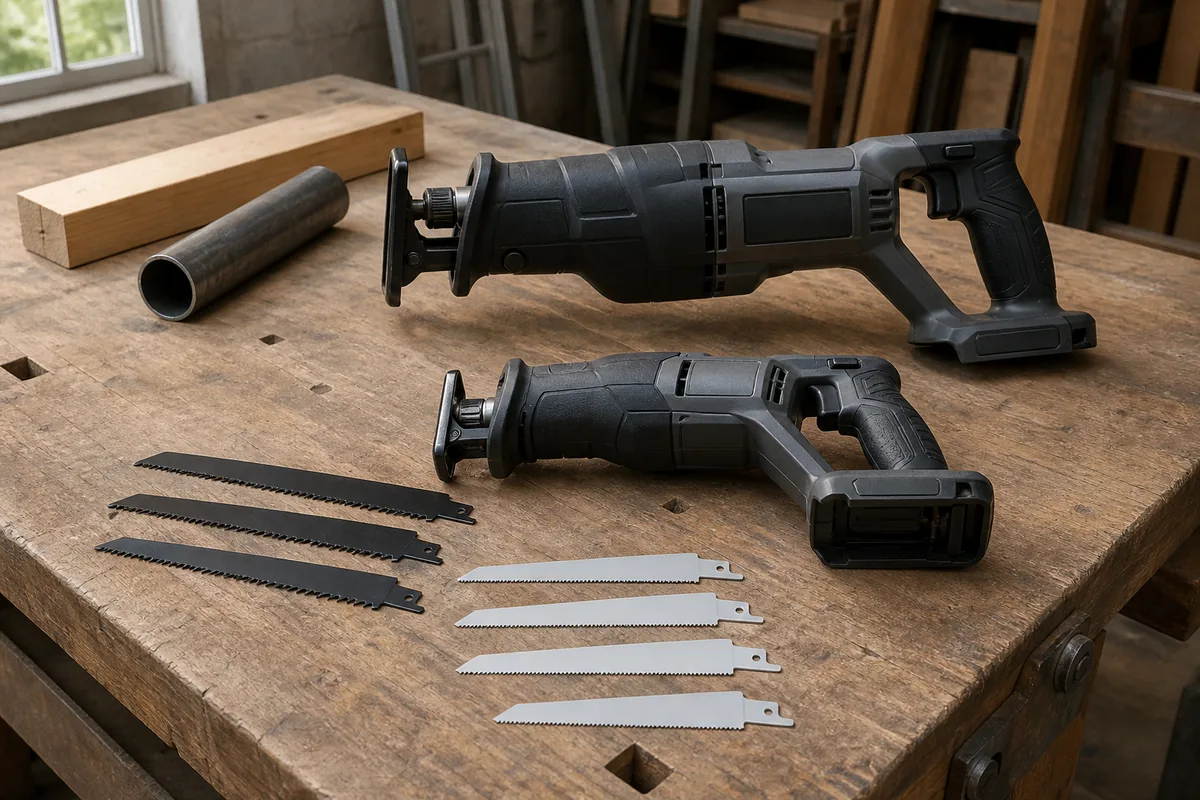
Start by matching the blade to the material, then choose the length, tooth pattern, and thickness. Almost all modern reciprocating saws use the same one-inch universal shank, regardless of whether the saw runs on an 18V, 20V MAX, or 24V battery. Still, check the saw’s manual before buying unusual demolition or specialty blades.
Match the Blade to the Material
Blade packaging usually identifies the intended material: wood, wood with nails, metal, stainless steel, plastics, or general demolition. Those labels are more useful than the battery voltage printed on the saw.
| Job | Blade type | Useful tooth range | What to expect |
|---|---|---|---|
| Clean cuts in lumber | High-carbon steel wood blade | 5–8 TPI | Fast cutting, relatively smooth finish |
| Framing lumber with nails | Bi-metal demolition or nail-embedded wood blade | 6–10 TPI | Slower than a coarse wood blade, but less likely to lose teeth |
| Thin sheet metal | Fine bi-metal blade | 18–24 TPI | Controlled cutting; requires firm support |
| Pipe and thick steel | Thick bi-metal or carbide blade | 8–14 TPI | Longer life, but higher cost and greater cutting resistance |
| Cast iron, hardened fasteners, or abrasive materials | Carbide-grit or carbide-tipped blade | Not always listed | Expensive, but often the only practical choice |
For ordinary remodeling, a mixed pack of reciprocating saw blades for wood and metal is usually the best starting point. A cheap assortment is fine for occasional nail-filled lumber and rough demolition. Do not expect bargain blades to last through repeated cutting of heavy steel.
Understand TPI and Tooth Engagement
TPI means teeth per inch. Low-TPI blades have large teeth and remove material quickly. High-TPI blades remove less material per stroke, but they are less likely to catch, chatter, or tear thin stock.
Try to keep at least three teeth engaged in the material during a cut. If a 6 TPI blade is used on very thin sheet metal, only one or two teeth may contact the work. The blade can snag and break. A 18–24 TPI blade is safer for thin metal, while a 6–10 TPI blade is more suitable for thick pipe or structural steel.
For wood, a 5 TPI blade cuts quickly through a 2×4 but leaves a rougher edge. An 8–10 TPI blade takes longer and may heat up sooner, but it gives better control around trim or plywood. Do not use a fine metal blade in wood unless a slow, controlled cut is more important than speed; it will often clog with sawdust and burn the teeth.
Choose Blade Length and Thickness
A blade should extend beyond the workpiece through the full stroke. For most cordless saws, a 6-inch blade is a practical general-purpose size. Use a 9- or 12-inch blade for thick timber, pruning, or flush cutting, but remember that longer blades flex more and require more battery power.
Blade length is not the same as maximum cutting capacity. A saw with a 1-1/8-inch stroke needs room for the blade to move without striking the workbench or nearby material. A blade that is too short can disappear into a cut and make it difficult to control.
Thicker blades resist bending and are preferable for demolition, nail-filled lumber, and heavy pipe. Thin blades are more flexible and can make flush cuts, but they are easier to twist. If a thin blade bends sideways, stop and reposition the saw rather than forcing it. Side loading is a common cause of broken blades and damaged blade clamps.
Account for Cordless Saw Power
Battery voltage does not tell the whole story. A compact 18V saw with a small 2.0Ah battery may cut adequately, but a high-output 5.0Ah or 6.0Ah pack will usually maintain speed better under load. It also adds weight. For overhead work, the lighter battery can be worth the shorter runtime.
High-resistance cuts expose weak batteries quickly. If the saw slows dramatically in thick lumber or stops when the blade binds, the cause may be a depleted or cold battery, not a poor blade. A fully charged high-output pack helps, but it cannot compensate for the wrong tooth pattern.
Keep a second battery available for demolition or repeated pipe cutting. A reciprocating saw can empty a 2.0Ah pack surprisingly fast when used continuously. For occasional pruning or cutting a few boards, buying a larger battery is unnecessary. For daily work, a high-output 5.0Ah cordless-tool battery is a more useful upgrade than buying premium blades alone.
Use Orbital Action Carefully
Some cordless reciprocating saws have orbital action, which moves the blade in a slight oval path. It cuts wood faster, especially during demolition, but it produces a rougher cut and more vibration. Turn orbital action off for metal, conduit, finish work, and situations where the blade needs to stay straight.
Orbital action also increases the chance of tooth damage if the blade catches a nail or the operator twists the saw. Use it with a coarse wood blade when speed matters, not as a universal performance setting.
Buying and Using Blades
Bi-metal blades are the sensible default for most cordless-platform owners. They combine a flexible spring-steel body with hardened teeth and cost more than basic carbon-steel blades, but they tolerate vibration and occasional nails. For frequent cutting of cast iron, cement board, or hardened screws, consider carbide reciprocating saw blades. They are not economical for one small repair.
Use cutting oil on steel when practical, support thin material close to the cut, and let the blade do the work. Excessive pressure bends the blade, overheats teeth, and increases battery drain. If the cut starts taking twice as long, the blade is smoking, or the saw is pulling sideways, replace the blade instead of pushing harder.
For a basic cordless kit, buy a few 6-inch bi-metal blades for mixed demolition, coarse wood blades for clean lumber, and fine-tooth metal blades for sheet stock. Add longer or carbide blades only when the jobs justify their cost. That small selection covers most home repairs without filling a toolbox with blades that match neither the material nor the saw.
Related guides
- Longest Lasting Lawn Mower Battery: AGM vs Lithium vs Flooded Lifespan and Cost per Season
- Duralast Gold Lawn Mower Battery Review: U1 Fit, CCA and When to Pay for AGM
- Greenworks Pro 80V 21-Inch Mower Review: Runtime Math, Push vs Self-Propelled and Yard Fit
- Bosch High Pressure Washer Gun Replacement: Fittings, Adapters and What Fits Your Model