What's inside
As an Amazon Associate I earn from qualifying purchases. This post may contain affiliate links at no extra cost to you.
For cutting pipe, a cordless reciprocating saw is usually the cheaper and more versatile choice. A compact cordless bandsaw is usually the faster, cleaner, and more controlled choice. The right tool depends less on the pipe diameter than on how many cuts you make, how accurately the ends must fit, and whether you already own batteries in a compatible platform.
As an Amazon Associate we earn from qualifying purchases at no extra cost to you.


The short answer
Buy a cordless reciprocating saw if you need one tool for demolition, occasional pipe cutting, and work in awkward locations. It can cut steel, cast iron, copper, PVC, and conduit with the correct blade. It is also more useful outside pipe work.
Buy a compact cordless bandsaw if you regularly cut steel pipe, threaded rod, conduit, strut, or tubing and care about square, repeatable cuts. Its enclosed blade is easier to control and produces fewer sparks and less flying debris.
| Factor | Cordless reciprocating saw | Compact cordless bandsaw |
|---|---|---|
| Typical best use | Demolition, tight access, mixed materials | Repeated metal cuts and clean stock preparation |
| Cut speed | Fast with the right blade, but variable | Consistently fast through metal |
| Cut quality | Often rough or angled without practice | Usually straighter and cleaner |
| Access | Excellent around installed pipe | Needs room to wrap around the work |
| Sparks and debris | More exposed blade movement and chips | Lower debris spread, though sparks are still possible |
| Typical tool cost | Lower, especially if batteries are owned | Higher, plus specialized blades |
| Other uses | Very broad | Mostly metal and plastic stock |
Where a reciprocating saw wins
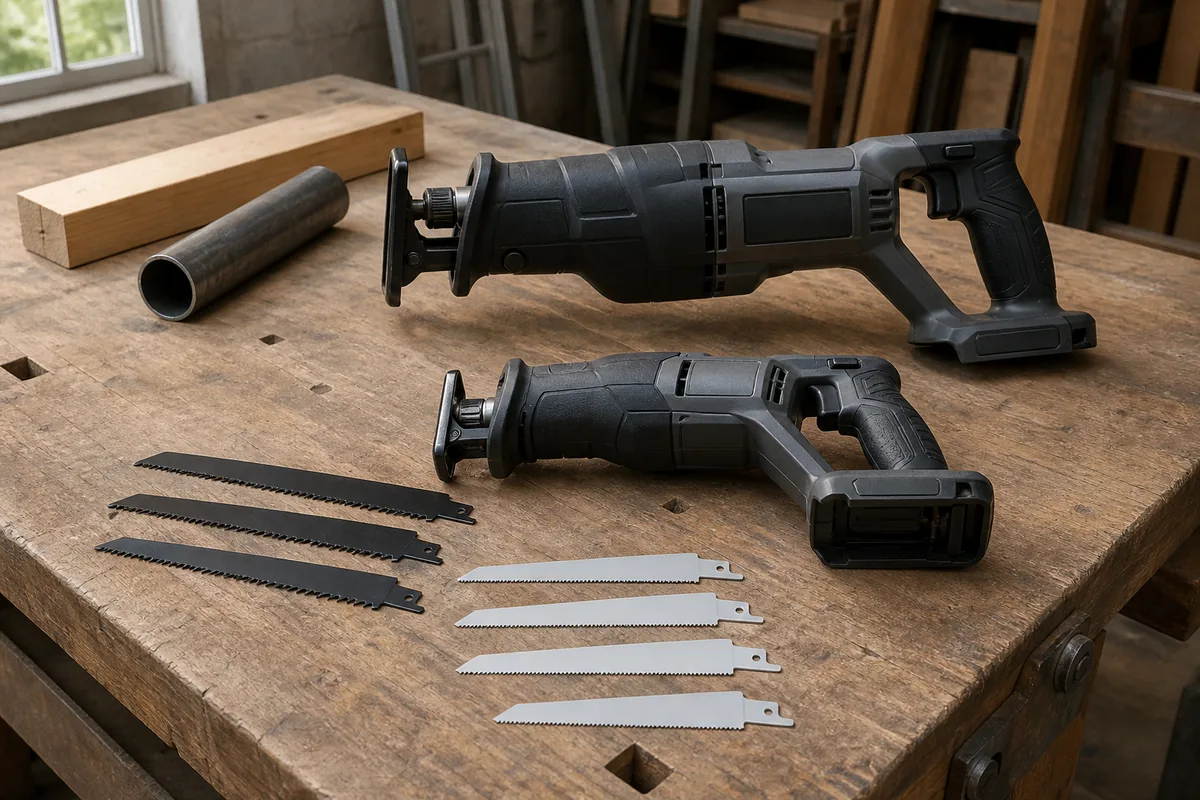
The reciprocating saw is the better tool for installed pipe. Its narrow blade can reach between studs, behind a boiler, alongside a wall, or into a trench where a bandsaw cannot be positioned. You can start a cut in the middle of a pipe, cut flush to a fitting, and remove pipe in short sections.
It is also the practical choice when the pipe is dirty, painted, rusty, or mixed with insulation and brackets. A demolition-style metal blade will tolerate some abuse. A long blade can cut through a pipe and its support hardware, although that increases vibration and blade wear.
The main weakness is control. The blade flexes, especially when cutting larger pipe or when too much pressure is applied. A 1-inch steel pipe can be cut cleanly, but a 3-inch pipe may leave a noticeably angled or ragged end. That matters when installing a compression fitting, welding, or joining sections that need to line up.
Use a blade intended for the material. Fine-pitch blades around 14 to 24 teeth per inch work well for thinner steel and conduit; coarser blades around 6 to 10 teeth per inch suit thicker steel and cast iron. Keep at least three teeth engaged in the wall. Too coarse a blade can snag thin tubing, while too fine a blade cuts slowly and packs with chips.
Where a compact bandsaw wins
A compact bandsaw guides a continuous blade around the work, so it does not have the same back-and-forth impact or tendency to kick when a tooth catches. Set the saw on the pipe, let the blade establish a groove, and apply steady pressure. On steel tubing, the result is normally straighter than a reciprocating-saw cut.
That control is valuable when making many cuts. A compact bandsaw can cut 1/2-inch conduit, 1-inch steel pipe, threaded rod, angle iron, and tubing with less operator fatigue. The enclosed blade also reduces the chance of contacting nearby surfaces compared with an exposed reciprocating blade.
It is not a universal pipe tool. The throat opening limits the maximum stock size, often to roughly 2 1/2 to 3 1/2 inches on compact models. Check the actual capacity before buying. The tool also needs enough clearance to pass around the pipe. A pipe close to a wall or elbow may be impossible to cut without removing adjacent parts.
Bandsaw blades are consumables, and the wrong blade is expensive in time. Use a bi-metal blade suited to the material and match the tooth pitch to the wall thickness. For thin-wall tubing, a finer pitch prevents tooth grabbing. Do not twist the saw during the cut; blade tracking problems and premature blade failure often start with side loading.
Battery platform and runtime
Battery compatibility should be a major part of the decision. A bare tool is attractive only if you already own the same brand’s batteries and charger. Otherwise, the battery and charger can add a substantial part of the purchase price.
For occasional pipe work, a 2.0Ah or 4.0Ah battery is usually enough. A reciprocating saw used for demolition can drain a small pack quickly, particularly in thick steel or cast iron. A compact bandsaw often makes more cuts per charge because the motor runs smoothly rather than driving an impact-style stroke, but heavy steel still consumes power.
High-output batteries can improve cutting speed and reduce voltage sag, especially on 18V or 20V-class tools. They also add weight. That extra weight is less noticeable when the bandsaw is resting on stock, but it can make an overhead reciprocating-saw cut tiring.
If you are starting from zero, compare the complete kit cost, charger speed, replacement battery prices, and the rest of the brand’s cordless hand-tool range. A platform with drills, impacts, lights, grinders, and outdoor tools may be worth more than a small difference in cutting performance.
How to get better pipe cuts
Support the pipe on both sides of the cut. Unsupported pipe can pinch the blade as the cut opens or closes, causing binding and overheating. Mark the cut with a wraparound guide for a square line. On larger pipe, use a strip of paper or tape around the circumference rather than relying on a single pencil mark.
Clamp loose stock whenever possible. With a reciprocating saw, brace the shoe firmly against the work and use moderate pressure. Let the blade do the cutting; forcing it bends teeth and makes the cut wander. With a bandsaw, begin slowly until a groove forms, then maintain steady feed pressure without twisting the frame.
After either tool, deburr the cut. A file, deburring tool, or flap wheel removes sharp internal and external edges that can damage seals, restrict flow, or cut hands. For plumbing or compressed-air work, clean out chips before assembly. Never assume a visually clean cut is free of metal fragments.
Which tool should you buy?
Choose the reciprocating saw when the pipe is already installed, access is restricted, or you also need a demolition tool. It is the sensible lower-cost option for a homeowner making a few cuts per year. Add quality metal blades and accept that some ends will need filing or additional fitting work.
Choose the compact bandsaw when you prepare pipe or tubing at a bench, make several dozen cuts, or need consistently square ends. The higher purchase price is easier to justify for maintenance workers, fabricators, electricians, and plumbers who cut metal stock regularly. If your work involves both stock preparation and demolition, owning both eventually makes sense; they solve different access and control problems rather than replacing each other.
FAQ
Which tool should you buy?
Related guides
- Longest Lasting Lawn Mower Battery: AGM vs Lithium vs Flooded Lifespan and Cost per Season
- Duralast Gold Lawn Mower Battery Review: U1 Fit, CCA and When to Pay for AGM
- Greenworks Pro 80V 21-Inch Mower Review: Runtime Math, Push vs Self-Propelled and Yard Fit
- Bosch High Pressure Washer Gun Replacement: Fittings, Adapters and What Fits Your Model