What's inside
As an Amazon Associate I earn from qualifying purchases. This post may contain affiliate links at no extra cost to you.
Choosing a Cordless Heat Gun for Wire Work
A cordless heat gun is useful when you are repairing wiring in a vehicle, sealing heat-shrink tubing in a junction box, or working where an extension cord is inconvenient. It is not a full replacement for a corded heat gun. Battery models generally heat more slowly, move less air, and run for a limited time. For occasional wire repair, those trade-offs are usually acceptable.
The most important specifications are operating temperature, airflow, nozzle control, warm-up time, and battery compatibility. Most cordless tools in this category reach roughly 500 to 1,000 degrees Fahrenheit, depending on the model and setting. Heat-shrink tubing normally needs far less: many common polyolefin tubes begin shrinking around 194 to 257 degrees Fahrenheit and are fully recovered near 257 to 356 degrees. A tool with adjustable heat is easier to control than one that only produces maximum heat.
As an Amazon Associate we earn from qualifying purchases at no extra cost to you.

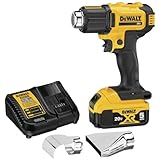


If you already own batteries from a major platform, start there. The bare tool is often much cheaper than buying a battery and charger, and using the same packs for a drill, impact driver, light, and heat gun is more useful than chasing a slightly better standalone specification.
The Main Cordless Platform Options
Milwaukee’s M18 heat gun is a practical choice for users already invested in the M18 system. DEWALT’s 20V MAX offering fits the same role in that battery ecosystem. Makita’s 18V LXT platform is another sensible option, particularly if you already use its compact batteries and chargers. Ryobi’s 18V ONE+ line is often the lower-cost route and is adequate for occasional automotive and household repairs.
For current availability, compare M18 cordless heat guns, DEWALT 20V MAX heat guns, or the equivalent bare tool in your existing system. Model packaging changes, so verify that the listing includes the nozzle and battery you expect.
| Platform type | Best for | Advantages | Limitations |
|---|---|---|---|
| Compact 18V/20V cordless | Repairs, heat-shrink tubing, service calls | No cord, fast setup, uses existing batteries | Shorter runtime and lower airflow than corded tools |
| Higher-output 18V/20V model | Repeated wire work and larger tubing | More heat reserve and quicker recovery | Heavier, more expensive, drains batteries faster |
| Small budget cordless tool | Occasional household use | Low purchase price and easy storage | Slower heating, fewer controls, weaker accessories |
| Corded heat gun | Bench work and long heating sessions | Continuous power, usually higher airflow, lower cost | Needs an outlet and is less convenient outdoors |
Features That Matter for Shrink Tubing
A two-temperature switch is the minimum I would consider. Low heat helps prevent scorching small wires and thin insulation. Variable temperature control is better, but only if the controls are easy to adjust while holding the tool. Some cordless heat guns offer two airflow settings; lower airflow is useful because it gives you more control around connectors and adjacent plastic parts.
Look for a supplied reflector or shrink-tubing nozzle. It wraps hot air around the tube and heats it more evenly than the open outlet. A wide reflector nozzle is useful for larger tubing, while a narrow reducer nozzle concentrates heat on small sections. If the tool does not include the nozzle you need, check whether replacements are available before buying.
A built-in work light is helpful in a dark engine bay, but it should not outweigh battery compatibility or temperature control. A stable base or hanging hook is also worthwhile. Never set a hot heat gun directly on a plastic work surface; the outlet and nozzle can remain hot after the motor stops.
Battery Size, Runtime, and Balance
Small 1.5Ah or 2.0Ah packs keep the tool lighter and are usually enough for several wire repairs. A 4.0Ah or 5.0Ah battery provides more runtime, but it makes a handheld heat gun noticeably heavier. Heat guns draw substantial power, so do not assume a large battery will run for hours. Runtime depends heavily on the temperature setting, airflow, and how often the heater cycles.
For work above shoulder height or inside a vehicle, a compact battery is often the better choice. For repeated shrinking on a workbench, a larger pack is reasonable. Keep a second charged battery available if you are repairing a harness with dozens of connections. Waiting for a battery to recharge is more frustrating than the actual heat-shrink operation.
Users without an existing platform should price the kit, not just the tool. A budget cordless heat gun kit can be the sensible buy when you need a heat gun, battery, and charger and have no brand loyalty. Once you own several tools, the bare tool from that ecosystem usually costs less overall.
How to Shrink Tubing Without Damaging the Wire
Slide the tubing onto the wire before making the splice. This is the most common failure: the connection is completed, then the tubing is discovered still sitting on the wrong side of the repair. Use tubing with an internal diameter slightly larger than the insulated wire, but not so large that it needs excessive heat to contract. For outdoor or automotive work, adhesive-lined tubing provides better moisture resistance than standard tubing.
Center the tubing over the splice and start on a low or medium setting. Keep the nozzle moving, usually 1 to 2 inches from the tubing. Rotate the wire or move around the connection so the adhesive and plastic shrink evenly. Stop when the tubing is tight and, for adhesive-lined types, a small bead of adhesive appears at the ends. Do not keep heating after the insulation has flattened or turned glossy.
Excessive heat can melt wire insulation, deform a connector, loosen solder, or damage nearby terminals. It can also make tubing brittle if it is scorched. A lighter may work in an emergency, but its flame creates hot spots and soot and can ignite insulation. For occasional work, the cheaper option is fine if it has a low setting and a suitable nozzle. Do not pay for the highest-output tool just to shrink a few small tubes.
Safety and Common Failure Modes
Disconnect vehicle batteries or equipment power before repairing wiring. Remove flammable solvents, paper, fuel residue, and loose insulation from the work area. Heat guns can ignite vapors even when the visible outlet is not touching anything. Wear eye protection, especially when shrinking adhesive-lined tubing, because hot adhesive can escape from the ends.
Do not use a cordless heat gun as a paint stripper near wiring, lithium batteries, or sealed containers. The heat spreads farther than the visible air stream. If the tool repeatedly shuts off, the battery may be too small, overheated, or near empty; let both the pack and tool cool rather than forcing the trigger. For long bench sessions, a corded heat gun remains the better tool. For quick repairs in the field, an existing 18V or 20V platform tool is usually the most convenient and least wasteful choice.
Related guides
- Longest Lasting Lawn Mower Battery: AGM vs Lithium vs Flooded Lifespan and Cost per Season
- Duralast Gold Lawn Mower Battery Review: U1 Fit, CCA and When to Pay for AGM
- Greenworks Pro 80V 21-Inch Mower Review: Runtime Math, Push vs Self-Propelled and Yard Fit
- Bosch High Pressure Washer Gun Replacement: Fittings, Adapters and What Fits Your Model