What's inside
As an Amazon Associate I earn from qualifying purchases. This post may contain affiliate links at no extra cost to you.
Most woodworkers don’t buy their first compressor thinking they’ll need a two-stage unit. You start with a small pancake or horizontal tank, run a brad nailer, and everything feels fine. Then you add the spray gun. Then the die grinder. Then someone mentions that your planer dust collector is choking on the same line. Suddenly you’re looking at a 60- or 80-gallon vertical tank bolted to a pad in the corner of the shop, and you realize two-stage is the only category that actually keeps up with a full day of real work.
What separates the best professional two stage air compressor for shop use from merely adequate machines comes down to three things: recovery rate under continuous draw, the quality of the pump casting and lubrication system, and whether the tank plumbing and pressure switch are built to survive daily cycling for a decade. You’ll find plenty of units that advertise impressive CFM numbers on paper but throttle back at actual operating pressure. The compressors below are selected because their output curves hold up when you’re pulling air from multiple tools simultaneously, and because their serviceability means you won’t be shopping for a replacement in three years.
As an Amazon Associate we earn from qualifying purchases at no extra cost to you.


Quick Picks
| Product | Best for | Price |
|---|---|---|
| Ingersoll Rand 2475N7.5 | Maximum airflow and long-term reliability | $2,979.99 |
| BILT HARD 80 Gallon 7.5HP | Highest rating for the money | $1,899.99 |
| BILT HARD 60 Gallon 5HP | Mid-size shops on a tighter budget | $1,499.99 |
| Industrial 3-Cylinder Silent | Noise-sensitive environments | $2,286.77 |
| Campbell Hausfeld 80-Gallon 5HP | Proven automotive and shop versatility | $1,639.99 |
| Ingersoll Rand 2340L5-V | Compact footprint with IR pedigree | $2,019.99 |
| Klutch 60-Gallon Vertical | Entry-level heavy-duty on a budget | $899.99 |
| DEWALT DXCMV5076055 | Brand ecosystem compatibility | $1,818.99 |
How We Picked
We narrowed this list by comparing continuous CFM delivery at 90 PSI (not max PSI, not free-air output), pump construction material and lubrication type, tank certification and capacity-to-horsepower ratio, and real-world owner feedback on longevity and serviceability. Compressors that rely on aluminum pump housings or splash-lube systems without oil monitoring were deprioritized unless noise reduction justified the trade-off. We also weighted the availability of replacement parts and the reputation of the manufacturer’s support infrastructure, because a compressor that cannot be serviced is a compressor that becomes scrap metal.
The 8 Best Professional Two Stage Air Compressor For Shop in 2026
Ingersoll Rand 2475N7.5 7.5 HP Two-Stage Air Compressor
This is the unit you buy when downtime is not an option. With 24.3 CFM at 90 PSI delivered from an 80-gallon vertical tank, it handles sandblasters, large die grinders, and multiple spray stations without the tank pressure sagging. The cast-iron pump is the same design Ingersoll Rand has refined over decades, and parts availability is essentially unmatched in this segment.
- Pro: Highest CFM output on this list, ideal for continuous high-demand use.
- Pro: Cast-iron pump with proven track record for decades of service.
- Con: Price puts it well above every other option here.
Skip this if your shop runs one or two tools at a time and you don’t need recovery speed. The $2,979.99 investment only pays off if you are consistently drawing heavy air loads across an eight-hour shift.
BILT HARD 80 Gallon 7.5HP Two-Stage Stationary Compressor
BILT HARD has made a serious play for the value segment, and this 80-gallon unit is the proof. It matches the Ingersoll Rand’s CFM rating almost exactly at 24 CFM at 90 PSI, hits 180 max PSI, and carries an ASME-certified tank. The perfect 5/5 owner rating suggests buyers are genuinely surprised by the build quality at $1,899.99.
- Pro: Delivers nearly flagship-level airflow at roughly two-thirds the price of the IR equivalent.
- Pro: ASME-certified 80-gallon tank with oil-lubricated two-stage pump.
- Con: Long-term parts and service availability is still unproven compared to legacy brands.
Skip this if you are in a region where BILT HARD does not have distributor support, or if you require a compressor you can keep running for fifteen years without sourcing anything.
BILT HARD 60 Gallon 5HP Two-Stage Stationary Compressor
Step down to 5 HP and a 60-gallon tank, and you still get 15 CFM at 90 PSI with 175 max PSI. This is the sweet spot for a two- or three-person shop that runs a brad nailer, a stapler, and a finish sprayer concurrently. At $1,499.99 with a 5/5 rating, it undercuts most competitors in this tank size by a meaningful margin.
- Pro: Excellent price-to-performance ratio for shops that do not need eight-plus CFM.
- Pro: Same oil-lubricated two-stage design and ASME certification as the larger model.
- Con: 15 CFM will not sustain sanding or grinding for extended periods without cycling.
Skip this if you regularly run a random-orbit sander or die grinder alone; its air consumption will outpace this unit’s recovery rate.
Industrial 3-Cylinder Silent Air Compressor 5HP 60Gal
Noise is a legitimate shop concern, and this 3-cylinder, 5 HP unit addresses it directly with isolator pads and a splash-lube pump that runs at 19 CFM on 230V single-phase power. Assembled in the USA, it carries a 4.9 rating that reflects how much quieter it is next to comparable machines. At $2,286.77, you are paying for that quietness.
- Pro: Significantly reduced noise output makes it viable in shared or residential-shop settings.
- Pro: 19 CFM from a 5 HP motor is competitive for its class.
- Con: Splash-lube design requires more attentive oil monitoring than full-pressure oiling systems.
Skip this if you cannot check oil levels weekly or if your priority is maximum runtime rather than noise reduction.
Campbell Hausfeld 80-Gallon 5 HP Two-Stage Air Compressor
Campbell Hausfeld has been in the compressor game long enough that their cast-iron, oil-lubricated pump design is well understood and widely supported. The 80-gallon tank with 16.0 CFM at 90 PSI puts it in the same league as the BILT HARD 60 for most woodworking applications, but with a larger reservoir that smooths out pressure between cycles. At $1,639.99, it is a pragmatic choice.
- Pro: 80-gallon tank provides substantial stored air for burst applications like sandblasting.
- Pro: Campbell Hausfeld parts network is among the most accessible in the industry.
- Con: 16 CFM is adequate but not exceptional; it trails the 7.5 HP units by a clear margin.
Skip this if you need sustained airflow above 16 CFM or if you want the highest possible owner satisfaction scores.
Ingersoll Rand 2340L5-V 5 HP Type 30 Two-Stage Air Compressor
The 2340L5-V is the compact Ingersoll Rand answer for shops with limited floor space. It delivers 14.3 CFM at 90 PSI from a vertical tank that occupies roughly the same footprint as many 60-gallon horizontal units. The 175 PSI maximum pressure gives you headroom for tools that run at higher operating pressures. The 4/5 rating from owners who bought it suggests reliability without the excitement of the larger models.
- Pro: Cast-iron pump with Ingersoll Rand’s parts and service infrastructure.
- Pro: Vertical design saves floor space in tight shop layouts.
- Con: 14.3 CFM at $2,019.99 is underpowered relative to its price tier.
Skip this if you are paying primarily for the brand name and could get more airflow from the BILT HARD 60 for significantly less money.
Klutch 60-Gallon Vertical Single-Stage Air Compressor
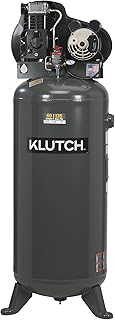
Full disclosure: this is a single-stage, 3.7 HP compressor, which makes it the outlier in a two-stage roundup. At $899.99 with a 4.5 rating, it earns its place here only as the absolute floor for someone who needs a 60-gallon vertical tank and cannot justify spending more. It will run nailers, staplers, and light spray work fine. It is not a true two-stage machine and should not be compared to the others here on recovery metrics.
- Pro: Lowest price for a 60-gallon vertical tank with any credible build quality.
- Pro: Maintenance-friendly access panel layout simplifies routine servicing.
- Con: Single-stage design cannot deliver the continuous pressure and CFM of the two-stage units on this list.
Skip this if you are specifically shopping for a two-stage compressor; it belongs in a different comparison entirely.
DEWALT DXCMV5076055 60-Gallon Stationary Vertical Air Compressor
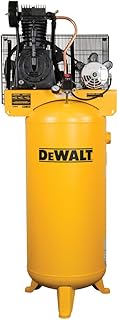
DEWALT’s entry is a belt-drive, oil-lubed two-stage unit rated at 5 HP and 175 max PSI on 230V. It should, on paper, be a serious competitor. In practice, the 3.7 owner rating signals recurring frustration—likely around noise, vibration, or quality control—that prevents it from earning a recommendation for someone making a $1,818.99 investment. The DEWALT ecosystem is convenient if you already run their chargers and tools, but the compressor itself does not deliver a compelling reason to accept the lower score.
- Pro: Belt drive reduces motor-to-tank heat transfer and extends belt life.
- Pro: Integrates with DEWALT shop systems if you already own their other equipment.
- Con: Owner satisfaction is the lowest on this list, suggesting real-world reliability concerns.
Skip this if your purchase is strictly about compressor performance and you are not heavily invested in the DEWALT ecosystem.
Buying Guide
CFM at Operating Pressure, Not Max Pressure
Every manufacturer advertises a max PSI number (150, 175, 180) that you will almost never use at the tank. What matters is the CFM rating at your working pressure, which for most shop tools sits between 90 and 125 PSI. Add up the CFM requirements of every tool you might run simultaneously and choose a compressor whose rated output exceeds that total by at least 20 percent to avoid tank pressure collapsing during operation.
Pump Construction and Lubrication Type
Cast-iron pumps with pressure-fed oiling systems are the gold standard for longevity in professional use. Splash-lube pumps (like the Industrial 3-Cylinder) work well but demand stricter oil-level discipline because they rely on crankcase splashing rather than a dedicated pump to circulate oil. Aluminum housings are common on budget units and will wear faster under continuous high-pressure cycling. If you plan to run your compressor more than a few hours per week, cast iron with pressure lubrication is worth the premium.
Tank Size, Orientation, and Certification
Larger tanks (60 to 80 gallons) provide more stored air, which means your compressor can cycle less frequently and recover between bursts of demand. Vertical orientation saves floor space and often puts the drain valve and filter at a more accessible height. ASME certification is not optional for a stationary shop unit—it confirms the tank was built and tested to recognized pressure-vessel standards, which matters for insurance and for your own safety.
Our Verdict
The BILT HARD 80 Gallon 7.5HP is the overall top pick for most professional shops. It delivers 24 CFM at 90 PSI—the same ballpark as compressors costing a thousand dollars more—with a perfect owner rating and ASME-certified construction. If budget is the binding constraint, the BILT HARD 60 Gallon 5HP at $1,499.99 is the smartest compromise between cost and continuous output. One condition where another unit wins outright: if noise is your primary concern and you share a workspace with a residence, the Industrial 3-Cylinder Silent justifies its premium over anything else on this list.
FAQ
Do I really need two-stage for woodworking?
If you only run nailers and staplers, single-stage is fine. The moment you add a spray gun for finishing work or a die grinder for template routing, two-stage becomes necessary because those tools consume air faster than a single-stage pump can replenish it.
What size tank is best for a shop compressor?
For most two- to three-person shops running multiple tools, 60 to 80 gallons is the practical range. Smaller tanks (20 to 30 gallons) work for solo users with low continuous draw but force the motor to cycle more often, which shortens its service life.
How often should I change the oil in a professional compressor?
Pressure-lubricated cast-iron pumps typically need an oil change every 500 to 1000 hours of operation. Splash-lube designs should be checked weekly and topped off as needed, with a full change at the lower end of that interval since they run less efficiently.
Can I run a 7.5 HP compressor on a standard 240V outlet?
Most 7.5 HP two-stage units require a dedicated 240V circuit rated for at least 30 amps. Before purchasing, verify your shop’s electrical panel can supply the sustained amperage; undersized wiring is a fire hazard and the most common reason compressors fail to start under load.