What's inside
As an Amazon Associate I earn from qualifying purchases. This post may contain affiliate links at no extra cost to you.
The Ryobi 36V 46cm brushless lawn mower is the right pick for suburban lawns of roughly 300–700m², and the single biggest factor in whether it fits yours is which amp-hour battery you pair it with — not the mower itself. It’s a push (not self-propelled) mower built around a powder-coated 46cm steel deck, a load-sensing brushless motor, and Ryobi’s dedicated 36V battery platform. Below: the specs that matter, realistic per-charge coverage for each battery size, and a straightforward way to match the mower to your block.
As an Amazon Associate we earn from qualifying purchases at no extra cost to you.
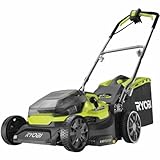


Specs at a glance
| Feature | Detail |
|---|---|
| Cutting width | 46cm (~18″) |
| Deck material | Stamped steel, powder-coated |
| Motor | Brushless with automatic load sensing |
| Cutting heights | Approx. 20–70mm, single-lever multi-position |
| Catcher | ~50L soft bag with hard top |
| Mulching | Yes — plug included |
| Drive | Push only |
| Weight | ~20–22kg tool only; add ~1.5–2.5kg depending on battery |
| Battery platform | Ryobi 36V lithium (accepts 2.0–8.0Ah packs) |
| Storage | Quick-fold handles; stores vertically on most versions |
Which Ryobi lawn mower 36V batteries fit — and which don’t
Every Ryobi 36V lithium pack slots straight in: 2.0Ah, 4.0Ah, 5.0Ah, 6.0Ah and the high-capacity 8.0Ah. The same packs also run the 36V line trimmers, blowers and chainsaws, which is where the platform’s value compounds — one charger, batteries that swap between tools.
The critical caveat: this is not the 18V ONE+ system. Ryobi 18V ONE+ batteries physically will not fit, and no adapter exists. Buyers who already own Ryobi 18V gear sometimes assume cross-compatibility — it’s the most common mistake with this cordless 36V mower. In North America the equivalent range is sold as 40V; those packs aren’t interchangeable with the 36V line either, so buy for your market.
One trade-off worth knowing: bigger batteries mean more weight in the rear of the deck. An 8.0Ah pack adds a noticeable couple of kilograms, which you’ll feel pushing uphill or turning at the end of each pass.
Realistic square metres per charge
Marketing figures assume short, dry grass on flat ground. The table below reflects what owners more typically see on an average weekly mow:
| Battery | Realistic coverage | Comfortably suits lawns up to |
|---|---|---|
| 2.0Ah | ~150–250m² | ~180m² |
| 4.0Ah | ~300–450m² | ~350m² |
| 5.0Ah | ~400–550m² | ~450m² |
| 6.0Ah | ~500–650m² | ~550m² |
| 8.0Ah | ~650–850m² | ~700m² |
Knock 30–50% off those numbers for wet grass, overgrown lawns, or thick buffalo and kikuyu. Slopes typically cost another 10–20% because the load-sensing motor works harder. The single biggest drain is scalping — dropping the deck two or three notches on long grass can halve your runtime in minutes.
Worked example
Say your backyard measures 15m × 25m (375m²) and the front strip adds 10m × 8m (80m²) — that’s ~455m² of lawn. A 6.0Ah battery finishes it in one session with margin to spare. A 4.0Ah pack will likely run dry near the end, so you’d either recharge mid-mow or keep a spare. At a normal walking pace the 46cm deck covers roughly 0.4m of effective width per pass, so 455m² works out to around 1.1km of pushing — about 20–25 minutes of actual mowing.
Matching the mower to your lawn
| Your situation | Recommended setup | Why |
|---|---|---|
| Under 300m², flat, already own 36V tools | Skin-only + existing 4–5Ah | No need to pay for batteries twice |
| 300–600m², first 36V tool | Kit with 5.0Ah or 6.0Ah | Finishes on one charge; bundled pricing |
| 600–900m² or heavy/thick grass | 8.0Ah, or two mid-size packs | A mid-mow swap beats a dead mower |
| Over ~900m², steep block, or limited mobility | Consider a self-propelled model instead | It’s a push mower — 1km+ per mow adds up |
If you’re between this and a smaller 33–40cm deck from the same range, the 46cm cuts about 25–35% fewer passes on the same lawn, which is the difference between a 30-minute and a 40-minute job. Above ~800m² of regular mowing, though, the honest advice is to look at self-propelled options — the mower will do the area, but your legs might object.
Living with it: wear items and upkeep
- Blade: The bar blade is the first consumable. Sharpen once or twice a season; replace it if it hits a rock and bends — a bent blade causes deck-rattling vibration.
- Steel deck: Steel outlasts plastic but rusts at seams if clippings sit against it. Scrape or hose the underside after every damp mow and touch up paint chips early.
- Catcher: The fabric sections clog with dust over time, starving airflow and causing clumps of grass to drop mid-pass. A hose-down restores it.
- Battery: Heat and deep discharge kill these packs fastest. Store them around half-charged, off the charger, and out of a hot shed. A replacement pack is by far the biggest running cost of ownership — often a third to half the price of the mower kit.
- Common mistakes: Mowing wet grass (clumps, extra load, deck corrosion), removing more than a third of the grass height in one pass, and putting the mower away dirty for winter.
Getting the best price on a Ryobi 36V lawn mower
The maths is simple: if this is your first 36V tool, buy the kit. A bundled battery and charger typically works out 25–40% cheaper than buying the skin and power pack separately. If you already own 36V batteries, the skin-only version is where the real value sits — often in the low-to-mid hundreds versus roughly double that for a kit with a high-capacity battery.
In Australia and New Zealand the 36V range is exclusive to a single big-box hardware chain, so cross-shop comparison is limited — the best price tends to appear during spring launch promotions, end-of-summer clearances, or when a kit’s bundled battery size gets superseded. Kits change configuration more often than the mower itself, so an outgoing kit can be a quiet bargain.
FAQ
Is the Ryobi 36V brushless lawn mower self-propelled?
No — it’s a push mower. The brushless motor keeps weight reasonable, but on steep or very large blocks a self-propelled model is worth the extra spend.
Can it mulch and catch?
Yes. A mulching plug is included, so you can catch, mulch, or (on most versions) rear-discharge without the catcher fitted.
Will my 18V ONE+ batteries work?
No. The 36V system uses a different interface — nothing from the 18V ONE+ range fits.
How long does a battery take to recharge?
Depending on the charger, roughly 1–2 hours for a 5.0Ah pack — slower on a standard charger, faster on a rapid unit. Owners of larger lawns often find two mid-size batteries more practical than waiting on one.
Is two batteries better than one big one?
Usually, yes. Two 4.0–5.0Ah packs give you redundancy, charge in parallel on dual chargers, and can be shared across other 36V tools — one large pack is simpler but leaves you stranded mid-mow if it underperforms.
Related guides
- Stihl Battery-Powered Weed Eater Guide: AK vs AP Systems, Weight, and Runtime
- Castle Garden Ride-On Mower Guide: Specs, Deck Sizes, and Who They’re For
- Sun Joe Electric Lawn Mower Guide: Corded vs Cordless and What Fits Your Lawn
- Husqvarna Ride-On Lawn Mower Guide: Deck Sizes, Engines, and Which Fits Your Yard