What's inside
As an Amazon Associate I earn from qualifying purchases. This post may contain affiliate links at no extra cost to you.
The short answer: at O’Reilly, an o reilly lawn mower battery is almost always either a BCI Group U1 or U1R, and the two are physically identical in every dimension except one — the position of the positive terminal — so the group code printed on your old battery’s label is the single piece of information you need before you order.
As an Amazon Associate we earn from qualifying purchases at no extra cost to you.
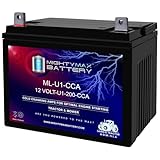


U1 vs. U1R: Same Case, Mirrored Posts
Both group sizes share the exact same footprint, height, and 12-volt electrical system. The “R” stands for reversed polarity: with the battery sitting upright and the front label facing you, a U1 has its positive (+) post on the left corner and a U1R has it on the right.
Why it matters in practice: mower battery cables are cut to length and routed to reach one specific corner. Buy the wrong orientation and you’ll either come up short on cable reach or be tempted to twist the battery around — which can stretch a cable, rub it against a sharp edge, or worst case, connect it backwards. Reversed polarity on a mower typically blows the main fuse instantly, and on machines with a regulator/rectifier it can cook the charging circuit or the ignition module. That’s a $30 battery choice turning into a $150 repair.
How to confirm yours in 30 seconds: look at the label or embossed code on your old battery — it will read U1, U1R, or sometimes “U1-9” style brand codes. If the label is gone, note which corner the red/positive cable reaches when the battery sits in the tray. Take a photo before disconnecting anything.
U1 and U1R Specs at a Glance
| Spec | Group U1 | Group U1R |
|---|---|---|
| Positive terminal position (facing label) | Left corner | Right corner |
| Voltage | 12 V | 12 V |
| Approx. dimensions (L × W × H) | 7.75 × 5.13 × 7.25 in | 7.75 × 5.13 × 7.25 in |
| Typical CCA range | ~160–350 CCA | ~160–350 CCA |
| Weight (flooded lead-acid) | ~13–17 lbs | ~13–17 lbs |
| Terminal style | Bolt/L-type posts | Bolt/L-type posts |
| Typical price range | ~$35–$55 flooded; ~$60–$90 AGM | ~$35–$55 flooded; ~$60–$90 AGM |
O’Reilly’s house line, Super Start, is the brand you’ll see most often on the shelf, and a refundable core charge applies at checkout — bring the old battery and you get that deposit back. Because U1/U1R is an industry-wide BCI standard, you’re never locked into one brand; the group code is what guarantees fit.
How Much CCA Does Your Mower Actually Need?
Cold cranking amps measure how much current the battery can deliver at 0°F for 30 seconds. For lawn equipment, CCA is really a proxy for “how easily does this spin a big engine on a cold spring morning.” Going higher than required is always safe — the starter only draws what it needs — but you’ll pay for capacity you don’t use.
| Mower / engine type | Minimum sensible CCA | Comfort zone |
|---|---|---|
| Single-cylinder rider or zero-turn (under ~15 hp) | 150 CCA | 180–230 CCA |
| V-twin lawn/garden tractor (17–24 hp) | 230 CCA | 250–350 CCA |
| Cold-climate use, hard-starting engines, infrequent starts | — | Top of range (300+ CCA) |
| Diesel subcompact tractor | 400+ CCA | Usually a different group size entirely — check manual |
One caveat: some budget lawn batteries are rated in “cranking amps” (measured at 32°F) rather than true CCA. The CA number always looks bigger. If a box only advertises a vague “amps” figure, assume it’s the warmer-temperature rating and buy a notch higher.
Flooded vs. AGM vs. Lithium: Picking the Chemistry
- Conventional flooded lead-acid is what most U1/U1R batteries on the shelf are. Cheapest option, proven, and fine for seasonal use — as long as you keep it charged over winter. This is what kills them early, not miles or hours.
- AGM (absorbed glass mat) versions cost roughly 50–70% more but are fully sealed, spill-proof, tolerate vibration better (relevant on rough-cutting zero-turns), self-discharge slower in storage, and typically deliver more CCA from the same case size.
- Lithium (LiFePO4) drop-in replacements exist in U1-size cases — a fraction of the weight (3–4 lbs) with strong cranking specs — but they want a lithium-compatible charger and can underperform in deep cold. Verify charging compatibility before going this route.
Match the Battery to Your Situation
| Your situation | Best pick | Why |
|---|---|---|
| Standard rider, mild climate, used weekly in season | Flooded U1/U1R, ~200 CCA | Cheapest path; regular use keeps it healthy |
| V-twin tractor or big zero-turn | 300+ CCA flooded or AGM | Larger engines need the extra cranking reserve |
| Mower sits for weeks between cuts | AGM, or flooded + maintainer | Slow self-discharge prevents sulfation damage |
| Winters where the shed drops below freezing | Remove battery indoors on a maintainer | A discharged battery freezes and cracks; a charged one doesn’t |
Getting the Install Right
- Disconnect negative first, reconnect it last. This prevents a wrench shorting the positive post to the frame.
- Clean the cable ends with a wire brush before attaching — green crust adds resistance and mimics a weak battery.
- Seat the battery fully and re-secure the hold-down strap. A loose battery bounces, cracks its case, and shakes plates apart internally.
- Check height clearance under the seat or hood. U1 cases run about 7.25 inches tall; some aftermarket AGM versions sit slightly taller at the terminals.
- Charge before first use if it sat on the shelf. Fresh stock is usually charged, but a battery that’s been sitting months benefits from a slow top-off.
What Actually Kills These Batteries
Replacement listings won’t tell you this: most mower batteries don’t wear out — they’re murdered by storage. Leaving a battery partially discharged for a winter lets sulfate crystals harden on the plates, permanently cutting capacity. Expect 3–4 seasons from a maintained flooded battery; one that sits dead all winter may not survive a single year.
A $15–25 float maintainer (1–1.5 amp) plugged in through the off-season pays for itself in one avoided replacement. Also worth knowing: if your new battery dies within weeks, suspect the charging system, not the battery. With the engine at full throttle, a healthy mower should show roughly 13.5–14.5 volts at the battery posts. Anything under ~13 volts means the stator or regulator isn’t charging — and a new battery will just die again. Many O’Reilly locations can test a 12-volt battery in-store before you buy, which is a free way to confirm the diagnosis.
Frequently Asked Questions
Can I use a U1R if my mower takes a U1?
Only if both cables genuinely reach their correct posts without stretching, crossing, or resting against anything sharp — and usually they won’t, which is why the reversed version exists. Never rotate or force it to make it work.
Is a higher-CCA battery harmful to a small engine?
No. CCA is available capacity, not forced output. The starter draws what it needs. The only real cost of overspeccing is the price difference.
How do I know the battery — not the mower — is the problem?
Slow cranking, clicking solenoids, and needing a jump every start point to the battery. If it cranks fine with a jump but won’t hold charge overnight, the battery or charging system is at fault — a quick voltage test separates the two.
What happens to my old battery?
Hand it over at the counter — you get the core charge refunded and the battery gets recycled properly. Lead-acid batteries shouldn’t go in household trash anyway.
Related guides
- DeWalt 18V Lithium-Ion Battery Guide: Sizes, Chargers, and 20V MAX Equivalence
- Craftsman 2800 PSI Pressure Washer Review: Engine, Specs, and Jobs It Handles
- DeWalt 20V Pressure Washer Review: How Much Cleaning Power Does Cordless Really Deliver?
- Black+Decker Pressure Washer Review: PSI Tiers, Portability, and Best Uses