What's inside
As an Amazon Associate I earn from qualifying purchases. This post may contain affiliate links at no extra cost to you.
The best 120V MIG welder for most garage DIY work is a compact machine that runs on an ordinary 120V circuit, delivers a useful range of wire-feed and voltage settings, and includes a spool gun or gas-ready capability if you expect to weld aluminum or use shielding gas. For occasional repairs on mild steel up to about 1/8 inch, a 120V machine is practical; for repeated work on thicker plate, choose a 240V welder instead.
There is no single best 120v mig welder for every garage. The right choice depends less on the maximum amperage printed on the case than on the circuit, duty cycle, material thickness, and how often you will weld. The comparison below focuses on established machines with published specifications; model configurations and specifications can vary by year and package, so confirm the exact manual before buying.
As an Amazon Associate we earn from qualifying purchases at no extra cost to you.
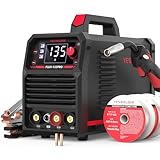


120V MIG welders compared
| Welder | Input and rated output | Duty cycle | Weight | Best fit |
|---|---|---|---|---|
| Hobart Handler 140 | 120V; 25–140A output | 20% at 90A | About 57 lb | Garage repairs and users who prefer a well-established, simple MIG platform |
| Lincoln Electric POWER MIG 140 MP | 120V; up to 140A; MIG, flux-core, DC TIG and stick capabilities | 20% at 90A in MIG mode | About 34 lb | People who want multiple processes in a relatively portable package |
| Forney Easy Weld 140 FC-i | 120V; 30–140A; flux-core only | 30% at 90A | About 19 lb | Budget-conscious, occasional outdoor repairs where shielding gas is inconvenient |
Figures are manufacturer-published specifications and may differ slightly by revision or included accessories. A higher amperage ceiling does not mean a machine can sustain that output continuously. In this group, the Forney is notably light and offers a higher stated duty cycle at 90A, but it is a self-shielded flux-core machine—not a gas MIG welder. The Hobart and Lincoln are better starting points if conventional gas-shielded MIG is central to your work.
Choose by job, not by the biggest number
- For indoor furniture, brackets, and automotive sheet metal: Favor a gas-capable machine with adjustable voltage and wire speed. Gas-shielded solid wire can produce cleaner welds with less spatter, particularly on clean, thin steel.
- For fence repairs, farm equipment, or outdoor work: A flux-core-capable 120V welder is useful because wind does not blow away its shielding gas. Expect more spatter and slag, and clean the joint between passes.
- For a small shed or frequent transport: The 19 lb Forney is easier to carry than the 57 lb Hobart. Check whether the package includes the accessories you need; a light machine still needs a cylinder, helmet, wire, and leads for the full setup.
- For mixed processes: The Lincoln POWER MIG 140 MP adds TIG and stick options. These modes require appropriate torches or accessories and do not turn a 120V input into a 240V-class power source.
- For frequent welding or thicker plate: Step up to 240V. If you regularly need multiple passes, long beads, or reliable penetration on 1/4-inch steel, a 120V welder is likely to become the bottleneck.
Circuit requirements: the garage may be the limiting factor
“Runs on 120V” does not mean every outlet will support the machine at full output. Many 120V welders call for a dedicated 20A branch circuit, while some can run at reduced output on a 15A circuit. Follow the nameplate and manual for the particular model. Avoid sharing the circuit with a compressor, heater, refrigerator, or other high-draw tool: voltage drop or a tripped breaker can interrupt the arc and make weld quality inconsistent.
Use a properly grounded outlet and an extension cord only if the manufacturer permits it. If needed, choose a heavy-gauge cord sized for the length and current; a long, thin cord can reduce voltage at the welder. Do not replace a breaker with a larger one to stop trips. If you are unsure whether a garage circuit is suitable, have a qualified electrician check it.
What thickness can a 120V MIG welder handle?
For ordinary mild steel, treat roughly 1/8 inch as a practical target for a single-pass weld on many 120V machines, not a universal guarantee. Thin sheet—around 18 gauge and lighter—can be welded, but it takes careful heat control to avoid burn-through. Material around 3/16 inch may be possible with joint preparation and multiple passes, depending on the welder, wire, joint design, and circuit. At 1/4 inch, do not assume a small 120V welder will make a dependable structural weld simply because its specification lists a high peak amperage.
Thickness alone does not determine suitability. A butt joint, fillet joint, and lap joint dissipate heat differently; rusty or painted steel also makes sound welds harder. For a thicker joint, a 240V machine offers more usable power and often a better margin for penetration. Do not rely on a DIY weld for a safety-critical trailer, lifting point, vehicle suspension part, or structural repair unless the work is designed and inspected by a qualified professional.
Duty cycle in practical terms
Duty cycle is the portion of a ten-minute period a welder can operate at a stated output before needing to cool. A 20% duty cycle at 90A means about two minutes of welding followed by eight minutes of cooling at that rating. A 30% rating at 90A means about three minutes on and seven minutes off. The rating changes with amperage, so consult the full chart—not just the headline figure.
Short DIY tacks may never reach the limit. Long beads, repeated passes, and thick work can. When a machine’s thermal protection trips, pause and let it cool; repeatedly forcing production can shorten component life. If your projects routinely require more arc-on time than a small machine allows, buying a larger 240V unit is more useful than choosing by peak amperage alone.
Gas MIG or flux-core?
A gas-capable 120v welder mig setup typically uses solid wire and shielding gas, commonly an argon-and-carbon-dioxide blend for mild steel. It is a good choice for cleaner indoor work and thin material, but the cylinder adds cost, storage needs, and setup time. A regulator, suitable hose, and correct polarity are also necessary; confirm the machine’s instructions.
Flux-core wire can work without an external gas cylinder and is more forgiving outdoors, but it produces slag that must be removed and generally more spatter. Some welders support both methods; others, such as the Forney Easy Weld 140 FC-i, are flux-core only. Check polarity requirements when changing wire types. This is one reason a “120v welder mig” search should lead to checking process capability, not just the voltage on the product page.
Buying checklist and ownership costs
- Confirm the input voltage, required breaker, plug type, and recommended circuit in the manual.
- Check the output range and duty-cycle chart at the amperage you will actually use.
- Verify whether the machine supports gas MIG, flux-core, or both—and whether a gas regulator is included.
- Compare weight and handle design with your storage and transport needs.
- Budget for wire, contact tips, nozzles, a suitable helmet, gloves, and—if using gas—a cylinder and regulator.
Contact tips and nozzles are routine wear items. Spatter can obstruct the nozzle, while a worn contact tip can cause erratic wire feeding or an unstable arc. Keep the gun liner clean and replace it if feeding remains inconsistent after checking the drive rolls and wire spool. Store wire dry, keep the work clamp connected to clean metal, and scrape paint or rust from the weld area. These small maintenance habits often matter more than a modest difference in rated amperage.
Bottom line
For a gas-capable general-purpose garage machine, compare the Hobart Handler 140 and Lincoln POWER MIG 140 MP based on portability, process options, and the exact package available. For lightweight, occasional outdoor repairs where flux-core is acceptable, the Forney Easy Weld 140 FC-i is a more portable option. Whichever mig welder 120v you choose, match it to a suitable circuit and realistic steel thickness. If thick material, long welds, or frequent use are routine, a 240V welder is the better tool for the job.