What's inside
- Top 3 Picks
- Quick Comparison
- How We Chose
- 1. MYMORE Western Cowgirl Shirts – Best for Rodeo and Dress-Up
- 2. MZEAZRK Retro Steer Skull Shirts – Best for Graphic Western Style
- 3. OFEEFAN Shirts for Women Boho 3/4 Length Sleeve – Best Budget Western Top
- 4. PRETTYGARDEN Bell Sleeve Ribbed Knit Top – Best for Going Out
- 5. AUTOMET Plaid Flannel Shacket – Best for Layering
- 6. LOTUCY Western Snap Shirt – Best Overall Everyday Western Shirt
- How to Choose
As an Amazon Associate I earn from qualifying purchases. This post may contain affiliate links at no extra cost to you.
The best western shirt for women overall is the LOTUCY Women Western Shirts Cowgirl Button Down Long Sleeve Snap Outfit in brown: a mid-range, snap-front, long-sleeve woven shirt in the classic cowboy cut, and the one that covers the widest range of situations — barn, bar, casual Friday, and light rodeo duty — without a premium price. The best budget pick is the OFEEFAN Boho 3/4-Length Sleeve Western Top, which handles warm-weather, trend-led wear for the least money. The best premium pick, and the one aimed squarely at rodeo weekends, Nashville trips and photo-heavy events, is the MYMORE Women’s Western Cowgirl Nashville Cowboy Rodeo Top Outfit. If you want a layer rather than a base shirt, the AUTOMET plaid flannel shacket is the strongest outer piece in this group; if you’d rather wear a graphic tee than a woven shirt, the MZEAZRK Steer Skull V-neck is the best of that type here. The rest of this guide compares fabric weight classes, snap versus button closures, fit, and embroidery durability across all six, so you can match one to how often you’ll actually wear it.
Our Top Picks
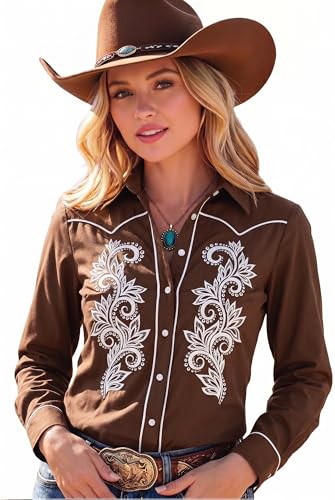 Women Western Shirts Cowgirl Button Down Long SleeveX-Large10 x 10 x 0.7 inches0.3 PoundsCheck on Amazon


Top 3 Picks
Best overall: LOTUCY Women Western Shirts Cowgirl Button Down Long Sleeve Snap
This is the shirt that behaves like a real western shirt: a long-sleeve woven placket shirt in brown with a snap front and a cowboy-cut yoke, which is exactly the combination that survives repeat wear and still looks intentional. It suits the reader who wants one shirt that works with jeans for a Tuesday errand and with boots for a Saturday night, and who doesn’t want to pay a statement-piece price for that. It’s mid-range, so it sits between the trend-led budget tops and the rodeo-specific premium pieces — and for most wardrobes, that middle position is the right one.
Best budget: OFEEFAN Shirts for Women Boho 3/4 Length Sleeve
The OFEEFAN top is the lowest-commitment way into the western-boho look: a 3/4-sleeve casual top positioned for spring and warm-weather styling, which means you’re not paying for heavyweight fabric or heavy hardware. It suits readers building a first western outfit, readers in hot climates where a full-weight twill shirt is unbearable by 11 a.m., and anyone who wants to test whether the silhouette works for them before spending mid-range money. Treat it as a seasonal, trend-forward piece rather than an heirloom, and it does its job well.
Best premium: MYMORE Women’s Western Cowgirl Shirts Nashville Cowboy Rodeo Top Outfit
MYMORE’s Nashville rodeo top is the piece you buy when the occasion is the point — a rodeo, a bachelorette weekend, a country concert, a themed party where people will be taking pictures. Premium pricing here buys decorative detailing and a more styled cut rather than brute durability, so it’s the right choice if you want a shirt that reads as an outfit on its own. If you need one shirt to wear forty times a year, buy the LOTUCY instead; if you need one shirt to look unmistakably western for six specific events, this is it.
Quick Comparison
Every product covered in this guide appears below. Specs are given as spec classes rather than invented measurements — fiber percentages, exact body lengths and hardware sizes vary by size and dye lot, so confirm the current numbers on the listing before you buy. Price tier is relative to the western and western-adjacent tops market as a whole, not to the other five shirts.
| Product | Best for | Key specs (listing-stated / category class) | Price tier |
|---|---|---|---|
| MYMORE Women’s Western Cowgirl Shirts Nashville Cowboy Rodeo Top Outfit | Rodeo, concerts, events, statement dressing | Woven western-style top marketed as an outfit; decorative yoke/detailing typical of Nashville rodeo styling; long sleeve; western placket; styled rather than workwear fit | Premium |
| MZEAZRK Retro Steer Skull Shirts Women V Neck Western Cowgirl Graphic Tees (Brown) | Graphic-tee casual, layering under shackets and open shirts | Knit jersey tee in the 140–180 gsm class; V-neck; printed steer skull graphic; relaxed unisex-leaning fit; brown colorway shown | Mid-range |
| OFEEFAN Shirts for Women Boho 3/4 Length Sleeve Womens Tops | Warm-weather everyday wear, first western purchase | Lightweight soft-hand top; 3/4 sleeve; boho/print-led detailing; relaxed drape; positioned as a casual spring top | Budget |
| PRETTYGARDEN Womens Bell Long Sleeve Ribbed Knit Tops (Beige) | Going out, Y2K styling, petite and cropped fits | Ribbed knit in the 180–260 gsm class; boat neck; bell long sleeve; cropped body; stretch recovery is the defining trait | Budget |
| AUTOMET Shackets for Women Plaid Flannel Shirts (Apricot) | Layering, shoulder seasons, workwear-adjacent outfits | Brushed flannel shirt-jacket (shacket) in the 5–8 oz/yd² class; plaid; button front; oversized layering cut; apricot colorway | Premium |
| LOTUCY Women Western Shirts Cowgirl Button Down Long Sleeve Snap (Brown) | Best overall everyday western shirt | Woven shirting in the 5–7 oz/yd² class; snap placket; long sleeve with western cuff; yoked cowboy cut; classic fit, brown | Mid-range |
Read the table in two passes. First, filter by “best for” — that removes anything whose job doesn’t match yours. Second, check the spec class against your climate and your wash habits: a brushed flannel shacket and a lightweight boho top are not interchangeable in July, and a knit tee will never develop the same patina as a woven twill shirt. Only after both passes does price tier become the deciding column.
How We Chose
Selection here is research-based, not hands-on. We compared currently listed product names, category-standard construction specs, and the well-documented behavior of these fabric and hardware classes, then filtered for four things. First, spec honesty: a shirt earns a place if its stated style class (woven western shirt, knit graphic tee, flannel shacket, ribbed knit top) tells you what you’re getting before you open the package. Second, category fit: each pick has to do a job the others don’t, so the list spans base-layer shirts, graphic tees, knit going-out tops, and outer layers rather than six near-identical snap shirts. Third, use case clarity: every entry is mapped to a real situation — rodeo weekend, hot-weather errand running, layering in a 50°F shoulder season, a night out. Fourth, upgrade path: we asked where each purchase leads. A budget boho top leads to a mid-range woven snap shirt if you keep wearing the look; a premium rodeo piece leads to a second premium piece only if events are actually on your calendar. We did not test, benchmark, or own any of these products, and we don’t report star ratings, review counts, or per-item pricing.
1. MYMORE Western Cowgirl Shirts – Best for Rodeo and Dress-Up
As an Amazon Associate we earn from qualifying purchases at no extra cost to you.

The MYMORE Nashville Cowboy Rodeo Top is the entry in this group that is designed to be looked at. Its listing positions it as a rodeo top and an outfit, which tells you the styling is the product: the cut, the detailing, and the overall read of “I dressed for this” rather than “I grabbed a shirt.” It suits the reader with specific events on the calendar — a rodeo, a country concert, a Nashville trip, a western-themed party, engagement photos — who wants one piece that carries the whole look. It does not suit the reader who wants a single shirt to wear twice a week for three years; that’s a different brief and a different shirt.
Specs and construction class (confirm current details on the listing):
- Style class: women’s western cowgirl top, marketed as a rodeo/Nashville outfit piece
- Fabric class: woven shirting, typically 5–7 oz/yd² in this category; a denser weave is what lets decorative stitching sit flat instead of puckering
- Sleeve: long sleeve with a western-style cuff and placket
- Closure: western front placket — verify whether the current listing ships with snap hardware or sewn buttons, because the two wear and repair differently
- Detailing: decorative yoke and front detailing typical of the Nashville/rodeo look
- Fit: styled and shaped rather than boxy workwear; expect a closer body and a more deliberate shoulder line
- Sizing: women’s letter sizing; check the listing’s own size chart rather than assuming your usual letter size
The strength of this pick is coherence. Budget western tops often mix a cowboy yoke with a cut that reads as a generic blouse, and the result looks like a costume. A piece built for the rodeo aesthetic generally gets the proportions right: a deeper yoke, a longer line through the torso, a sleeve that ends at the wrist bone rather than mid-forearm, and detailing concentrated where the eye lands. If you’re only going to own one “occasion” western shirt, that coherence is worth more than a heavier fabric.
The trade-off is that styled detailing has more failure points than a plain shirt. Decorative stitching, appliqué, contrast trim and embellishment all create small edges that can catch, and dense embroidery placed over a snap or button placket is the single most common place western shirts develop wear — the stitching bridges the placket and flexes every time you fasten it. If your MYMORE arrives with detailing directly over the closure, fasten and unfasten it a few times before your event to confirm nothing pulls. Wash it inside out, cold, and hang it to dry if you want the detailing to stay crisp.
Pros
- Reads unmistakably western without extra styling effort
- Occasion-first design: yoke, sleeve and detailing are coordinated, not assembled
- Long sleeve and full placket make it wearable beyond a single event type
- Premium tier means you’re paying for design decisions, not just fabric weight
Cons
- Premium price for a shirt you may wear a handful of times a year
- Heavier detailing means more snag points and more careful laundering
- Styled fit is less forgiving across body types than a classic boxy western cut
- Marketed as an outfit — confirm exactly what’s included before ordering
Versus the nearest alternative: the LOTUCY snap shirt is the direct comparison, and the split is simple. LOTUCY is the wear-it-constantly shirt: plainer detailing, classic cut, mid-range price, built to be laundered and re-worn. MYMORE is the wear-it-for-the-occasion shirt: more visual payoff per wearing, less value per dollar if you wear it twenty times a year. If your calendar has three western events in it, buy MYMORE. If it has one event and fifty ordinary days, buy LOTUCY and spend the difference on boots.
2. MZEAZRK Retro Steer Skull Shirts – Best for Graphic Western Style

The MZEAZRK Retro Steer Skull shirt is the graphic-tee route into western style, and it’s a genuinely different product category from everything else on this list. It’s a V-neck knit tee with a steer skull print, shown in brown, in a relaxed fit. That makes it the pick for readers who like the western aesthetic but not the western uniform — no placket, no yoke, no pearl snaps, just a print that says where your taste sits. It’s also the most useful layering piece in the group: worn under an open shacket or an unbuttoned flannel, it does the same job a band tee does, but in the right visual language.
Specs and construction class (confirm current details on the listing):
- Style class: women’s V-neck western graphic tee
- Fabric class: knit jersey, typically 140–180 gsm (roughly 4.1–5.3 oz/yd²); lighter than any woven shirt here
- Neckline: V-neck — check the depth against your own preference, since V depth varies widely in this category
- Print: steer skull graphic; print method (screen print, DTG or sublimation) determines how it ages
- Fit: relaxed, straight-body tee cut
- Colorway shown: brown; the listing name references a specific size variant, so confirm both color and size options
Print durability is the whole ballgame with a graphic tee, and it’s the spec nobody puts in a product listing. Screen-printed graphics sit as a layer of ink on top of the fabric and can crack along fold lines if you dry them hot; direct-to-garment prints sit slightly into the fiber and fade more evenly but can look softer from day one; sublimated prints are essentially dyed into polyester and almost never crack, but they don’t work on cotton. The practical rule regardless of method: wash cold, inside out, and skip the dryer. A graphic tee that air-dries will outlast one that goes through a hot cycle by a wide margin — often several times the wear life for the same purchase price.
The other thing to know is that a knit tee is a different fit proposition from a woven western shirt. Knit stretches, so it forgives a slightly-too-small size and shows a slightly-too-large one as drape rather than structure. If you’re between sizes and want a fitted look, size down; if you want the relaxed layering look the print is styled for, stay true to size. And because the fabric is light, this is the piece in the group that actually works in genuine summer heat, where a 6 oz woven twill shirt becomes uncomfortable by mid-morning.
Pros
- Lightest and most breathable option in this comparison
- Western identity without western hardware — no placket, snaps or cuffs to maintain
- Excellent layering piece under shackets, open flannels and denim jackets
- Knit stretch makes sizing more forgiving than woven shirts
Cons
- Printed graphics are the fastest-wearing surface in any wardrobe — heat and friction are the enemies
- No structure: it will never read as a “real” western shirt for a formal or rodeo setting
- V-neck depth is a personal fit variable you can’t fully judge from a listing photo
- Knit jersey shows wear at the underarm and neckline before woven shirts do
Versus the nearest alternative: the OFEEFAN boho top is the other low-structure option, and they split by styling philosophy. OFEEFAN leans soft, drapey and boho, with 3/4 sleeves and a casual spring feel; MZEAZRK leans graphic and retro, with a V-neck and a bolder visual statement. Choose MZEAZRK if you want the print to be the focal point and you plan to layer. Choose OFEEFAN if you want a softer, more feminine everyday top and you’d rather the western reference be subtle.
3. OFEEFAN Shirts for Women Boho 3/4 Length Sleeve – Best Budget Western Top

The OFEEFAN boho 3/4-sleeve top is the entry point. It’s positioned as a casual western-adjacent top for spring and warm weather, with a soft hand, a relaxed drape, and 3/4 sleeves that keep it wearable when full-length woven sleeves would be too warm. It suits three kinds of readers: the one building a first western outfit who doesn’t want to commit mid-range money before knowing whether the look is for them; the one in a hot climate who needs the aesthetic in a fabric weight that survives July; and the one who wants a top that reads western without reading costume.
Specs and construction class (confirm current details on the listing):
- Style class: women’s boho/casual western-adjacent top
- Fabric class: lightweight soft-hand woven or knit blend, the lightest end of the shirt spectrum — think lawn, voile or a light jersey rather than twill
- Sleeve: 3/4 length, which lands between the elbow and the wrist bone and avoids the cuff maintenance of a full sleeve
- Detailing: boho/print-led styling rather than hardware-led western detailing
- Fit: relaxed, drapey, designed to skim rather than shape
- Season positioning: spring and warm-weather casual wear
Lightweight tops are where cost-per-wear math gets interesting, and it usually favors them. A budget-tier top worn weekly through a three-month warm season — call it twelve to fourteen wearings a year — costs very little per wearing even if it only lasts two seasons, because the purchase price is low and the wearing frequency is high. That’s the opposite of the premium rodeo shirt, which might be worn six times a year at a much higher price. Neither is a mistake; they’re just different equations, and it’s worth knowing which one you’re solving before you buy.
The real constraint with a light, budget-tier top is not durability in the abstract but durability in specific places. Expect the first visible wear at the underarm (friction and deodorant), the neckline (stretch and shape loss), and any print or embroidery edge (cracking or fraying). A 3/4 sleeve removes one whole failure point — the cuff — which is genuinely to this top’s advantage if you’re hard on shirt cuffs. Wash it cold, inside out, on a short cycle, and dry it flat or on low. A light top that air-dries keeps its shape far longer than one that tumbles.
One styling note that matters more than it sounds: 3/4 sleeves change the proportion of the whole outfit. They visually shorten the arm and put the emphasis on the forearm and wrist, which is exactly where western accessories live — cuffs, bracelets, a watch, a turquoise cuff. If you own any of those, this sleeve length is an advantage, not a compromise. If you don’t, a full sleeve will read more classic.
Pros
- Lowest price tier here, so it’s the cheapest way to test the western-boho look
- Lightweight fabric works in real heat, where twill and flannel do not
- 3/4 sleeve eliminates the cuff as a wear point and shows wrist accessories well
- Relaxed drape is forgiving across body types and easy to layer
Cons
- Light fabric shows wear at underarms and neckline sooner than woven shirting
- Budget construction means fewer reinforcements at stress points
- Reads boho-casual rather than authentically western — not a rodeo shirt
- Drapey fit gives no structure under a jacket
Versus the nearest alternative: against the PRETTYGARDEN ribbed knit top, the split is fabric behavior rather than style. OFEEFAN’s light woven/soft-hand fabric drapes and skims; PRETTYGARDEN’s ribbed knit grips, stretches and recovers, so it hugs the body and holds its shape through the wash. If you want an easy, floaty top for daytime, OFEEFAN wins. If you want something that stays put, holds its neckline, and works for evening, the ribbed knit is the better engineering choice even though both sit in the budget tier.
4. PRETTYGARDEN Bell Sleeve Ribbed Knit Top – Best for Going Out

The PRETTYGARDEN bell-sleeve ribbed knit top is the night-out option in this group. The listing describes a beige ribbed knit with a boat neck, long bell sleeves and a cropped body, styled around Y2K going-out looks. In practice that means a stretch knit that hugs the torso, a wide neckline that opens up the shoulder, and a sleeve that flares below the elbow and moves when you do. It suits readers who want western-adjacent style in a silhouette that reads modern rather than traditional — the kind of top that works with high-waisted jeans and boots without a single pearl snap in sight.
Specs and construction class (confirm current details on the listing):
- Style class: women’s ribbed knit cropped going-out top, Y2K-leaning
- Fabric class: ribbed knit, typically 180–260 gsm (roughly 5.3–7.7 oz/yd²) — heavier per square yard than jersey, but with stretch
- Neckline: boat neck, a wide horizontal neckline that sits near the collarbone
- Sleeve: long bell sleeve with a flare below the elbow
- Length: cropped body, designed to end near the waistband of high-rise jeans
- Colorway shown: beige, in a mid-range letter size per the listing name
Rib knit is the most underrated fabric class in this whole comparison, and it’s worth understanding why. The ribs are knitted-in vertical channels that let the fabric stretch horizontally and recover — meaning a ribbed top holds its shape through repeated wear in a way that plain jersey does not. That’s why a good rib knit survives fifty wearings without going baggy at the elbows, and why it’s the go-to construction for fitted tops. The trade-off is that rib knit is less breathable per unit weight than a loose woven, and it shows every contour, so it’s a fit-forward fabric.
Boat necks are the specific fit variable to watch here. A boat neck is wide and shallow, which means it sits across the collarbones rather than around the neck. That’s flattering on most frames and it makes shoulders look broader, but it also means the top has less structure to hold itself up — the fabric tension across the chest and back is what keeps it in place. If you’re between sizes in a boat-neck rib knit, sizing down usually keeps the neckline sitting correctly, while sizing up can leave it sliding. Bell sleeves bring their own maintenance reality: a wide flare catches on door handles, chair arms and car doors, and the fabric at the flare edge is where pilling and fraying start. Fold bell sleeves rather than hanging them by the cuff.
Cropped length is a deliberate decision, not a flaw. It’s designed to pair with high-rise bottoms, which is where the Y2K styling lands, and it works because the proportions are consistent — a shorter top over a higher waist. If you prefer mid-rise jeans, this top will leave a gap, and no amount of styling fixes that; buy the OFEEFAN or MZEAZRK instead if you want full-length coverage. If you do wear high-rise, the cropped cut is actually the most flattering of the six for that specific pairing.
Pros
- Rib knit construction holds shape and recovers better than plain jersey
- Boat neck and bell sleeves create a strong, deliberate silhouette
- Cropped cut is proportioned for high-rise denim and western boots
- Budget tier pricing for a fabric class that usually costs more
Cons
- Fitted rib knit shows every contour — unforgiving if you prefer a loose fit
- Bell sleeve flares snag and pill at the edges
- Boat necklines can shift if the size is wrong; sizing is less forgiving than a drapey top
- Cropped length limits styling to high-rise bottoms
Versus the nearest alternative: the comparison is PRETTYGARDEN versus MZEAZRK, both knit, both lighter-weight than the wovens. MZEAZRK is a graphic tee: straight cut, relaxed, print-forward, best layered. PRETTYGARDEN is a shaped knit: fitted, structured by ribbing, best worn as the main event. Pick PRETTYGARDEN when the top is the outfit and you want the neckline and sleeve to do the work; pick MZEAZRK when the top is a canvas for a graphic and a layer underneath something else.
5. AUTOMET Plaid Flannel Shacket – Best for Layering

The AUTOMET plaid flannel shacket is the odd one out in this list and the one most readers will end up wearing the most. A shacket is a shirt-jacket — cut like a shirt, built with the weight and drape of a light jacket — and AUTOMET’s version is a plaid flannel in apricot, button-front, in the oversized layering fit the category is known for. It suits readers in shoulder seasons, readers who want a western-adjacent workwear layer over a tee or a graphic shirt, and readers who like the flannel-and-denim combination but don’t want a full jacket. It’s the piece that makes the other five shirts wearable in more months of the year.
Specs and construction class (confirm current details on the listing):
- Style class: women’s plaid flannel shacket (shirt-jacket)
- Fabric class: brushed flannel, typically 5–8 oz/yd² (roughly 170–270 gsm); the napped surface is what makes it warm relative to its weight
- Closure: button front — the standard for shackets, since buttons flex with the layer underneath
- Cut: oversized layering fit with a longer body and dropped shoulder line
- Pattern: plaid; colorway shown is apricot
- Season positioning: fall through spring layering; wearable as an outer layer in mild weather
Flannel’s key property is the brushed, napped surface, and it drives both its comfort and its maintenance. The nap traps air, which is why a 6 oz flannel feels substantially warmer than a 6 oz flat-woven twill of the same weight. But the same nap is what pills and mats over time, especially at the cuffs, the underarm, and anywhere a bag strap or seatbelt rubs. The single biggest mistake people make with flannel is using fabric softener: softener coats the fibers and collapses the nap, which flattens the fabric and reduces the loft that was the reason to buy it. Skip softener, use a small amount of detergent, wash cold, and dry on low or line dry. Do that and a flannel shacket keeps its hand for years; do the opposite and it goes flat in a season.
Layering math is the other thing to get right, and it’s arithmetic rather than taste. If your base layer is a knit tee in the 150 gsm class and your shacket is a brushed flannel in the 200–250 gsm class, you have a combination that handles roughly the 45–65°F band comfortably. Add a thermal underneath and you extend it down another ten degrees. Try to wear the same shacket over a heavyweight sweatshirt and you’ll compress the flannel, lose the loft, and find the shoulders tight. The oversized cut exists precisely to leave room for one mid-weight layer — not two.
Plaid matching is a small quality signal worth checking on arrival. On a well-made plaid, the pattern lines up across the front placket and at the chest pocket seam. On a cheaper one, it doesn’t. It doesn’t affect durability, but it tells you how much attention the factory paid to the whole garment. Also check that the buttons are anchored through a reinforced placket rather than a single layer of fabric — that’s the first place a shacket fails.
Pros
- Highest warmth-to-weight ratio of anything here because of the brushed nap
- Oversized cut layers cleanly over tees, graphic shirts and light knits
- Button front is easy to repair and flexes with whatever is underneath
- Extends the wearable season of every other shirt in this guide
Cons
- Premium tier for what is fundamentally a casual layer
- Brushed flannel pills at cuffs and underarm; fabric softener destroys the nap
- Oversized fit is genuinely too much fabric if you’re petite or prefer a close cut
- Too warm for real summer wear — it’s a two-to-three-season garment, not year-round
Versus the nearest alternative: the AUTOMET shacket versus the LOTUCY snap shirt is a layering-versus-base-layer decision. The LOTUCY is a shirt you wear against your skin or over a tee in mild weather, with a placket that closes fully and a cut that tucks. The AUTOMET is a layer you wear open over something else, with a cut that’s meant to hang. Buy the LOTUCY if you need one shirt. Buy the AUTOMET if you already have shirts and need something to wear over them. Buy both if you’re building the flannel-over-western-shirt combination that defines the look.
6. LOTUCY Western Snap Shirt – Best Overall Everyday Western Shirt

The LOTUCY Women Western Shirts Cowgirl Button Down Long Sleeve Snap is the best overall pick because it does the boring, essential thing: it’s a real western shirt. Long sleeve, snap placket, button-down front, brown, in the classic cowgirl cut. It suits the reader who wants one shirt that works for errands, work-casual days, dinners, and the occasional rodeo, and who intends to wear it dozens of times a year rather than save it for occasions. It’s mid-range, which is exactly where a shirt that gets washed weekly should sit — expensive enough to have decent fabric and hardware, cheap enough that you don’t baby it.
Specs and construction class (confirm current details on the listing):
- Style class: women’s western cowgirl button-down, snap-front, long sleeve
- Fabric class: woven shirting, typically 5–7 oz/yd² — dense enough to hold a yoke and take embroidery without puckering, light enough to wear indoors
- Closure: snap placket (stated in the listing name), which is the traditional western choice
- Sleeve: long sleeve with a western cuff; check whether the cuff closes with a snap or a button, since that’s a high-wear point
- Cut: yoked western body with a classic fit — straighter through the waist than a fashion blouse
- Colorway: brown, which hides dust, denim transfer and light soiling far better than white or pale blue
Snap closures are the reason to buy this shirt over a button-front alternative, and the advantage is practical rather than aesthetic. Snaps fasten and unfasten one-handed, which matters when you’re getting dressed in a hurry or wearing gloves. They don’t loosen the way thread-sewn buttons do — a button that’s been caught on a seatbelt a hundred times will eventually hang by a thread, while a well-set ring snap either holds or fails completely. And on a western shirt specifically, snaps are part of the visual language: a pearl or metal snap on a yoked placket is what makes the garment read western rather than generic.
The failure mode to know about is snap pull-out. A snap consists of a cap on the face side and a post or ring on the back, crimped together through the fabric. Under enough sideways force — a hard tug, a snag on a fence, a heavy dryer cycle — the crimp can loosen and the whole snap pulls through, leaving a small hole. Two habits prevent almost all of it: fasten the snaps before washing so the placket isn’t flexing open in the drum, and dry on low or line dry so heat doesn’t soften the fabric around the crimp. If a snap does pull, it’s a five-minute repair with a snap-setting tool and a refill pack of the same ligne size — worth keeping on hand, because snap sizes are standardized and refills are cheap.
Brown woven shirting is also the most forgiving fabric-and-color combination in this guide. It doesn’t show the light soiling that comes with real use, it doesn’t yellow the way white does, and it pairs with denim, black, cream, and tan without thought. That’s why it makes sense as the everyday pick: the shirt’s job is to be worn hard and washed often, and this is the combination that tolerates both.
Pros
- Genuine western construction: snap placket, yoke, long sleeve, western cuff
- Mid-range pricing matches the frequency of wear it’s designed for
- Snap closures are faster to use and don’t loosen like sewn buttons
- Brown woven fabric hides everyday soiling and pairs with everything
Cons
- Snaps can pull through the fabric under hard sideways force; keep a repair kit
- Woven fabric has no stretch, so fit is less forgiving than any knit here
- Classic yoked cut is straighter through the waist than a shaped fashion top
- Plain detailing means it won’t stand out at a dressy western event
Versus the nearest alternative: against the MYMORE rodeo top, LOTUCY wins on frequency and value and loses on occasion impact. The MYMORE is designed to be noticed once; the LOTUCY is designed to be worn constantly and blend in while doing it. If you’re buying your first western shirt and you’re not sure how often you’ll wear it, buy the LOTUCY — it’s the safer bet, and it’ll tell you whether the silhouette suits you before you spend premium money on a statement piece. If you already know you love the look and you have events coming, MYMORE is the upgrade.
How to Choose
Choosing a western shirt comes down to four variables that actually change what you should buy: fabric class, closure type, fit, and how the decorative work is attached. Everything else — color, print, trend — is preference. Work through these four in order and the decision mostly makes itself.
Start with fabric class, because it determines everything else
Fabric weight is measured in ounces per square yard (oz/yd²) for wovens and grams per square meter (gsm) for knits. One oz/yd² is roughly 33.9 gsm, so a 150 gsm jersey is about 4.4 oz — that conversion matters because listings mix the two units constantly. Here’s how the classes actually behave:
| Fabric class | Typical weight | Feel and behavior | Best season | First-wash shrinkage | Where it fails first |
|---|---|---|---|---|---|
| Lawn / voile / light soft-hand blends | 2–3.5 oz/yd² (70–120 gsm) | Light, crisp to floaty, creases easily | High summer | 1–3% | Underarm, neckline |
| Chambray / poplin | 3.5–5.5 oz/yd² (120–190 gsm) | Smooth, slight sheen, takes embroidery well | Spring–summer | 1–3% | Collar points, cuffs |
| Western twill / sateen shirting | 5–7 oz/yd² (170–240 gsm) | Dense, structured, holds a yoke | Year-round | 2–4% | Placket edge, elbow |
| Brushed flannel | 5–8 oz/yd² (170–270 gsm) | Napped, warm for its weight, pills | Fall–winter | 3–5% | Cuffs, underarm, strap rub |
| Ribbed knit | 180–260 gsm (5.3–7.7 oz) | Stretchy, shape-holding, contouring | Year-round | 3–5% | Neckline stretch, flare edges |
| Jersey knit (tees) | 140–180 gsm (4.1–5.3 oz) | Soft, drapey, print-friendly | Summer | 2–4% | Print cracks, underarm |
Two practical rules fall out of that table. If you want one shirt for three seasons, buy in the 5–7 oz woven range — it’s the only band that’s genuinely year-round. If you run hot or live somewhere with a real summer, buy a knit or a light woven and accept that it won’t layer under a jacket as cleanly.
Snap versus button: what actually differs
This is the most over-argued question in western shirts, and the honest answer is that both work — they just fail differently and suit different habits.
| Closure | Typical hardware size | How it holds | How it fails | Repair |
|---|---|---|---|---|
| Ring snap (pearl or metal) | 16 ligne ≈ 10 mm cap; 20 ligne ≈ 13 mm cap | Positive click; releases on a firm straight pull | Cap deforms, or the crimp loosens and the snap pulls through the fabric | Snap pliers and a refill
Best Western Shirts for Women: Classic & Modern Affiliate disclosure. As an Amazon Associate we earn from qualifying purchases at no extra cost to you. Prices accurate as of the date shown. Best Western Shirts for Women: Classic & ModernCheck price on Amazon Related guidesMore ways to save on Amazon |