What's inside
As an Amazon Associate I earn from qualifying purchases. This post may contain affiliate links at no extra cost to you.
The best automatic egg turners in 2026 come down to three options depending on your setup: the Brinsea Ovation series for cabinet-style convenience, the Little Giant Automatic Egg Turner for standard still-air incubators, and the Harris Farms Nurture Right 360 for a fully integrated turner-and-incubator combo. Below, we break down how each handles capacity, turning intervals, egg size compatibility, and noise so you can match the right model to your hatch.
As an Amazon Associate we earn from qualifying purchases at no extra cost to you.


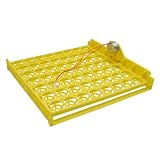
How Automatic Egg Turners Work (and Why Turning Matters)
In nature, a hen rotates her eggs several times a day. That movement prevents the embryo from sticking to the shell membrane and promotes even development of the circulatory system. An automatic turner replicates this by rocking eggs roughly 30–45 degrees every few hours on a motorized rail or cradle.
The practical stakes: hatch rates on unturned eggs commonly drop by 15–30%. A turner removes human error from the three-week routine—no missed evening turnings, no forgetting to mark eggs with an X/O system.
Key Buying Criteria
Egg Capacity and Cradle Compatibility
Ratings are always based on standard chicken eggs. If you hatch duck or goose eggs, count on roughly 60–70% of the listed capacity. If you hatch quail, you’ll need an adapter tray—usually sold separately—that converts each chicken slot into four quail slots.
Turning Interval
Most turners run on a fixed cycle (every 1–4 hours) or use a slow continuous-motion design where the rack creeps back and forth over a set period. Fixed-interval motors are simpler; continuous-motion units produce gentler, more hen-like movement. Either works—the critical thing is that eggs don’t sit in one position for more than 6–8 hours.
Motor Noise
Turners sit inside an insulated box, but budget motors still produce a noticeable hum or click during each cycle. If the incubator lives in a bedroom or classroom, prioritize models with low-RPM gear motors. Noise complaints in this category concentrate almost entirely on off-brand universal turners under about $25.
Cleaning
After every hatch, trays get coated in shell fragments, down, and dried fluids. Dishwasher-safe plastic rails (Brinsea) are the gold standard. Styrofoam-fitted turners can’t be soaked or scrubbed aggressively, so budget replacement foam into your ownership cost.
Top Picks Compared
| Model | Capacity (chicken eggs) | Turning Type | Turning Interval | Egg Size Range | Footprint | Typical Price |
|---|---|---|---|---|---|---|
| Little Giant Automatic Egg Turner | 41 | Rail-rocking | Every ~4 hrs | Bantam to large chicken | ~15″ x 15″ | $45–60 |
| Brinsea Ovation 28 / 56 (integrated) | 28 / 56 | Cradle tilt | Programmable | Quail to duck | Self-contained unit | $300–450 (full incubator) |
| Harris Farms Nurture Right 360 (integrated) | 22 | Rolling cradle | Automatic continuous | Bantam to duck | ~18″ diameter | $120–160 (full incubator) |
| GQF Hova-Bator 1611 Turner | 42 | Rail-rocking | Continuous slow cycle | Bantam to large chicken | ~15″ x 15″ | $50–65 |
| Farm Innovators Model 3200 (integrated) | 41 | Rail-rocking | Every ~4 hrs | Quail to goose (with racks) | ~18″ x 18″ | $90–120 (full incubator) |
Which One Fits Your Situation?
Best for a standard still-air incubator you already own: Little Giant or Hova-Bator 1611
Both drop into foam incubators with a roughly 15-inch square floor. The Little Giant’s motor is slightly quieter; the Hova-Bator’s continuous slow movement is gentler on fragile eggs. Check your incubator’s interior dimensions before buying—an inch too small and the rails bind against the wall.
Best for a first-time hatcher: Harris Farms Nurture Right 360
The integrated design eliminates fit questions entirely. The turner rolls eggs rather than tilting them, handles up to 22 eggs including duck sizes, and the clear dome makes it the most classroom-friendly option. You can’t expand capacity later, but for household-scale hatching that’s rarely a problem.
Best for serious or mixed-species hatching: Brinsea Ovation
Programmable turning intervals, dishwasher-safe trays, and capacity for goose-sized eggs with the correct carriers. It’s the most expensive route, but the cradle system and build quality justify it if you hatch several batches per year.
Best budget full setup: Farm Innovators 3200
An integrated incubator-turner with 41-egg capacity at entry-level pricing. Expect more manual oversight—the temperature regulation and turning reliability are adequate rather than refined.
Decision Matrix
| Your Situation | Recommended Choice |
|---|---|
| Own a foam still-air incubator already | Little Giant or Hova-Bator turner |
| First hatch, kids or classroom involved | Nurture Right 360 |
| Hatching quail or pheasant | Any rail turner + quail rack adapter |
| Duck and goose eggs regularly | Brinsea Ovation or Farm Innovators with large-egg racks |
| Incubator sits in a bedroom | Nurture Right 360 or Brinsea (quietest motors) |
| Batch of 40+ eggs on a tight budget | Farm Innovators 3200 |
Setup and Ownership Realities
- Stop turning on day 18 for chickens (day 25 for ducks, day 28 for geese). Eggs must lie flat for lockdown; a turner that keeps running past this point can cost you hatchlings.
- What wears first: on rail-style turners, the plastic linkage arms and rail clips are the common failure points—usually after 3–5 seasons. Spare racks are cheap and worth buying with the unit.
- Cleaning routine: remove trays, soak in warm soapy water, then disinfect with a diluted bleach or veterinary disinfectant solution. Never submerge the motor housing—wipe it down only.
- Pointed end down: eggs load with the pointed end facing down. Upside-down eggs develop displaced air cells and lower hatch rates.
- Verify the cycle: mark one rail’s position and confirm movement after the stated interval before loading eggs. A dead motor discovered on day 10 of incubation is a lost batch.
FAQ
Can I use an automatic turner for quail eggs?
Yes, with a quail rail adapter that fits four quail eggs per chicken slot. Without it, small eggs tip sideways and don’t rotate properly.
How many times a day should eggs be turned?
A minimum of three times, with odd numbers ensuring eggs don’t rest on the same side two nights in a row. Automatic turners handling the job every 1–4 hours exceed this comfortably.
Will a universal turner fit my incubator?
Measure the interior floor first. Standard rails need about 15″ x 15″ of flat space plus clearance for the motor arm’s travel. Round or compact incubators often can’t accept them at all.
Do I still need to candle eggs if I use a turner?
Yes—turning doesn’t tell you whether eggs are developing. Candle around day 7 and day 14 to remove clears and early quitters before they spoil the batch.