What's inside
- Best Leather Recliners for Living Rooms: Comfort & Style
- Quick picks by living-room situation
- Leather grades: what you are actually paying for
- Frame construction matters more than decorative styling
- Manual versus power reclining
- Measure the room before choosing a chair
- Decision matrix: which specifications deserve priority?
- Ownership realities: what wears first
- Bottom line
- Best Leather Recliners for Living Rooms: Comfort & Style
- Quick picks by living-room situation
- Leather grades: what you are actually paying for
- Frame construction matters more than decorative styling
- Manual versus power reclining
- Measure the room before choosing a chair
- Decision matrix: which specifications deserve priority?
- Ownership realities: what wears first
- Bottom line
As an Amazon Associate I earn from qualifying purchases. This post may contain affiliate links at no extra cost to you.
Best Leather Recliners for Living Rooms: Comfort & Style
The best leather recliners for living rooms are usually medium-to-large power or manual chairs with a kiln-dried hardwood or reinforced steel frame, top-grain or corrected-grain leather on high-contact areas, and at least 8–12 inches of clearance behind or beneath the chair for safe reclining.
The right choice depends less on the label “leather recliner” than on four practical questions: how much space you have, how often the chair will be used, which leather grade suits your budget, and whether the mechanism can handle daily movement. A compact manual recliner may be the best fit for a small apartment, while a wide power recliner makes more sense for frequent evening use in a larger room.
As an Amazon Associate we earn from qualifying purchases at no extra cost to you.

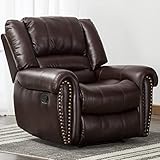


Quick picks by living-room situation
| Situation | Best configuration | Recommended dimensions | Typical market range |
|---|---|---|---|
| Small room or apartment | Wall-hugger manual recliner | 30–34 in wide; 34–40 in deep closed | $500–$1,200 |
| Daily television or reading chair | Power recliner with reinforced frame | 34–40 in wide; 38–44 in deep closed | $900–$2,500 |
| Large family room | Wide leather recliner or matching pair | 38–44 in wide; 40–46 in deep closed | $1,000–$3,000 per chair |
| Traditional or formal decor | Button-tufted or rolled-arm manual recliner | 34–40 in wide; 40–45 in deep closed | $800–$2,200 |
| Frequent use by several people | Power recliner with steel mechanism and 300–350 lb capacity | 36–42 in wide; 40–46 in deep closed | $1,200–$3,500 |
Dimensions vary by manufacturer, so treat these figures as planning ranges rather than guarantees. Always check the chair’s fully open depth, not just the boxed or upright depth.
Leather grades: what you are actually paying for
Full-grain leather
Full-grain leather retains the natural grain and usually develops a visible patina. It can be durable and attractive, but natural markings are normal and the surface may show scratches more readily. It is often the most expensive option, commonly starting around $1,500 for a recliner and rising substantially with premium construction.
Top-grain leather
Top-grain leather has been lightly corrected or sanded to create a more uniform appearance. It offers a useful balance of natural feel, consistency and price. For most living rooms, a well-made top-grain recliner is the best all-round choice, particularly when the seating surfaces, arms and back are clearly identified as leather.
Corrected-grain or protected leather
Corrected-grain leather is more heavily finished to reduce visible imperfections. A protective coating can make it easier to wipe clean, although it may feel less supple than minimally finished leather. This is a sensible choice for households with children, pets or frequent food and drink near the chair.
Bonded leather and leather-match upholstery
Bonded leather contains leather fibers combined with binders, while leather-match furniture typically uses leather on the seat and other touch points with synthetic upholstery on the sides or back. These materials can reduce the purchase price, often to roughly $400–$900, but the coated surface may peel or crack sooner under heat, friction and body oils. Confirm which panels are genuine leather before comparing prices.
Frame construction matters more than decorative styling
A handsome leather cover cannot compensate for a weak frame. Look for kiln-dried hardwood, engineered hardwood reinforced at stress points, or a steel-and-wood frame designed for reclining furniture. Corner blocks, screwed-and-glued joints and a mechanism attached to solid structural members are useful signs of durability.
- Wood frame: Comfortable and quiet when properly braced; quality depends heavily on joinery and drying.
- Steel mechanism: Handles repeated opening and closing well, but must be aligned and lubricated according to the manufacturer’s instructions.
- Suspension: Eight-way hand-tied springs are traditional, while sinuous springs and webbing can also perform well when properly supported.
- Cushion core: High-resilience foam around 1.8–2.5 lb per cubic foot generally offers better long-term support than very soft, low-density foam.
- Load rating: Choose a stated capacity at least 50 lb above the heaviest expected user to allow for movement and repeated loading.
Manual versus power reclining
A manual recliner is mechanically simple, usually less expensive and usable during a power outage. It may require more effort to operate, and the available positions are often limited to upright and one or two reclined settings.
A power recliner provides gradual positioning and is convenient when several people share the chair. Dual-motor models can adjust the footrest and back independently, which is useful for finding a precise sitting angle. The trade-offs are higher cost, greater weight, a nearby electrical connection and more components that may eventually require service.
Power-lift functions should be treated as a separate feature rather than assumed to be part of every power recliner. If you need that configuration, verify the weight rating, motor warranty and required clearance around the chair.
Measure the room before choosing a chair
Begin with the usable floor area, including walking routes. A chair that technically fits may make the room uncomfortable if its footrest blocks a doorway or the reclined back crowds a sofa.
- Measure the chair’s upright width and depth.
- Measure its fully reclined depth and the manufacturer’s wall clearance.
- Leave at least 24–30 inches for the main walking path where possible.
- Allow 12–18 inches between the recliner and a coffee table so the footrest can open.
- Check doorway, hallway and stairwell widths; add protection for corners and packaging.
For example, suppose a recliner is 38 inches wide and needs 12 inches behind it when closed. If its open depth is 68 inches and you want a 16-inch gap before the coffee table, plan for 84 inches from the back wall to the table. A 10-by-12-foot room may accommodate it, but only after accounting for the sofa, walking route and side tables. The calculation prevents the common mistake of planning around the closed depth alone.
Decision matrix: which specifications deserve priority?
| Your priority | Choose | Be cautious about |
|---|---|---|
| Lowest long-term maintenance | Protected top-grain or corrected-grain leather | Unsealed, very pale leather near food areas |
| Smallest footprint | Wall-hugger with 3–6 in wall clearance | Oversized rocker-recliners needing 12 in or more |
| Daily heavy use | Steel mechanism, reinforced frame, 1.8 lb/ft³ or denser foam | Unspecified foam density and vague weight limits |
| Classic decor | Dark brown or oxblood leather, rolled arms, exposed wood feet | Bulky contemporary silhouettes in a tightly edited room |
| Flexible lounging | Dual-motor power control and adjustable headrest | Single-position mechanisms with no replacement-parts policy |
Ownership realities: what wears first
The seat front, arm tops, footrest edge and control area usually show wear before the back. Repeatedly sitting on the footrest, dragging the chair while open, or allowing it to rub against a wall can damage both upholstery and mechanism. Direct sunlight can fade dyed leather, while radiators and heating vents can dry or shrink it.
Dust the chair weekly with a soft, dry cloth. Blot spills immediately with a clean absorbent cloth rather than rubbing. Use only a leather cleaner and conditioner approved for the specific finish, and test it on an inconspicuous area first. Avoid household disinfectants, saddle soap, abrasive wipes and excessive water unless the care instructions expressly permit them.
Inspect the power cord, bolts and exposed mechanism every few months. Stop using the chair if it rocks unusually, makes a new grinding sound, or fails to close evenly. Do not place fingers near moving linkages, and do not exceed the stated capacity. Replacement remotes, motors and power supplies may be available, but availability varies, so ask about parts support before purchasing.
Bottom line
For most living rooms, the best leather recliners for living rooms combine top-grain or well-protected corrected-grain leather, a reinforced wood or steel-supported frame, resilient cushioning and dimensions that leave a real walking path when fully reclined. Choose manual operation when simplicity and price matter most; choose power, preferably with a durable dual-motor mechanism, when the chair will be used every day and precise positioning justifies the extra cost. The best-looking chair is only the right choice after its leather finish, frame, mechanism, capacity and open-room footprint all match the way you live.