Our Top Picks


What's inside
- How to weigh the trade-offs before you buy anything
- 1–2: cutting and driving, $410
- 3–4: surface and profile, $230
- 5: crosscuts, $180
- 6–7: the boring, essential rest, $180
- The mistakes that waste this budget
- Who this build suits, and who should spend differently
- What this shop can build
- What to add at $1,500 and beyond
- FAQ
- How to weigh the trade-offs before you buy anything
- 1–2: cutting and driving, $410
- 3–4: surface and profile, $230
- 5: crosscuts, $180
- 6–7: the boring, essential rest, $180
- The mistakes that waste this budget
- Who this build suits, and who should spend differently
- What this shop can build
- What to add at $1,500 and beyond
- FAQ
As an Amazon Associate I earn from qualifying purchases. This post may contain affiliate links at no extra cost to you.
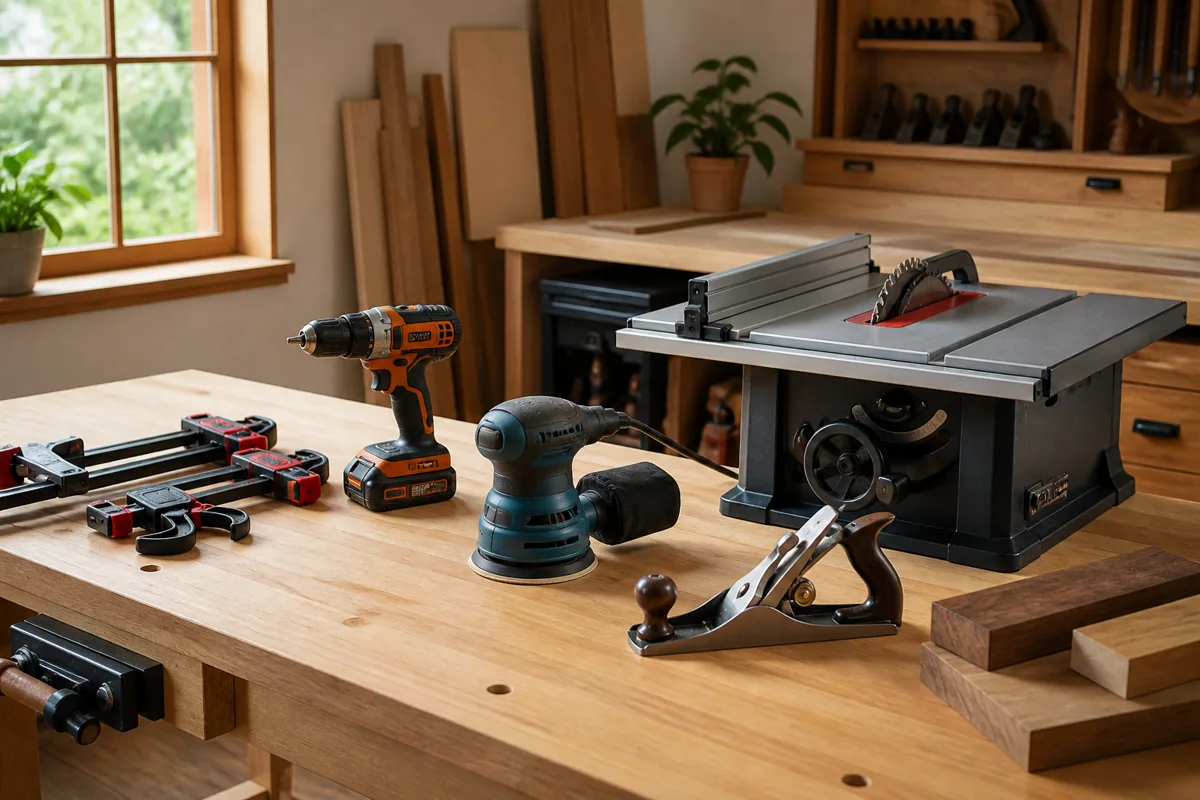
This is the budget where a hobby shop becomes genuinely capable. The allocation below assumes you own nothing and want to build furniture, not just do repairs. That distinction drives every line of it. A repair kit is a drill, a recip saw and a bag of fasteners. A furniture shop has to cut straight, cut square, smooth a surface, shape an edge, and hold a glue joint closed while the glue cures. Four different jobs, and every one of them has to be covered before any of them gets upgraded.
So the list below is ordered by purchase priority, not by price and not by how satisfying the tool is to own. A thousand dollars is enough to do this properly once and not enough to do it twice, which means the real failure mode is spreading the money too thin: seven mediocre tools that each need replacing inside a year. Read the table as an allocation. If you already own a decent drill, that $190 moves down the list, it does not disappear.
As an Amazon Associate we earn from qualifying purchases at no extra cost to you.


![1 na 1 000 000 [Explicit]](https://m.media-amazon.com/images/I/71yULjb1eEL._AC_UY218_.jpg)
| Priority | Item | Budget | |
|---|---|---|---|
| 1 | Brushless drill + impact combo | $190 | |
| 2 | Track saw or circular saw + guide | $220 | |
| 3 | Random orbital sander + discs | $90 | |
| 4 | Compact router + bit set | $140 | |
| 5 | Miter saw (10″ | compound) | $180 |
| 6 | Clamps (8 pieces) | $120 | |
| 7 | Blades, bits, glue, abrasives | $60 |
How to weigh the trade-offs before you buy anything
Every tool at this price point asks you to give something up. These are the three trade-offs worth making the same way every time.
- Accuracy over power. Furniture fails at the joint, not at the motor. A saw that tracks dead straight with a modest motor will build better work than a powerful one with a sloppy base or a fence that flexes. Check flatness, squareness and how solidly the adjustments lock before you look at amps or volts.
- Capacity over features. Lasers, LED work lights and single-speed “soft start” branding cost money that should have gone into the casting, the bearings or the fence. Pay for cut depth, cut width and rigidity.
- Consumables are tools. A sharp blade in a cheap saw outperforms a dull blade in an expensive one. The $60 line at the bottom of the table is not padding; it is what makes the other $940 work.
1–2: cutting and driving, $410
The combo kit and a straight-cutting solution. At this budget a track saw becomes realistic, and in a small shop it beats a table saw for sheet goods.
Buy the drill and impact driver as a two-tool brushless kit, because that purchase is really a decision about which battery platform you will be buying bare tools on for the next five years. Any of the major 18V/20V systems will do. What matters is that you commit, that the kit includes two batteries and a real charger, and that you ignore the six-piece bundles that pad the box with a flashlight and a brushed circular saw you will replace within months. Brushless is worth the premium here for heat and runtime under sustained driving, not for the marketing.
For straight cuts you have two honest options. A track saw gives you a factory edge on plywood with almost no tear-out and takes up no floor space. A good circular saw plus a clamp-on straightedge guide does most of the same work for less, at the cost of setup time and a rougher edge. What separates a good pick from a bad one is the base: a saw with a thin stamped shoe that flexes will wander no matter how careful you are. Skip the track saw only if your work is mostly solid lumber rather than sheet goods.
Track saws
Dead straight cuts in plywood, minimal tear-out, no floor space. The best $220 in a small woodworking shop.
3–4: surface and profile, $230
A random orbital sander decides how your work looks; a compact router decides whether it looks finished or assembled. Both are cheap relative to their impact.
On the sander, the criteria that actually matter are dust extraction, vibration and pad quality. A 5-inch hook-and-loop pad with a port that fits a shop vacuum hose will keep the surface clean, stop discs from clogging, and let you feel what the abrasive is doing. Cheap sanders fail in two ways: the pad brake is missing, so the disc spins up and swirls the surface on contact, and the hooks wear out fast so discs slide and tear. Buy a full grit range in a single brand of disc rather than a bargain assortment; consistent abrasive is what stops sanding scratches from showing up under finish.
The compact router is the highest-leverage purchase in the whole list. It rounds edges, chamfers, trims edge banding flush, cuts hinge mortises and follows a template. Look for smooth micro-adjust height control, a fine-thread depth lock and clear sightlines; get a plunge base in the kit if the budget allows. Carbide bits, not high-speed steel, and always take shallow passes.
Compact router and bit set
Round-over, chamfer, straight and flush trim bits cover nearly everything a furniture maker needs early on.
5: crosscuts, $180
A 10-inch compound miter saw handles furniture-scale crosscuts accurately and repeatably. Add a stop block on a simple bench extension and repeat cuts become trivial.
At this price band, take the non-sliding compound saw over a wobbly slider. A fixed-arm saw with tight bearings and a flat fence will crosscut squarely for years, whereas budget sliders spend their money on rails and give back deflection at the end of the cut. Test the things you cannot fix: fence flatness across both wings, how positively the 45- and 90-degree detents seat, and whether the blade returns to square after you move the bevel. Miter saws are the one tool where the factory blade is almost always the weak point, so treat a fine-finish crosscut blade as part of the purchase.
Compound miter saws
Check the detents and fence flatness. A fine-finish blade upgrade is worth doing immediately.
6–7: the boring, essential rest, $180
Clamps, blades, bits, glue, abrasives. This is the part beginners skip, and it is the difference between a shop that produces good work and one that produces frustration.
Parallel clamps are wonderful and completely out of reach at this budget, so buy quantity in steel bar clamps and F-clamps instead. Eight is a working minimum for one glue-up at a time: it is enough for a small case or a panel, not enough to have two assemblies in the clamps at once. Judge them on how square the jaws stay under pressure and whether the bar twists; a clamp that racks pulls your carcase out of square as you tighten it. Buy one type of yellow wood glue and one spare blade for each saw, and keep them stocked.
Clamp sets
Four 24-inch bar clamps and four F-clamps to start. You will add more within a month.
The mistakes that waste this budget
- Buying two battery platforms. Chasing whichever brand is on sale means duplicate chargers and batteries that fit nothing else. Pick a system and stay in it.
- Spending the clamp money on a seventh power tool. Tools cut parts; clamps make furniture. An unclamped glue-up is a pile of parts.
- Buying a cheap benchtop table saw anyway. A saw with a flexing fence and an underpowered motor is worse than no table saw at all, and it eats the router or miter saw line.
- Skipping grits when sanding. Jumping from 80 to 220 leaves scratches that only appear once finish goes on.
- Ignoring dust. A shop vacuum and a decent respirator are not glamorous, but sanding and routing indoors without them is the fastest way to stop enjoying the hobby.
Who this build suits, and who should spend differently
This allocation suits someone working in a garage, basement or single-car space who wants to build cabinets, casework and tables from plywood and dimensional lumber, and who values portability and storage as much as capability. It also suits anyone who is not yet certain which direction their woodworking will go, because every tool here stays useful no matter what you specialise in later.
Skip it if you already know you want to work primarily in rough-sawn hardwood: your money is better spent on milling capability and hand tools than on a track saw. Skip it too if your real need is home repair rather than furniture, in which case a recip saw and an oscillating multi-tool matter far more than a router.
What this shop can build
Bookcases, cabinets, tables, bed frames, built-in storage, workbenches, cutting boards, floating shelves — essentially all flat-panel and frame furniture.
What it cannot do easily is mill its own lumber flat and square, cut precise repeated joinery in thick stock, or resaw. Those are the gaps the next thousand dollars closes, which is why the upgrade list below reads the way it does.
What to add at $1,500 and beyond
- ✔ A jobsite table saw with a rack-and-pinion fence
- ✔ A benchtop planer for milling your own stock
- ✔ Dust collection and an air filter
- ✔ A drill press
- ✔ More clamps, always
FAQ
No table saw? Correct, deliberately. A track saw plus a miter saw covers more, in less space, at this budget. The table saws available for what a track saw costs are not accurate enough to build furniture on, and they consume floor space you probably do not have.
Corded or cordless? Cordless for the drill, driver and sander; either for the saws. Corded stretches the budget further. If you go corded on the miter saw and circular saw, put the savings into clamps and better blades rather than a bigger tool.
Should I buy used? Used bare tools and older machines are excellent value. Avoid used batteries. Check that a used saw returns to square, that the arbor has no play and that guards and fences are intact, since replacement parts often cost more than the discount.
What is missing from this list? Measuring and marking, and a flat surface to work on. A combination square, a tape, a marking knife and a pencil are cheap, and a hollow-core door on sawhorses is a serviceable first bench. Budget for them outside the tool money.
Price the shop →