What's inside
- What Is a 1/4-Inch Drill Bit in Millimeters?
- Is a 1/4-Inch Drill Bit the Same as a 6 mm Bit?
- How to Convert Drill Bit Sizes From Inches to Millimeters
- Choosing the Right 1/4-Inch Drill Bit for Your Material
- Drill Bit Diameter vs. Shank Diameter
- How to Check Whether Your Drill Bit Measures 1/4 Inch
- Common Mistakes When Converting 1/4-Inch Drill Bit Sizes
- Frequently Asked Questions
- Final Verdict
As an Amazon Associate I earn from qualifying purchases. This post may contain affiliate links at no extra cost to you.
A 1/4-inch drill bit measures 6.35 mm in diameter. This is the exact conversion using 25.4 millimeters per inch. Although a 6 mm metric drill bit is close in size, it is 0.35 mm smaller and may not produce the required hole diameter for precision work, fastener installation, or applications with strict dimensional requirements.
If you are converting an imperial drill bit size to metric, replacing a missing bit, or following a project plan that lists measurements in millimeters, understanding the difference between nominal sizes and actual dimensions helps prevent incorrectly sized holes. You should also consider the workpiece material, the required hole type, and the drill bit’s cutting design before selecting a replacement.
What Is a 1/4-Inch Drill Bit in Millimeters?
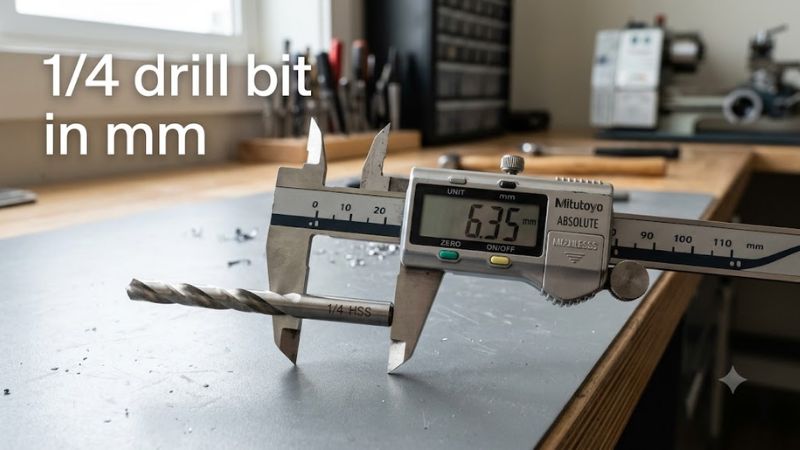
A standard 1/4-inch drill bit has a nominal cutting diameter of 6.35 mm. The conversion is straightforward because one inch equals exactly 25.4 mm.
The calculation is:
6.35 mm = 0.25 inches × 25.4 mm per inch
The measurement refers to the diameter of the cutting portion, not necessarily the shank that fits into the drill chuck. A drill bit can have a 1/4-inch cutting diameter and a different shank diameter, depending on its design.
For ordinary drilling, the nominal diameter is usually the measurement you need when choosing a bit. However, the finished hole may differ slightly from the nominal diameter because of the material, cutting geometry, tool condition, runout, and drilling technique.
1/4-Inch Drill Bit Conversion Table
The following table compares common fractional-inch drill bit sizes with their metric equivalents.
| Fractional drill bit size | Decimal inches | Exact metric equivalent |
| 1/16 inch | 0.0625 | 1.5875 mm |
| 3/32 inch | 0.09375 | 2.38125 mm |
| 1/8 inch | 0.125 | 3.175 mm |
| 5/32 inch | 0.15625 | 3.96875 mm |
| 3/16 inch | 0.1875 | 4.7625 mm |
| 7/32 inch | 0.21875 | 5.55625 mm |
| 1/4 inch | 0.2500 | 6.35 mm |
| 9/32 inch | 0.28125 | 7.14375 mm |
| 5/16 inch | 0.3125 | 7.9375 mm |
| 11/32 inch | 0.34375 | 8.73125 mm |
| 3/8 inch | 0.375 | 9.525 mm |
| 7/16 inch | 0.4375 | 11.1125 mm |
| 1/2 inch | 0.5000 | 12.7 mm |
These values are mathematical conversions, not guarantees of the finished hole diameter. Actual drill bit dimensions can be affected by manufacturing tolerances and wear.
Is a 1/4-Inch Drill Bit the Same as a 6 mm Bit?
No. A 1/4-inch drill bit measures 6.35 mm, whereas a 6 mm drill bit measures 6.00 mm. The difference is 0.35 mm in diameter.
That difference may seem small, but it can matter when drilling holes for bolts, dowels, fittings, or components that must fit within a specified tolerance.
| Measurement | 1/4-inch bit | 6 mm bit |
| Nominal diameter | 6.35 mm | 6.00 mm |
| Diameter in inches | 0.2500 in | Approximately 0.2362 in |
| Diameter difference | 0.35 mm larger | 0.35 mm smaller |
| Best choice when the specification requires 1/4 inch | Yes, assuming the correct bit type and tolerance | Only if a smaller hole is acceptable |
When Can You Substitute a 6 mm Bit?
A 6 mm bit may be suitable when the project allows a slightly smaller hole and the fit remains acceptable. For example, some rough woodworking tasks may tolerate a small difference, depending on the fastener and the required clearance.
However, a 6 mm bit is not an exact substitute when a drawing, manufacturer instruction, or machining specification requires a 1/4-inch hole. A smaller hole can prevent a component from fitting, increase the effort required to insert a fastener, or require additional finishing.
For precision applications, consult the relevant engineering drawing, fastener specification, or manufacturer’s instructions instead of choosing the closest metric measurement automatically.
How to Convert Drill Bit Sizes From Inches to Millimeters
You can convert any fractional or decimal inch measurement into millimeters using a simple formula.
Formula:
Millimeters = Inches × 25.4
Follow these steps:
- Convert the fraction into a decimal. For 1/4 inch, divide 1 by 4 to obtain 0.25.
- Multiply the decimal measurement by 25.4.
- Record the result in millimeters.
- Round only when the application permits it.
For example:
- 1/8 inch × 25.4 = 3.175 mm.
- 3/16 inch × 25.4 = 4.7625 mm.
- 1/4 inch × 25.4 = 6.35 mm.
- 3/8 inch × 25.4 = 9.525 mm.
- 1/2 inch × 25.4 = 12.7 mm.
For general reference, 6.35 mm may be rounded to 6.4 mm. However, do not treat the rounded value as a different standardized drill bit size or assume that rounding is appropriate for precision work.
Choosing the Right 1/4-Inch Drill Bit for Your Material
The correct diameter is only one part of choosing a drill bit. Cutting geometry, bit material, shank design, and compatibility with the drill all affect whether the accessory suits the job.
1. Drilling Wood
For wood, a 1/4-inch twist bit can handle many general-purpose drilling tasks when its design and rating are suitable for the material. A brad-point bit may be preferable when accurate positioning and a cleaner entry hole are important.
For a through-hole, support the workpiece where practical to reduce splintering as the bit exits. When appearance matters, drilling from both sides or using a suitable backing board can help improve the exit edge.
The appropriate bit also depends on the wood. Softwood, hardwood, plywood, and composite panels can behave differently during drilling. Use controlled pressure, secure the workpiece, and avoid forcing a bit that is binding or overheating.
2. Drilling Metal
A 1/4-inch bit intended for metal may be made from high-speed steel (HSS), cobalt-alloy steel, or another material suited to the workpiece.
For general metalworking, select a bit that is explicitly rated for the metal being drilled. Harder alloys and stainless steel can require different cutting conditions from mild steel or aluminum.
Follow the bit manufacturer’s recommendations for rotational speed, lubrication, and feed pressure. Secure metal firmly before drilling, remove chips safely, and allow hot workpieces and accessories to cool before handling them.
Do not assume that a cobalt bit is automatically suitable for every metal or that a harder bit eliminates the need for correct drilling technique.
3. Drilling Masonry
For brick, concrete, and other masonry materials, choose a 1/4-inch masonry bit designed for the intended material and drilling method.
Some masonry bits are suitable for rotary drilling, while others are rated for use with a hammer drill or rotary hammer. Check the accessory specifications and the tool manual before engaging hammer mode.
Masonry drilling can generate substantial dust and debris. Use appropriate eye protection and dust controls, and check for concealed electrical wiring, plumbing, or other services before drilling into a wall.
A general-purpose wood or metal bit should not be treated as a substitute for a properly rated masonry accessory.
4. Drilling Plastic
A 1/4-inch bit may be appropriate for certain plastics when its geometry and the material manufacturer’s guidance support its use. However, some plastics can crack, melt, or deform if the bit overheats or the workpiece is poorly supported.
Use controlled drilling pressure, secure the material, and avoid excessive heat. For brittle or thin plastic, consider whether a specialized bit or another hole-making method is more appropriate.
Because plastics vary considerably, there is no single speed or technique that is correct for every plastic material.
Drill Bit Diameter vs. Shank Diameter
One common source of confusion is the difference between a bit’s cutting diameter and its shank diameter.
The cutting diameter determines the nominal hole size. The shank diameter describes the portion held by the drill chuck or collet.
A 1/4-inch drill bit may have a 1/4-inch shank, but this is not universal. Some larger bits use reduced shanks, and some specialized accessories use different mounting systems.
Before buying or installing a replacement bit, check both dimensions. The shank must fit the tool’s chuck or collet correctly, and the accessory must be rated for the intended application.
A compatible chuck alone does not establish that the bit is suitable for a particular material or drilling operation.
How to Check Whether Your Drill Bit Measures 1/4 Inch
If the bit is unmarked or you are unsure whether it is metric or imperial, you can check its diameter with a suitable measuring tool.
- Disconnect the drill from its power source or remove its battery before handling the bit.
- Clean dirt, resin, and metal debris from the cutting portion.
- Use a caliper to measure across the widest part of the cutting diameter, avoiding the flutes where possible.
- Compare the result with the expected nominal diameter of 6.35 mm.
- If accurate sizing is important, account for measurement uncertainty and the bit’s specified manufacturing tolerance.
A drill bit gauge can also help identify standard fractional and metric sizes. If the cutting edges are worn or damaged, the measured diameter may not represent the original nominal size.
Do not measure a rotating bit, and never attempt to check its diameter while it is installed in an operating drill.
Common Mistakes When Converting 1/4-Inch Drill Bit Sizes
Assuming 6 mm and 1/4 Inch Are Identical
The most common mistake is treating the two measurements as interchangeable because they are close. The difference is 0.35 mm, which may affect fit and clearance.
Confusing the Bit Diameter With the Shank
A 1/4-inch cutting diameter does not guarantee a 1/4-inch shank. Check the mounting dimensions before inserting the bit into a drill or collet.
Choosing a Bit Based on Diameter Alone
Two bits with the same nominal diameter may be designed for different materials. A wood bit, metal bit, and masonry bit are not automatically interchangeable.
Rounding Measurements Too Early
Rounding 6.35 mm to 6 mm changes the nominal diameter rather than simply expressing the same value in fewer decimal places. Keep the exact conversion until you know what precision the application requires.
Ignoring the Required Hole Fit
The correct bit size depends on whether you need a clearance hole, pilot hole, tapped hole, or another type of opening. A 1/4-inch drill bit does not automatically produce the correct hole for every 1/4-inch fastener.
Frequently Asked Questions
What is a 1/4 drill bit in mm?
A 1/4-inch drill bit has a nominal diameter of 6.35 mm, calculated by multiplying 0.25 inches by 25.4.
Is a 1/4-inch drill bit bigger than a 6 mm drill bit?
Yes, a 1/4-inch bit is 0.35 mm larger in diameter than a 6 mm bit, so the two sizes are not identical.
What size hole does a 1/4-inch drill bit make?
A 1/4-inch drill bit is intended to make a nominal hole approximately 6.35 mm in diameter, but the actual hole can vary with the material, bit condition, tool runout, and drilling method.
Can I use a 1/4-inch drill bit in a 6 mm chuck?
Not necessarily; compatibility depends on the chuck’s supported clamping range and design. Check the drill manufacturer’s specifications and ensure the bit is held securely before operating the tool.
Final Verdict
A 1/4-inch drill bit measures 6.35 mm, making it slightly larger than a 6 mm metric bit. Use the exact conversion when following plans or specifications, and choose the appropriate bit design for wood, metal, masonry, or plastic.
For the best fit, verify the required hole diameter, cutting and shank dimensions, accessory compatibility, and material-specific instructions before drilling. This simple check can help prevent undersized holes, poorly fitting fasteners, and avoidable damage to the workpiece.
Related guides
- Black and Decker Jigsaw Blades: How to Choose the Right Blade
- Drill Bit for Ceramic Tile: How to Choose the Right Bit and Drill Without Cracking the Tile
- BLACK+DECKER Mouse Sander Pads: Sizes, Grits, Compatibility, and Replacement
- Best Drill Bits for Stainless Steel: 5 Top Picks for Home and Workshop Use