What's inside
- RYOBI 18V battery and charger: Key specifications
- Price and value: Is the PSK005 worth $99?
- Battery compatibility: Which RYOBI tools work with it?
- Charging performance and battery care
- Advantages and disadvantages
- Who should buy the RYOBI 18V battery and charger kit?
- Frequently asked questions
- Final verdict
As an Amazon Associate I earn from qualifying purchases. This post may contain affiliate links at no extra cost to you.
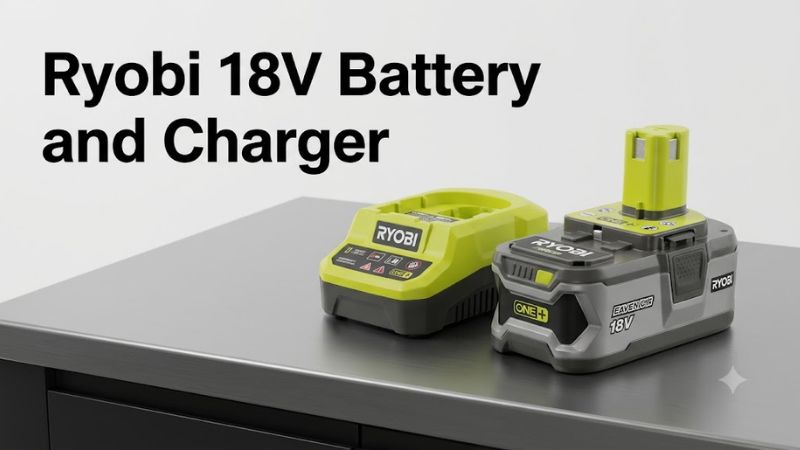
The RYOBI 18V ONE+ battery and charger kit is a practical starting point for DIYers who own compatible RYOBI cordless tools but need a battery and charger. The right choice depends on how much runtime you need, which tools you use, and whether a compact 2.0Ah battery or a higher-capacity option offers better value.
For this review, the primary model is the RYOBI ONE+ PSK005 18V 2.0Ah Lithium-Ion Battery and Charger Starter Kit, which includes a PBP006 battery and PCG002 charger. RYOBI lists the kit at $99 in the US as of October 22, 2026. The price can change, so treat it as a reference rather than a guaranteed checkout price.
Verdict: The PSK005 is worth considering for light DIY work, occasional repairs, and adding a compact battery to an existing ONE+ collection. If you regularly use a circular saw, grinder, or another power-hungry tool, compare it with a higher-capacity battery kit before buying.
RYOBI 18V battery and charger: Key specifications
Research date: October 22, 2026 · US market
The PSK005 is a starter kit rather than a complete power-tool set. Its purpose is to provide a rechargeable battery and compatible charger for tools in the RYOBI 18V ONE+ family.
| Specification | Verified detail |
| Kit model | PSK005 |
| Battery model | PBP006 |
| Battery chemistry | Lithium-ion |
| Nominal voltage | 18V |
| Capacity | 2.0Ah |
| Charger model | PCG002 |
| Charger indicator | LED charging-status light |
| Charger cord | 6 ft |
| Battery charge indicator | Integrated LED fuel gauge |
| Listed kit price | $99 |
| Manufacturer warranty | 3 years, subject to applicable terms |
| Included items | One battery, one charger, operator’s manual |
Specifications and package contents are based on the manufacturer’s product information and the US retailer’s listing. Confirm the package and warranty terms for the specific unit before purchasing.
What does 2.0Ah mean?
Amp-hours (Ah) describe a battery’s charge capacity. A 2.0Ah battery stores less energy than a 4.0Ah battery of the same nominal voltage, so it will generally run a comparable tool for less time under similar conditions.
A rough nominal-energy calculation is:
- 18V × 2.0Ah = approximately 36Wh.
- 18V × 4.0Ah = approximately 72Wh.
These are calculated nominal energy figures, not guarantees of usable energy or runtime. Actual runtime depends on the tool, material, workload, temperature, battery condition, and operating pattern.
Price and value: Is the PSK005 worth $99?
RYOBI lists the PSK005 at $99, while the standard PCG002 charger is listed separately at $34.97. Buying the kit can make sense if you need both components, but its value should be compared with the available higher-capacity kits.
The following prices are US reference listings observed on October 22, 2026.
| Option | Battery capacity | Listed price | Value assessment |
| PSK005 starter kit | 2.0Ah | $99 | Best suited to light-duty use and compactness |
| PSK014 starter kit | 4.0Ah | $129 | More attractive for frequent use if available at this price |
| PCG002 charger alone | Not included | $34.97 | Useful if you already own a compatible battery |
The PSK014 is a separate RYOBI ONE+ 18V starter kit with a 4.0Ah battery and fast charger. RYOBI advertises longer runtime, up to 30% more power from its High Performance battery compared with standard lithium batteries, and faster charging for this kit. Those are manufacturer claims, not independently measured results for every tool.
The PSK004 is another 4.0Ah High Performance kit, but RYOBI identifies that model as discontinued. It should not be treated as the preferred current purchase when a newer kit is available.
Value verdict: If the PSK005 costs $99 and the PSK014 is available for $129, the $30 difference makes the 4.0Ah kit worth serious consideration. You get twice the nominal battery capacity and a charger designed for faster charging. Choose the 2.0Ah version when lower weight and compact size matter more than runtime.
Prices and availability can change by retailer, location, and promotion. Confirm the exact model and included accessories before paying.
Battery compatibility: Which RYOBI tools work with it?
The PSK005 belongs to RYOBI’s 18V ONE+ battery platform. RYOBI states that its 18V ONE+ batteries work across the 18V ONE+ tool family, which includes many drills, impact drivers, saws, sanders, and other cordless tools.
However, do not assume that every RYOBI product uses this platform.
Compatible tool categories
The 18V ONE+ battery family includes tools such as:
- Cordless drills and impact drivers.
- Circular saws and jigsaws.
- Sanders and other woodworking tools.
- Select grinders and rotary hammers.
- Workshop lights, fans, and other compatible equipment.
Compatibility with a tool category does not confirm that a specific model is supported. Check the tool’s model number and manual, particularly for older tools and specialized equipment.
What about RYOBI 40V tools?
The PSK005 is not a replacement for a RYOBI 40V battery. The 18V ONE+ and 40V systems are different battery platforms, and physical fit should never be used as the only test of electrical compatibility.
Do not use improvised adapters or modify battery terminals to make incompatible systems fit.
Can you use a larger-capacity 18V battery?
Many RYOBI 18V ONE+ tools accept compatible batteries with different amp-hour ratings. A higher-capacity battery can provide longer runtime, but the exact tool’s instructions remain the authority on compatibility and operating restrictions.
For demanding applications, check whether a compatible High Performance battery offers additional power benefits with the particular tool. Do not assume that increasing battery capacity automatically increases tool output by a proportional amount.
Charging performance and battery care
The included PCG002 charger has a charging-status indicator and a six-foot power cord. RYOBI advertises charging a 1.5Ah battery in as little as 45 minutes. That figure should not be interpreted as the charging time for the included 2.0Ah battery: battery capacity and charging conditions differ.
The manufacturer does not establish one universal charging time for every battery condition and operating environment.
Practical charging advice
- Use the correct charger. Confirm that the charger is intended for the battery model and follow both manuals.
- Inspect the battery first. Do not charge a swollen, cracked, leaking, or otherwise damaged battery.
- Use an appropriate location. Follow the specified temperature and ventilation requirements, away from heat sources and combustible materials.
- Monitor the indicator. Use the charger’s LED to determine charging status according to its manual.
- Store the battery carefully. Protect the terminals from metal objects, moisture, physical damage, and accidental short circuits.
Lithium-ion batteries contain stored energy even when disconnected from a tool. Never open, crush, puncture, burn, or attempt to repair a damaged battery pack. If a battery becomes unusually hot, smokes, or shows signs of thermal failure, keep away and follow local emergency guidance.
Advantages and disadvantages
Advantages
- Broad ecosystem compatibility: The 18V ONE+ platform supports a wide range of compatible cordless tools.
- Compact capacity: A 2.0Ah battery is a reasonable choice when minimizing battery size and weight is important.
- Convenient charging: The included PCG002 charger means you do not need to purchase a separate compatible charger.
- Simple charge monitoring: The battery fuel gauge and charger indicator help you check battery status.
- Straightforward entry point: The kit can be useful when adding a first battery to an existing compatible tool or expanding a small collection.
Disadvantages
- Limited capacity for sustained workloads: A 2.0Ah pack may require more frequent charging when running demanding tools.
- Price competition: At $99, the kit is less compelling when a higher-capacity starter kit is available for a relatively small additional cost.
- No tool included: The kit does not provide a drill, saw, or other cordless tool.
- Charging time varies: The manufacturer’s 45-minute claim applies to a 1.5Ah battery under stated conditions, not every battery in the product family.
- Platform restriction: It does not replace batteries from RYOBI’s separate 40V family or other manufacturers’ battery systems.
Who should buy the RYOBI 18V battery and charger kit?
The PSK005 makes the most sense for someone who needs a compact battery for lighter tasks, already owns compatible ONE+ tools, or wants a spare battery for occasional household projects.
| Your situation | Recommendation |
| You use a drill for occasional repairs | The PSK005 is worth considering |
| You need a light battery for overhead work | The 2.0Ah capacity may be a good fit |
| You regularly use saws or grinders | Compare 4.0Ah options first |
| You work for long periods without charging breaks | Prioritize higher capacity and consider a spare battery |
| You already own a compatible charger | Compare the cost of a battery-only purchase |
| You own RYOBI 40V tools only | Buy a compatible 40V battery instead |
Alternatives worth considering
RYOBI PSK014 4.0Ah starter kit: This is the stronger value candidate when you need longer runtime and the listed $129 price is available. Its higher-capacity battery is more suitable for many sustained workloads than a 2.0Ah pack, although actual results vary by tool.
RYOBI PCG002 charger alone: If you already have a suitable battery and only need a replacement charger, buying the charger separately may avoid unnecessary spending.
A battery-only 18V ONE+ option: Existing ONE+ owners should compare battery-only pricing against starter-kit pricing. A kit is not automatically the best value if the charger would sit unused.
Frequently asked questions
1. Is the RYOBI 18V 2.0Ah battery good enough for power tools?
Yes, a 2.0Ah RYOBI ONE+ battery can suit compatible drills, impact drivers, lights, and other tools for appropriate workloads. Runtime will generally be shorter than with a higher-capacity battery, especially in demanding applications.
2. How long does it take to charge a RYOBI 18V battery?
Charging time depends on battery capacity, charger model, battery temperature, and its state of charge. RYOBI advertises as little as 45 minutes for a 1.5Ah battery with the PCG002 charger, but that figure should not be applied directly to the included 2.0Ah battery.
3. Can a RYOBI 18V battery fit every RYOBI cordless tool?
No. RYOBI 18V ONE+ batteries are designed for compatible tools within the 18V ONE+ platform, not every cordless tool sold by RYOBI. Check the exact tool model and manual before purchasing or charging a battery.
4. Is a RYOBI 4.0Ah battery better than a 2.0Ah battery?
A 4.0Ah battery generally offers longer runtime than a 2.0Ah battery under comparable conditions, but it may be larger or heavier. The best choice depends on the tool, workload, and whether compactness or fewer charging breaks is more important.
Final verdict
The RYOBI 18V ONE+ PSK005 battery and charger kit is a sensible option for light DIY tasks and existing ONE+ owners who need a compact battery with a charger included. Its broad platform compatibility and straightforward charging features make it practical, but the 2.0Ah capacity limits its appeal for sustained, demanding work.
At the listed US price of $99, it is worth buying when compactness is a priority or when a suitable promotion improves its value. If the PSK014 4.0Ah starter kit is available at $129, the higher-capacity option is likely the better overall purchase for frequent tool use.
Before buying, verify the kit model, included battery and charger, current price, and compatibility with your exact tool. That simple check can prevent an unnecessary purchase.