
What's inside
As an Amazon Associate I earn from qualifying purchases. This post may contain affiliate links at no extra cost to you.
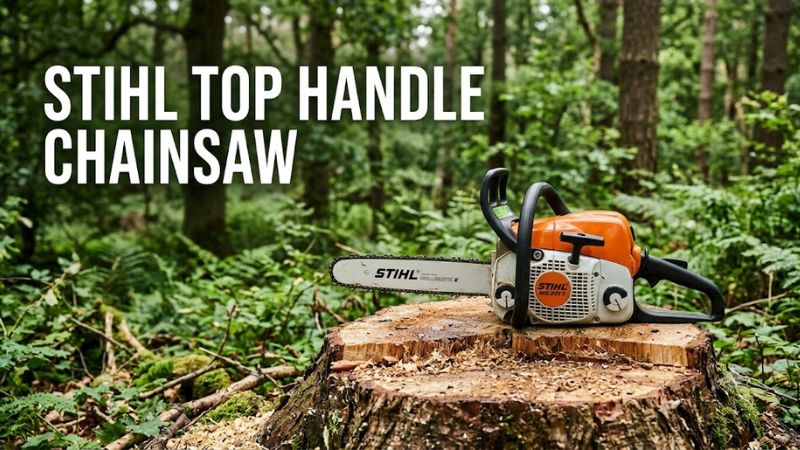
A STIHL top handle chainsaw is designed primarily for trained arborists and tree-care professionals who need a compact saw for specialized work in trees. Unlike a conventional rear-handle chainsaw, it places the rear handgrip above the engine, creating a compact design suited to certain aerial cutting tasks.
STIHL offers gasoline and battery-powered top-handle chainsaws. The right option depends on the cutting workload, power requirements, battery availability, maintenance preferences, and operator training.
A top-handle chainsaw is specialized professional equipment, not simply a smaller chainsaw for homeowners. If you need a saw for pruning from the ground, cutting firewood, or general property maintenance, a suitable rear-handle chainsaw is generally the better starting point.
What Is a STIHL Top Handle Chainsaw?
A top-handle chainsaw has its rear handle positioned above the powerhead rather than extending behind it. This arrangement creates a compact profile for specific cutting tasks performed by trained arborists.
Common applications include:
- Removing selected branches during professional tree maintenance.
- Performing controlled cuts during specialized aerial tree-care operations.
- Carrying out pruning and crown-maintenance work when the saw and working position are appropriate.
- Completing tree-service jobs where compact equipment is beneficial.
The compact design does not make the saw inherently safer or easier for inexperienced operators. STIHL warns about the increased injury risks associated with its specialized design and reactive forces. Training, appropriate work positioning, and compliance with the exact model’s instruction manual are essential.
STIHL Top Handle Chainsaw Models: Gas vs. Battery
The main decision is whether a gasoline engine or battery-powered saw better suits your professional workload. STIHL’s lineup includes lightweight gasoline options, higher-powered gasoline models, and battery-powered equipment for crews that prefer cordless operation.
The following models illustrate different choices. They are not a performance ranking, and specifications should be checked against the exact model and configuration available in your market.
| Model | Power source | Published specifications | Best suited to |
| MS 151 T C-E | Gasoline | 23.6 cc; 1.5 bhp | Lightweight, specialized tree-care work |
| MS 194 T | Gasoline | 31.8 cc; 1.9 bhp | General professional arborist work |
| MS 201 T C-M | Gasoline | 35.2 cc; 2.4 bhp | More demanding professional cutting |
| MSA 220 TC-O | Battery | 36 V rated voltage; 2.10 kW power consumption | Professional tree care where battery power is preferred |
Specifications are manufacturer-published figures. Gas-engine output and battery power consumption are different measurements and cannot be compared directly as equivalent cutting performance.
1. STIHL MS 151 T C-E: A Lightweight Gas Option
The MS 151 T C-E is a compact gasoline-powered arborist saw designed for professional in-tree use. Its published specifications include a 23.6 cc engine producing 1.5 bhp and a powerhead weight of approximately 5.7 lb (2.6 kg), excluding the guide bar and chain.
Why consider it: Its low powerhead weight can be valuable when a qualified arborist needs a compact saw for appropriate light-duty cutting tasks.
Limitations: It is not a replacement for a larger saw in every situation. Confirm the permitted guide-bar and chain combinations in the model-specific manual before purchase.
2. STIHL MS 194 T: A Versatile Gasoline Arborist Saw
The MS 194 T has a 31.8 cc engine producing 1.9 bhp, with a published powerhead weight of approximately 7.3 lb (3.3 kg), excluding the guide bar and chain. A 16-inch configuration is listed in STIHL’s U.S. product information, but approved cutting attachments depend on the exact version.
Why consider it: It provides more engine displacement and rated power than the MS 151 T C-E for professional workloads that warrant the additional capacity.
Limitations: Its greater weight may matter during extended work. Engine displacement alone does not determine cutting performance or make the saw appropriate for every branch diameter.
3. STIHL MS 201 T C-M: For More Demanding Professional Work
The MS 201 T C-M is a gasoline-powered top-handle chainsaw featuring STIHL M-Tronic engine management. Its published specifications include 35.2 cc displacement, 2.4 bhp, and a powerhead weight of approximately 8.2 lb (3.7 kg), excluding the guide bar and chain.
The recommended guide-bar range is listed as 12–16 inches for the applicable configuration, subject to the manufacturer’s specifications.
Why consider it: Its higher rated engine output makes it worth evaluating for professional workloads that require more cutting capacity than smaller arborist saws provide.
Limitations: More power does not make it suitable for every cutting position. Its additional weight and gasoline-engine maintenance should also factor into the decision.
4. STIHL MSA 220 TC-O: A Battery-Powered Alternative
The MSA 220 TC-O is a professional battery-powered top-handle chainsaw in STIHL’s battery lineup. Published U.S. specifications include a 36 V rated voltage, 2.10 kW power consumption, a brushless motor, oil-level monitoring, and a 12-inch configuration with a 3/8-inch PICCO chain.
Why consider it: Battery power avoids gasoline mixing and exhaust from the saw during operation. It can suit professional crews that already use compatible STIHL batteries or prefer a cordless operating setup.
Limitations: Runtime varies with workload, wood, chain condition, and battery configuration. The tool-only package requires a compatible battery and charger unless a specific dealer package includes them.
Verify battery and charger compatibility before purchasing. Physical fit alone does not establish electrical compatibility across STIHL’s different battery systems.
How to Choose the Right STIHL Top Handle Chainsaw
Choose according to the work you perform rather than automatically selecting the largest engine or longest guide bar.
Gasoline vs. Battery Power
| Consideration | Gasoline top-handle saw | Battery top-handle saw |
| Energy supply | Approved gasoline-oil mixture | Compatible rechargeable battery |
| Energy replenishment | Refuel according to the manual | Recharge or swap compatible batteries |
| Exhaust at the saw | Produces engine exhaust | No exhaust from the saw during operation |
| Routine maintenance | Engine, fuel system, air filter, chain, and bar as specified | Battery care, chain, bar, and electrical-system inspection |
| Work planning | Carry suitable fuel and refueling equipment | Plan charging, battery swaps, and energy use |
| Main decision factor | Existing engine-powered workflow | Battery ecosystem, worksite conditions, and charging logistics |
Neither power source is automatically best for every arborist. Compare the complete operating setup, including consumables, maintenance, and energy requirements.
Match the Saw to the Cutting Task
Consider these factors before committing to a model:
- Branch size and wood condition: Species, moisture, branch tension, and cutting position affect cutting difficulty. Guide-bar length alone does not determine suitability.
- Frequency of use: Full-time tree-care professionals have different needs from operators who occasionally perform specialized maintenance.
- Complete operating weight: Include the guide bar, chain, and battery where applicable. Powerhead weight alone understates the load carried.
- Cutting attachments: Verify chain pitch, gauge, guide-bar length, drive-link count, and approved combinations for the exact model.
- Service availability: Access to an authorized STIHL dealer can help with parts, inspections, repairs, and model-specific guidance.
- Total ownership cost: Account for the saw, batteries and charger if required, protective equipment, cutting attachments, consumables, and maintenance.
Choose the Correct Guide Bar and Chain
A physically compatible guide bar is not necessarily an approved configuration. The manufacturer’s instructions specify which cutting attachments may be used with each saw.
Before replacing a chain or guide bar, check:
- The exact chainsaw model and version.
- The approved guide-bar length and part number.
- The chain pitch and drive-link gauge.
- The required number of drive links.
- The manufacturer’s requirements for compatible cutting attachments and safety features.
Do not fit an unapproved bar or chain to increase cutting reach or change cutting behavior. Follow the instructions for the exact model.
Safety: Who Should Use a STIHL Top Handle Chainsaw?
A top-handle chainsaw should be treated as specialized arborist equipment. It is not a suitable shortcut for homeowners who want to cut branches from a ladder or reach overhead limbs more easily.
Before operating one, make sure you have:
- Appropriate training: Instruction in chainsaw operation and specialized aerial tree-work techniques.
- Protective equipment: Suitable head, eye, face, hearing, hand, leg, and foot protection based on the task and applicable safety requirements.
- A safe work plan: Assessment of falling branches, suspended or tensioned wood, electrical hazards, nearby workers, and the landing area.
- A properly maintained saw: Functional chain brake, throttle interlock, chain catcher, lubrication system, and other safety features.
- Suitable working positioning: Appropriate climbing equipment, fall protection, and procedures for the specific job.
A chain brake reduces risk but cannot guarantee protection against injury. Never rely on it to compensate for poor positioning or unsafe cutting practices.
Practices to Avoid
- Do not use a top-handle chainsaw one-handed during cutting.
- Do not cut above shoulder height or directly overhead.
- Do not treat a ladder as a substitute for proper arborist positioning.
- Do not disable the throttle interlock, chain brake, or other safety systems.
- Do not operate a saw with damaged cutting components or malfunctioning controls.
- Do not attempt unfamiliar aerial cutting, complex rigging, or work near power lines without the necessary qualifications and safety controls.
For professional tree-care work in the United States, consult applicable OSHA requirements and the current ANSI Z133 arboricultural safety standard.
Maintenance Tips for STIHL Top Handle Chainsaws
Maintenance requirements differ by model and power source. Always follow the instruction manual for your exact saw rather than applying a generic service schedule.
| Maintenance item | What to check |
| Saw chain | Sharpness, damage, correct tension, and lubrication |
| Guide bar | Wear, damage, oil passages, and guide-bar groove condition |
| Chain brake and safety controls | Correct function before use |
| Chain lubrication | Adequate bar-and-chain oil and correct lubrication-system operation |
| Gasoline engine | Approved fuel mixture, air filter, spark plug, and other specified service items |
| Battery-powered saw | Compatible battery, battery condition, and charger condition |
| Storage | Clean the saw, protect the guide bar, and follow the manufacturer’s fuel or battery storage instructions |
Stop using the saw if a safety feature malfunctions. Do not dismantle safety-critical components or attempt repairs beyond your training. Consult an authorized service provider when the saw’s condition is uncertain.
Frequently Asked Questions
Is a STIHL top handle chainsaw suitable for homeowners?
Generally, it is not the right choice for routine homeowner yard work. STIHL top-handle models are designed for professional in-tree applications, while many homeowners are better served by a suitable rear-handle chainsaw or pole pruner operated according to its manual.
What is the best STIHL top handle chainsaw?
The best model depends on the workload and preferred power source. The MS 151 T C-E is a lightweight gasoline option, the MS 194 T offers a higher-displacement alternative, the MS 201 T C-M provides more rated engine power, and the MSA 220 TC-O is a battery-powered option for professional tree care.
Is a battery-powered STIHL top handle chainsaw as powerful as a gas model?
It depends on the exact models and work being performed. The MSA 220 TC-O has a published power-consumption figure of 2.10 kW, while the MS 201 T C-M has a rated engine output of 2.4 bhp. These figures measure different things and do not establish equal cutting performance; comparable independent testing under the same conditions would be needed.
Can you use a STIHL top handle chainsaw on the ground?
Do not assume a top-handle saw is appropriate for routine ground-based cutting. These saws are designed for specialized professional tree-care work. For ordinary ground-level limbing and bucking, choose a suitable rear-handle chainsaw and follow its operating manual.
Final Verdict
A STIHL top handle chainsaw is worth considering when professional tree-care work calls for a compact saw designed specifically for trained arborists. The MS 151 T C-E, MS 194 T, and MS 201 T C-M offer different gasoline-powered options, while the MSA 220 TC-O provides a battery-powered alternative.
Choose according to the cutting workload, complete operating weight, approved cutting attachments, power-source requirements, and service support—not simply engine size or guide-bar length.
For homeowners, a conventional rear-handle chainsaw or suitable pole pruner is usually the more appropriate choice. Before purchasing a top-handle saw, confirm the exact model configuration with a STIHL dealer and ensure you have the required training and protective equipment.







Write Your Review
No reviews yet. Be the first to share your experience!