What's inside
As an Amazon Associate I earn from qualifying purchases. This post may contain affiliate links at no extra cost to you.
Choosing a cordless framing nailer
A cordless framing nailer can save you from dragging a compressor and hose around a deck or wall job. The trade-off is weight, battery management and, on some designs, a delay between pulling the trigger and firing. For a short deck repair or a few wall sections, those costs may be worth it. For a full house frame, compare the nailer’s pace and running cost with a pneumatic setup before buying.
Start with the nails, not the tool. Framing nailers commonly take 21-degree plastic-collated or 30- to 34-degree paper-collated nails; these are not interchangeable. Check the required nail length and diameter for your project, and confirm that the tool accepts the nail type you can readily buy. For typical framing, nail lengths often run from about 2 inches to 3-1/2 inches, but the plans and local code determine what belongs in a joint.
As an Amazon Associate we earn from qualifying purchases at no extra cost to you.


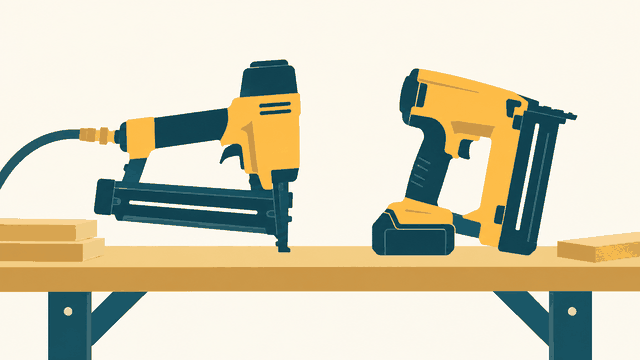
Two cordless designs, different compromises
Battery-only models use a motor and mechanical drive to set nails without a gas cartridge. They avoid fuel purchases and cartridge cold-weather issues, but tend to be heavy and can fire more slowly than a pneumatic nailer. Gas-assisted models use a battery for ignition and a replaceable fuel cell to drive the nail. They can feel quicker, but add ongoing fuel cost and another consumable to keep on hand.
For buyers already invested in a battery platform, a cordless framing nailer compatible with your battery system is usually the simplest place to start. Check the bare-tool price, included battery size and charger compatibility. A large battery may extend runtime but make an already bulky tool harder to hold overhead.
Compare the practical trade-offs
| Option | Best fit | Main drawback | What to check |
|---|---|---|---|
| Battery-only framing nailer | Decks, repairs and framing where mobility matters | Weight and slower sustained pace than many pneumatic setups | Battery platform, magazine angle, nail range and tool balance |
| Gas-assisted cordless nailer | Users who value a quick, self-contained setup | Fuel cells add cost and may be harder to source | Fuel availability, cold-weather guidance and required battery |
| Pneumatic framing nailer | Long production runs with compressor access | Compressor, hose and setup time | Compressor capacity, hose reach and compatible nails |
| Rent or borrow | One small project or occasional repairs | Availability and rental time limits | Included nails, battery or fuel, and return condition |
For deck construction
Deck framing often means moving between joists, working around stairs and fitting hardware in awkward positions. A cordless tool avoids a hose snagging on framing, but its weight becomes noticeable after repeated shots. Try to handle the nailer with a battery installed before buying if possible. A roughly 9- to 11-pound tool can feel substantially heavier when held away from your body for long periods.
Use the fasteners specified for the connection. A framing nailer is not a substitute for structural screws, joist hangers or the connector nails called for by hardware instructions. Nail heads that sit proud can catch decking, while overdriving can weaken a connection. Test depth on scrap of the same wood, then adjust for wet, dense or unusually hard lumber. If the driver starts leaving nails high, check battery charge, nail compatibility and whether the tool needs maintenance before simply increasing pressure.
If you only need a nailer for one modest deck, renting or borrowing may be cheaper than buying batteries and a tool. For repeated outdoor projects, a bare-tool cordless framing nailer can make sense when you already own compatible batteries and a charger.
For wall construction
Building walls involves repeated nailing and often faster work than a small deck repair. A cordless nailer can handle a wall or addition, but a low battery or empty magazine interrupts a rhythm that a pneumatic tool can maintain with a full compressor. Keep a charged spare battery nearby and reload before the magazine is nearly empty. For a full framing job, compare the time required to swap batteries and clear jams against the convenience of cordless setup.
Check whether the nailer offers sequential and bump-fire modes. Sequential firing requires lifting and pressing the trigger for each nail; it gives better control around edges and is generally the safer mode for new users. Bump fire can increase pace, but requires deliberate handling and may be restricted by workplace rules. Follow the manual, wear eye and hearing protection, keep hands clear of the nose, and disconnect the battery before clearing a jam.
What to check before buying
Verify the nail collation angle, accepted nail lengths and head style against products sold locally. Look for a readable depth adjustment, a tool-free jam-release mechanism and a usable belt hook. Ask whether the kit includes a battery and charger; a bare tool may look inexpensive until you add both. Also check the manufacturer’s service and parts support, since a damaged driver blade can make a bargain tool uneconomical to repair.
Runtime claims are difficult to compare because nail length, wood species, firing mode and temperature all affect results. Treat published shots-per-charge figures as best-case guidance, not a guarantee. In cold weather, batteries lose output and gas-assisted tools may be more sensitive to temperature. Keep spare batteries warm according to their manual, and do not charge a battery outside the allowed temperature range.
Make the choice fit the workload
For occasional deck work or a small wall project, renting is often the sensible low-cost choice. If you already own batteries in a supported platform and expect to frame regularly, a battery-only model avoids fuel-cell purchases and compressor setup. For sustained production framing, a pneumatic nailer can still be the better value if you have a suitable compressor and do not mind managing a hose. Buy around the nails you can source, the battery system you own and the number of hours you expect to use the tool—not just the advertised firing speed.
Related guides
- Longest Lasting Lawn Mower Battery: AGM vs Lithium vs Flooded Lifespan and Cost per Season
- Duralast Gold Lawn Mower Battery Review: U1 Fit, CCA and When to Pay for AGM
- Greenworks Pro 80V 21-Inch Mower Review: Runtime Math, Push vs Self-Propelled and Yard Fit
- Bosch High Pressure Washer Gun Replacement: Fittings, Adapters and What Fits Your Model