What's inside
As an Amazon Associate I earn from qualifying purchases. This post may contain affiliate links at no extra cost to you.
What matters when cutting full sheets
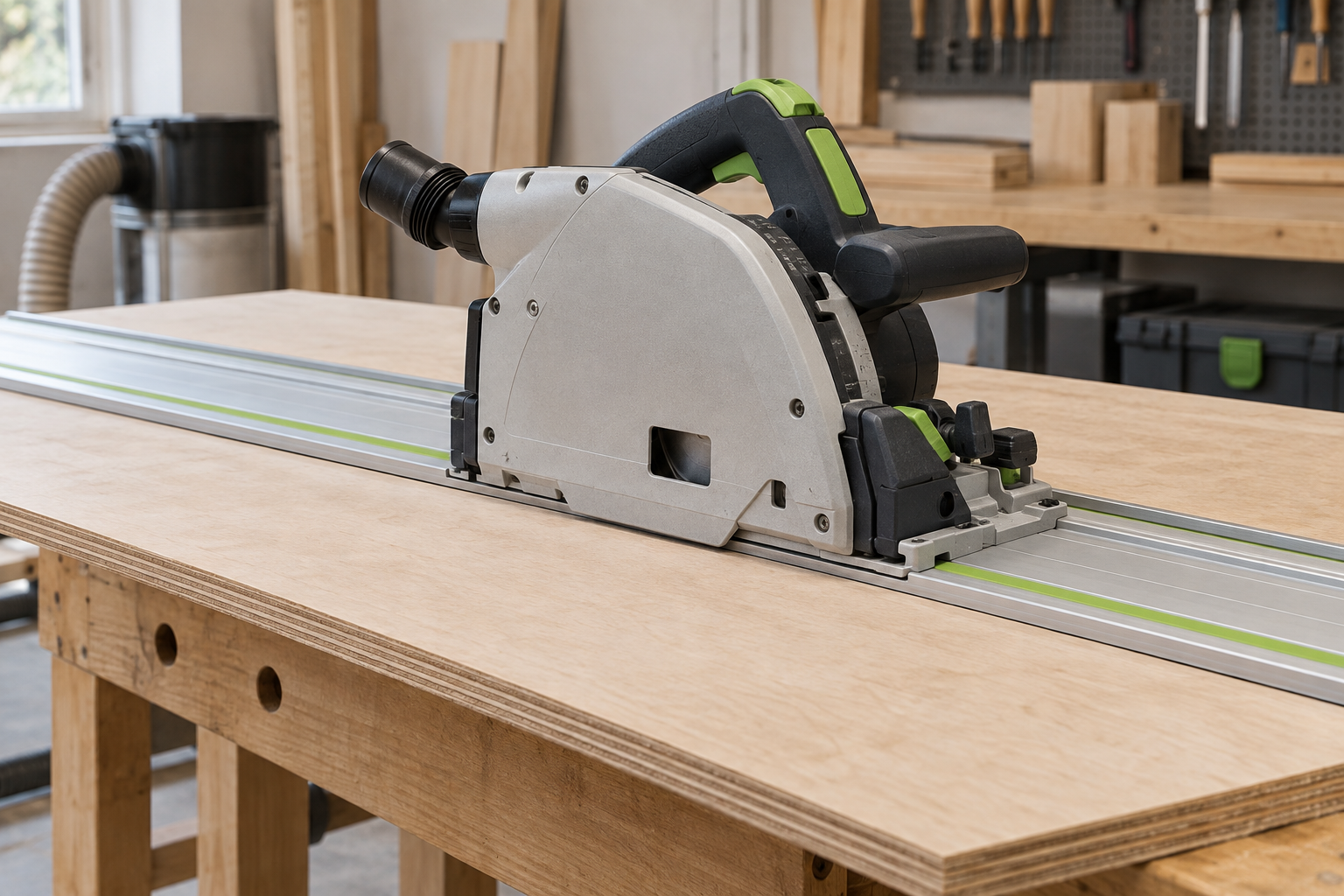
A cordless track saw is useful for breaking down plywood, MDF and other sheet goods when a table saw is impractical. The track guides the saw, so you can make long, straight cuts on a work surface without balancing a 4-by-8-foot sheet on a small saw table. But a track saw is a system: saw, track, battery, blade and work support all affect the result.
For a full sheet, check the saw’s cutting depth at 90 degrees, whether the track length covers your cut, and whether the battery platform matches tools you already own. Most saws in this category cut roughly 2 inches deep at 90 degrees, enough for typical 3/4-inch plywood and a sacrificial layer beneath it. A single 55-inch track is shorter than an 8-foot cut; you’ll need a longer track or compatible joined sections, and the joint must be aligned carefully to avoid a kink in the cut.
As an Amazon Associate we earn from qualifying purchases at no extra cost to you.


Battery capacity matters more on long cuts in dense material than on short crosscuts. A larger battery can reduce interruptions, but it adds weight and cost. If you already own compatible batteries, buying a bare tool may be the sensible choice. If you’re starting from scratch, compare the kit price with the cost of the saw, track, charger and battery bought separately.
Cordless track saw buying comparison
| Option | Best fit | Main trade-off |
|---|---|---|
| Premium cordless track saw system | Frequent sheet breakdown and repeatable shop work | Higher upfront cost; track and accessories can add substantially to the price |
| Midrange cordless track saw | Occasional furniture, cabinet or remodeling cuts | Check track availability, battery cost and dust collection before buying |
| Corded track saw | Long cuts and steady work when an outlet is nearby | Lower battery-system cost, but the cord can snag or limit placement |
| Circular saw with a guide rail | Infrequent cuts on a tight budget | Usually less convenient to adjust and may not give the same plunge-cut control |
Choose the system, not just the saw
For regular work, look for a saw with a reliable depth scale, a riving knife or effective anti-kickback design, a clear view of the cut line, and dust extraction that can connect to your vacuum. Plunge control is important for starting a cut in the middle of a panel. Verify the rail is sold in lengths that suit your work and that connectors are available if you need to join tracks. Rail compatibility is not universal, so don’t assume a track from another brand will fit.
Compare cordless track saw kits with a track if you want one purchase to cover the essentials. Kits vary: some include a short rail, while others include a battery and charger but no track. Read the package contents before comparing prices.
If you already use a cordless platform, a bare tool can save money and keep charging simple. Search for a bare-tool cordless track saw that matches your batteries. For a new platform, account for at least one suitable battery and charger, not just the tool’s advertised price. A compact battery may work, but a higher-capacity pack is generally a better choice for repeated long cuts.
Set up full sheets to prevent bad cuts
Support the sheet across the cut so both sides stay flat, while leaving a narrow gap or sacrificial material beneath the blade. Foam insulation board is a practical support: it holds the panel and lets the blade cut slightly into the foam without hitting a bench. Place supports so the offcut cannot drop, pinch the blade or twist the panel as the cut finishes. A 4-by-8-foot sheet is awkward even before the saw starts; get help moving it rather than trying to steer a heavy sheet one-handed.
Set the blade depth just beyond the material, typically about 1/8 inch into the sacrificial layer. Too much exposed blade increases the risk of injury and can worsen tear-out. Confirm the track is straight and secured, and keep the saw’s base fully seated against it through the cut. On joined rails, check alignment along the full joint before committing to a long cut.
Use a sharp blade intended for the material. A fine-tooth blade generally leaves a cleaner edge in veneered plywood, while a coarser blade can cut faster but may chip the face. If both faces must look clean, use the saw’s scoring function if available, or make a shallow scoring pass before the full-depth cut. Test on scrap first; blade direction, veneer quality and support all affect chipping.
When a cheaper option is enough
If you only break down a few sheets a year, a circular saw and a straightedge can be adequate. A clamped guide or a circular-saw guide rail costs less than a dedicated track-saw setup, but you’ll spend more time positioning and clamping it. Make sure the saw base stays against the guide and that the clamps do not block the motor or cut path.
Choose a dedicated cordless track saw if you make long cuts often, need plunge cuts, or value quick setup without a cord. Choose corded if your work is near an outlet and you want to avoid adding batteries and chargers to your purchase. Either way, dust control and sheet support matter more than a small difference in advertised no-load speed.
Avoid common failure modes
A saw that bogs down, leaves a rough edge or stops partway through a sheet may have a dull or unsuitable blade, an undersized battery, a pinched cut, or an overly fast feed rate. Don’t force it. Stop, disconnect power or remove the battery, and check that the offcut is supported and the kerf is open. Let the blade reach full speed before entering the cut, then feed steadily without twisting the saw.
Wear eye and hearing protection, and use dust extraction when cutting MDF or dusty sheet goods. Keep hands out of the cut line, secure the rail and workpiece, and follow the saw maker’s instructions for kickback protection and blade changes. A track saw makes long cuts easier to control, but it does not make an unsupported sheet or a rushed setup safe.
Related guides
- Longest Lasting Lawn Mower Battery: AGM vs Lithium vs Flooded Lifespan and Cost per Season
- Duralast Gold Lawn Mower Battery Review: U1 Fit, CCA and When to Pay for AGM
- Greenworks Pro 80V 21-Inch Mower Review: Runtime Math, Push vs Self-Propelled and Yard Fit
- Bosch High Pressure Washer Gun Replacement: Fittings, Adapters and What Fits Your Model