What's inside
As an Amazon Associate I earn from qualifying purchases. This post may contain affiliate links at no extra cost to you.
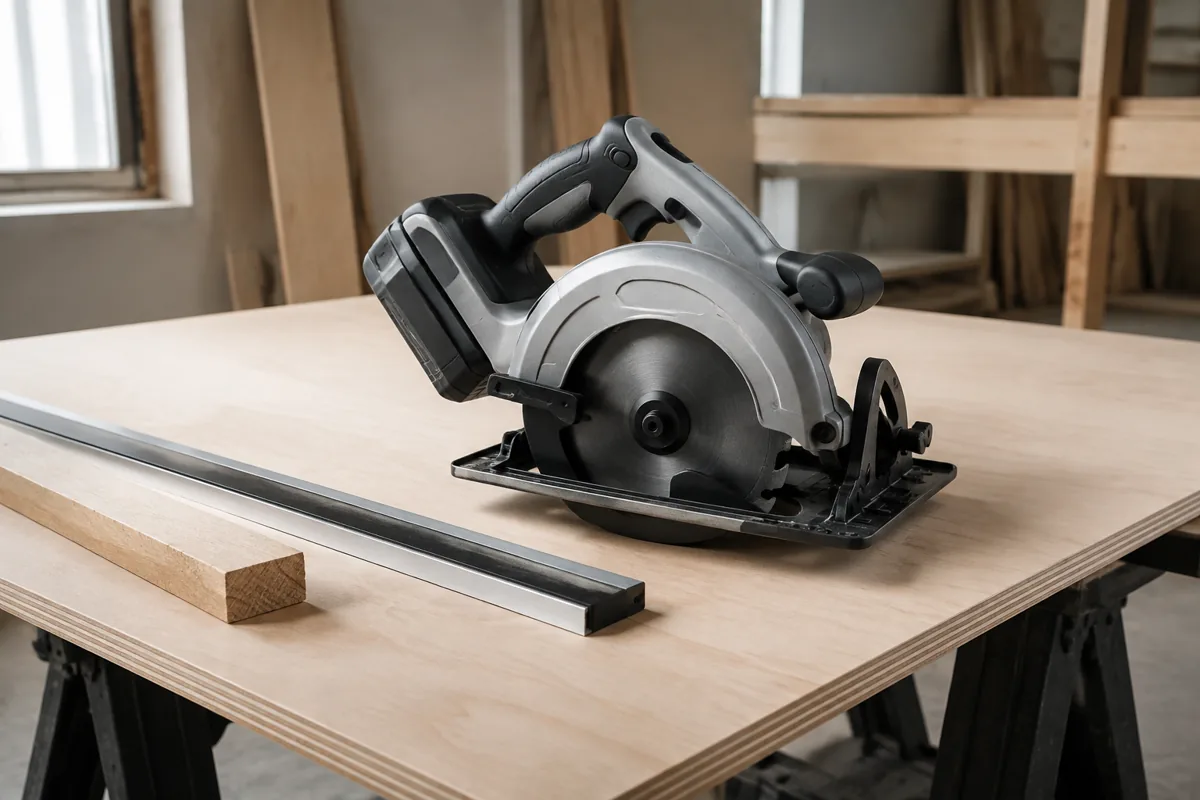
For breaking down plywood, MDF, and other sheet goods, a cordless circular saw is the cheaper, more flexible choice. A cordless track saw is easier to guide accurately and usually leaves a cleaner edge, but it costs more and works best when you have room to set up a track. The right pick depends on how often you cut full sheets, whether the edges will be visible, and what cordless batteries you already own.
As an Amazon Associate we earn from qualifying purchases at no extra cost to you.


Quick comparison
| Factor | Cordless circular saw | Cordless track saw |
|---|---|---|
| Typical setup | Straightedge or cutting guide added separately | Guide rail and saw designed to work together |
| Cut accuracy | Good with careful clamping and alignment | Easier to repeat accurately |
| Edge quality | More likely to chip veneer without a suitable blade and setup | Splinter guard helps support the cut edge |
| Portability | Compact; useful for general framing and repair work | Saw and rail take more space, especially with long rails |
| Cost | Lower if you already own the saw and battery | Higher once you include rails, clamps, and batteries |
| Best fit | Occasional sheet cuts and mixed-purpose work | Frequent cabinet, furniture, or finish-panel work |
What makes a track saw different
A track saw runs along a guide rail, so the rail sets the cut line and helps keep the saw traveling straight. Many rails have a replaceable splinter guard that sits at the blade’s cut edge. When it is trimmed to the saw, it can reduce chipping on the visible face of plywood or laminate. The setup is not foolproof: a damaged guard, a dull blade, or a rail that shifts can still spoil a cut.
A circular saw can make equally straight cuts, but you have to provide the guidance. A clamped straightedge works well, as does a dedicated saw guide. Measure where the blade will actually cut—not just where the saw’s baseplate sits—and account for the offset from the edge of the saw to the blade. That small setup step is where many inaccurate cuts start.
Accuracy and edge quality
For cabinet parts, shelves, or panels that will stay exposed, a track saw makes it easier to place the cut precisely and get consistent results. A long guide rail is especially useful for a straight cut across a 4-by-8-foot sheet. Check that the rail is positioned against your marks at both ends before cutting, and secure it if it could move. A track saw cannot correct a sheet that is bowed, unsupported, or poorly marked.
A circular saw can still produce clean sheet cuts. Use a sharp, fine-tooth blade intended for plywood or laminate, support the work so the offcut cannot pinch the blade, and place the show face according to the saw’s blade rotation. On many conventional circular saws the teeth enter the top face and exit the bottom, so chipping is often worse on the bottom; confirm this with a test cut because saw designs and blade setups vary. For a basic construction cut where the edge will be covered, these precautions may be more than enough.
Batteries and runtime
Both tools can draw heavily on a battery when cutting thick material or forcing a dull blade. A larger-capacity battery generally provides more runtime, but it also adds weight. For full sheets of 3/4-inch plywood, a well-matched saw and a fresh, high-capacity pack are more comfortable than a small compact battery, particularly if you have several cuts to make. There is no reliable single runtime figure: blade condition, material, feed rate, and battery age all matter.
If you already own batteries from a cordless platform, staying within that ecosystem can make the circular saw the better value. Before buying, check that the battery is compatible with the saw and that you have a suitable charger; bare-tool prices can be misleading if you need to add both. Compare a cordless circular saw with a cordless track saw and guide rail as complete setups, not just saw bodies.
Cost and workspace
A circular saw is the sensible starting point if you cut sheet goods occasionally, already have a compatible battery, or also need a saw for framing and general site work. Add a straightedge or guide when the cut needs to be accurate. For a few panels in a garage, that combination can do the job without the cost and storage demands of a track system.
A track saw makes more sense when repeated, precise cuts are part of the work. Budget for rails long enough for the cuts you make, plus connectors if you need to join shorter rails, and consider clamps or another way to hold the rail securely. A long rail is awkward to store and transport. If you work in a small space, plan where the sheet and rail will sit before buying; the saw cannot make a full-length cut if the sheet is hanging unsupported over an edge or blocked by nearby walls.
Common cutting mistakes
With either saw, poor support can cause the offcut to drop, bind the blade, or tear the face veneer. Support both sides of the cut without putting a support directly in the blade’s path. Foam insulation boards or a sacrificial sheet beneath the plywood can work if the surface is flat and stable. Keep the cord-free saw’s battery clear of the sheet edge, and do not reach across a moving blade to catch a falling offcut.
On a circular saw, a guide that is not clamped tightly can creep. On a track saw, a rail that is misaligned or not seated flat can lead to a cut that is straight but in the wrong place. Test the setup on scrap, especially when using a new blade, rail, or splinter guard. Feed at a steady pace: pushing hard to save time can overheat the blade, drain the battery faster, and leave a rough edge.
Which one to buy
Choose a cordless circular saw if low cost, portability, and versatility matter most, and you are willing to set up a guide for accurate cuts. For occasional construction cuts, a straightedge and a careful test cut are usually sufficient. Choose a cordless track saw if you regularly break down full sheets or need accurate, clean edges with less measuring and guiding effort. Its advantage is control and repeatability—not a guarantee of perfect cuts or a replacement for sound support, a sharp blade, and a compatible battery setup.
Related guides
- Longest Lasting Lawn Mower Battery: AGM vs Lithium vs Flooded Lifespan and Cost per Season
- Duralast Gold Lawn Mower Battery Review: U1 Fit, CCA and When to Pay for AGM
- Greenworks Pro 80V 21-Inch Mower Review: Runtime Math, Push vs Self-Propelled and Yard Fit
- Bosch High Pressure Washer Gun Replacement: Fittings, Adapters and What Fits Your Model