Key takeaways
- A ranked oil free air compressor comparison that orders picks by the jobs they unlock, from brad nailing to sustained sanding, plus the categories worth skipping.
What's inside
- Oil free air compressor comparison at a glance
- 1. The quiet twin-stack, because it is the one you will actually turn on
- 2. The pancake, when budget or truck-bed abuse decides it
- 3. The wheeled vertical, only once a specific tool demands it
- 4. The cordless inflator, which replaces a compressor for most homeowners
- What to skip in an oil free air compressor
- Frequently asked questions
- Related Guides
- Oil free air compressor comparison at a glance
- 1. The quiet twin-stack, because it is the one you will actually turn on
- 2. The pancake, when budget or truck-bed abuse decides it
- 3. The wheeled vertical, only once a specific tool demands it
- 4. The cordless inflator, which replaces a compressor for most homeowners
- What to skip in an oil free air compressor
- Frequently asked questions
- Related Guides
As an Amazon Associate I earn from qualifying purchases. This post may contain affiliate links at no extra cost to you.
Most buyers pick an oil free air compressor by looking at horsepower on the box, which is the least useful number printed on it. The spec that decides whether a compressor can actually run your tool is CFM delivered at 90 PSI, and the spec that decides whether you enjoy owning it is how loud it is in a closed garage. This oil free air compressor comparison ranks the main categories by what you should buy first, based on the job each one unlocks rather than what it costs.
Oil free means the pump uses permanently lubricated bearings and a low-friction cylinder liner instead of an oil bath. You give up some pump lifespan and gain no oil changes, no oil carryover into your air line, and the ability to run the unit tilted or hauled around in a truck bed without draining anything. For finish work, tire inflation, blowing out sawdust, and intermittent nailing, that is the right trade. For eight hours of continuous sandblasting, it is not.
As an Amazon Associate we earn from qualifying purchases at no extra cost to you.
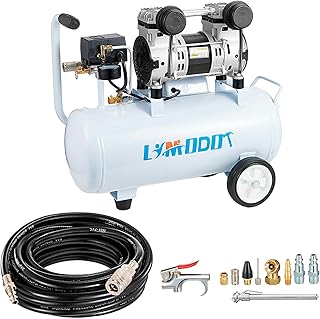

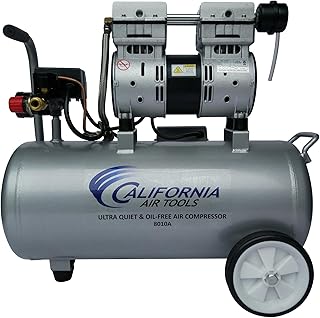


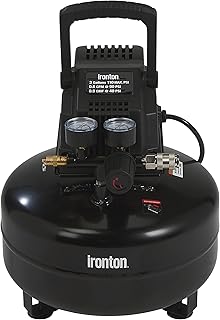
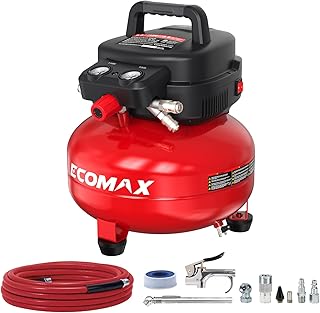

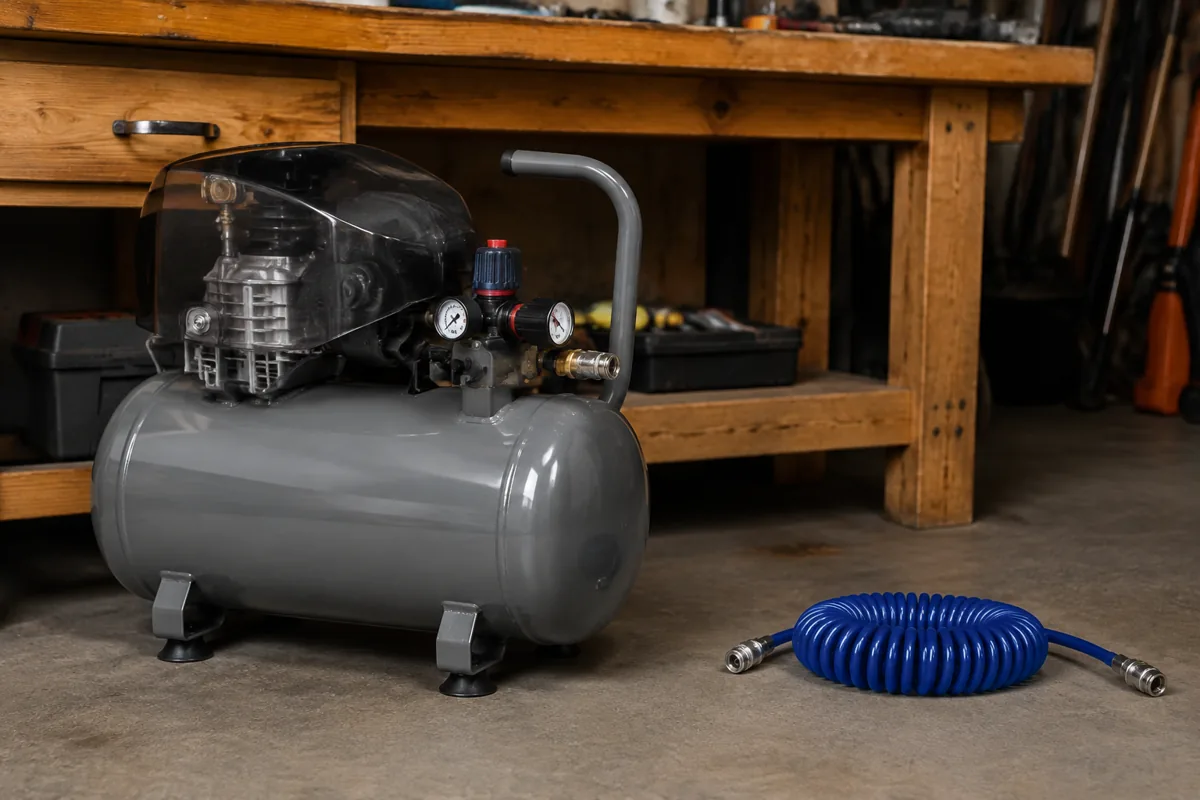
Oil free air compressor comparison at a glance
The table below groups the market by tank size and airflow class, because those two numbers determine which tools you can run. Every figure here is a typical class range, not a promise about a specific model, so verify the plate on whatever unit you shortlist.
| Class | Typical tank | Typical CFM at 90 PSI | What it unlocks | Realistic noise |
|---|---|---|---|---|
| Pancake | 4 to 6 gal | 2.0 to 3.0 | Brad, finish, roofing nailers, inflation | Loud, 78 to 90 dBA |
| Quiet twin-stack | 4 to 10 gal | 2.0 to 3.5 | Same as pancake, indoors, near people | Quiet, 60 to 70 dBA |
| Hot dog / trim | 1 to 3 gal | 0.7 to 2.0 | 18ga brads, pin nails, tires | Varies, often shrill |
| Wheeled vertical | 20 to 30 gal | 4.0 to 6.0 | Impact wrenches, small HVLP, ratchets | Loud, stationary |
| Cordless tire inflator | No tank | N/A, duty rated | Tires, sports gear, air mattress | Quiet, brief |
1. The quiet twin-stack, because it is the one you will actually turn on
This goes first for a reason that has nothing to do with performance charts. A standard pancake compressor in a two-car garage measures somewhere in the high 80s dBA, which is loud enough that you delay firing it up, work around it, or skip the nailer and grab screws instead. A quiet oil free unit in the 60s dBA range runs a slower motor with a larger displacement pump, and the practical effect is that the tool gets used. That is the job it unlocks: trim carpentry inside a finished house, cabinet installs with a client in the next room, apartment or basement shops, early mornings without waking anyone.
Look for a tank of at least 4.5 gallons paired with roughly 2.0 CFM or better at 90 PSI. Below that, a 16 gauge finish nailer in a fast rhythm will outrun the pump and you will wait on recovery. The DeWalt and Makita quiet lines and California Air Tools have all pushed this category hard, and the compromise is real: these units are heavier and physically bigger than a pancake of the same capacity, and they cost noticeably more per gallon of tank.
Quiet Oil Free Air Compressor, 4.5 to 10 Gallon
If you own a nailer and a garage attached to a house, buy the quiet unit and stop reading. Filter your search by decibel rating first, then confirm CFM at 90 PSI is 2.0 or higher, then check the weight because anything past 40 pounds stops being portable in practice. Skip models that advertise a noise number without stating the measurement distance.
2. The pancake, when budget or truck-bed abuse decides it
The 6 gallon pancake is the default for a reason. It is cheap, it is genuinely light enough to carry one-handed up a ladder, the flat base will not tip on a joist, and the oil free pump tolerates being thrown in a truck at 20 degrees. Airflow in this class comfortably runs brad nailers, finish nailers, staplers, and roofing guns, and it will handle a framing nailer for a fence or deck if you accept pauses on long runs.
Where pancakes fall down is sustained demand. Anything that consumes air continuously rather than in bursts, meaning die grinders, cutoff tools, DA sanders, and full-size spray guns, will empty a 6 gallon tank in under a minute and then leave you working at whatever the pump can deliver, which is not enough. No amount of hose or fitting upgrades fixes a CFM deficit.
- ✔ Lowest cost of entry for a real nailing setup
- ✔ Light enough for ladder and rooftop work
- ✔ Oil free pump survives cold starts and transport
- ✔ Stable flat footprint on uneven surfaces
- ✘ Loud enough to be genuinely unpleasant indoors
- ✘ Short duty cycle under continuous demand
- ✘ Small tanks mean frequent cycling and more heat
- ✘ Pump lifespan trails an oil-lubricated equivalent
3. The wheeled vertical, only once a specific tool demands it
A 20 to 30 gallon vertical oil free unit is the answer when a tool on your bench has a CFM requirement your portable cannot meet. That usually means a 1/2 inch impact wrench for suspension and brake work, an air ratchet you use for more than a few fasteners, a small HVLP or LVLP gun for cabinet doors and furniture, or a media blast cabinet for rust removal. Those jobs are the whole justification. If none of them are on your list, this class is a bigger, louder version of what you already have.
Two cautions before you commit. First, check the outlet voltage: many verticals in this size run on 120V and plug into a normal outlet, but the larger ones want a dedicated 20 amp circuit or 240V, and finding that out after delivery is a bad afternoon. Second, understand that oil free verticals are the noisiest category in this comparison and they are not portable, so plan a permanent corner with a drain you can actually reach. A tank drained after every session lasts years; one that is never drained rusts from the inside and fails without warning.
20 to 30 Gallon Vertical Air Compressor
Buy on CFM at 90 PSI, not on horsepower or tank gallons. Write down the requirement of the thirstiest tool you own, add roughly 30 percent headroom, and ignore anything that does not meet that number. Confirm the electrical requirement and the freight or curbside delivery terms before ordering, since these ship heavy.
4. The cordless inflator, which replaces a compressor for most homeowners
Ranked last in capability and first in honesty: a large share of people shopping for a small compressor only need to inflate tires, bike tires, sports balls, and air mattresses. A battery inflator on a platform you already own, whether that is DeWalt XR, Milwaukee M18 FUEL, Ryobi ONE+, or Makita LXT, does that job better than any tank compressor because it fits under a seat, needs no outlet, and holds a target pressure automatically. It cannot run a nailer or a blow gun with any usefulness, and that is fine if you were never going to.
What to skip in an oil free air compressor
Skip the 1 gallon trim compressors unless you are a professional installer working from a stair tread. They save a few pounds and give up most of the reserve air, and the tiny tank cycles constantly under any real workload.
Skip any unit whose listing advertises peak horsepower or maximum PSI but never states CFM at 90 PSI. That omission is deliberate and it is the only meaningful number.
Skip bundled hose-and-nailer kits when the tools are unbranded. The compressor may be fine, but the included nailer and the vinyl hose are usually the reason the price looks good, and a stiff vinyl hose in cold weather is genuinely miserable to work with.
Skip oil free entirely if your plan is continuous production spraying, sandblasting, or running an air-hungry tool for hours a day. That is a two-stage, oil-lubricated, 60 gallon and up conversation, and no oil free portable will survive that duty cycle.
Skip aftermarket regulators and filters at purchase time. Buy the compressor, use it, and add a water separator or desiccant filter later if you take up spraying. Most owners never need one.
Frequently asked questions
Do oil free air compressors last as long as oil-lubricated ones? Generally no. The permanently lubricated pump wears faster under heavy use, and most oil free units are treated as replaceable rather than rebuildable. Under typical homeowner and finish-carpentry duty, that difference rarely matters because the compressor spends most of its life idle. Under daily production use, it matters a lot.
How much CFM do I actually need? Add up the requirement at 90 PSI for the tools you run at the same time, then add roughly 30 percent headroom so the pump is not running continuously. Brad and finish nailers are intermittent and forgiving, so around 2.0 CFM covers them. Impact wrenches and sanders are continuous and typically want 4 CFM or more, which is why they push you to a larger tank.
Is a quiet compressor worth the extra cost? If it lives in an attached garage, a basement, or anywhere near other people, yes, because the deciding factor is whether you reach for the tool at all. If it lives on a job site or in a detached shop where noise is already ambient, put the money into tank size and airflow instead.
Buy in the order above: quiet twin-stack if noise is a factor, pancake if cost and portability are, vertical only when a specific tool forces it, and a cordless inflator if tires were the real goal all along.
Check prices on Amazon →