
What's inside
- What Is a Battery Operated Pressure Washer?
- How Does a Battery Powered Pressure Washer Work?
- What Can a Battery Operated Pressure Washer Clean?
- PSI vs. GPM: Which Specification Matters More?
- How Long Does a Battery Operated Pressure Washer Run?
- Advantages of a Battery Operated Pressure Washer
- Limitations You Should Understand Before Buying
- How to Choose the Right Battery Operated Pressure Washer
- Safety Tips for Using a Cordless Pressure Washer
- Battery and Pump Maintenance
- Frequently Asked Questions
- Final Thoughts
As an Amazon Associate I earn from qualifying purchases. This post may contain affiliate links at no extra cost to you.
A battery operated pressure washer provides portable cleaning power without requiring a permanent electrical connection or a gas engine. Powered by rechargeable lithium-ion batteries, these machines are useful for washing vehicles, outdoor furniture, patios, bicycles, garden equipment, and other surfaces around the home. However, cordless pressure washers are not all designed for the same workload. Some are lightweight power cleaners intended for light maintenance, while larger battery-powered models offer higher pressure and flow rates for more demanding residential cleaning.
Understanding pressure, water flow, battery capacity, water supply requirements, and nozzle compatibility is essential before choosing one. This guide explains how battery operated pressure washers work, what they can realistically clean, their advantages and limitations, and which specifications matter most when comparing models.
As an Amazon Associate we earn from qualifying purchases at no extra cost to you.


Our Top Picks

What Is a Battery Operated Pressure Washer?
A battery operated pressure washer is a portable cleaning machine that uses an electric motor powered by rechargeable batteries to operate a water pump. The pump draws water from an available source and sends it through a hose and spray nozzle at an elevated pressure.
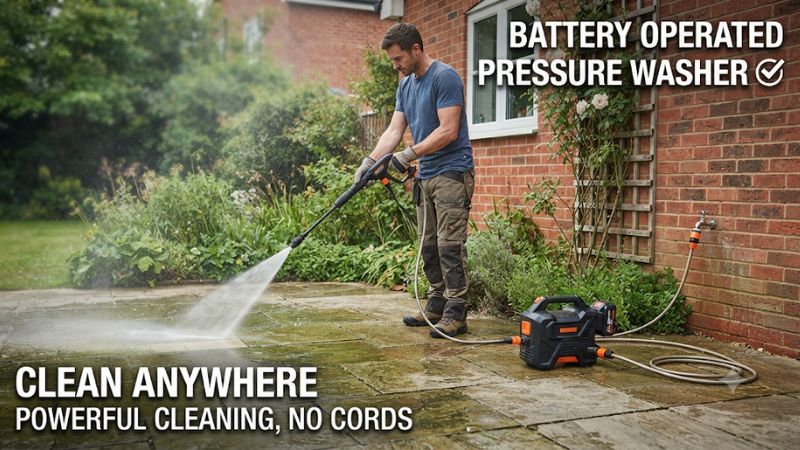
Unlike traditional gas-powered pressure washers, cordless models do not require gasoline, engine oil, or engine maintenance. They also avoid the need for a power cord running from an electrical outlet to the cleaning area.
Most models use lithium-ion battery technology because it offers a combination of energy density, rechargeable performance, and relatively low weight.
Depending on the design, a cordless pressure washer may draw water from:
- A standard garden hose connection.
- A bucket or portable water container.
- A dedicated onboard water tank.
- Another approved freshwater source through a compatible suction hose.
This flexibility makes battery-powered equipment particularly useful when cleaning vehicles in parking areas, washing outdoor equipment away from a house, or maintaining recreational gear at a campsite.
However, an important distinction exists between a cordless pressure washer and a cordless power cleaner. Some compact machines advertise relatively high maximum PSI figures but deliver lower pressure and water flow under normal operating conditions. Their intended purpose is usually convenient, light-duty cleaning rather than replacing a full-size pressure washer.
How Does a Battery Powered Pressure Washer Work?
A cordless pressure washer uses a relatively straightforward operating system consisting of a battery, electric motor, water pump, inlet connection, high-pressure hose, trigger gun, and spray nozzle.
The process begins when the battery supplies electrical energy to the motor. The motor drives the pump, which draws water through an inlet hose or garden hose connection.
The pump then pressurizes the water and sends it through the high-pressure hose toward the spray gun. When the operator presses the trigger, water exits through the selected nozzle.
The nozzle controls the spray pattern and influences how the available water pressure is distributed across the cleaning surface.
The main components include:
- Lithium-ion battery: Supplies electrical energy to the motor. Battery voltage and capacity influence the machine’s power system and potential operating duration.
- Electric motor: Converts electrical energy into mechanical movement. Some higher-performance models use brushless motors, which eliminate conventional carbon brushes.
- Water pump: Creates the pressure needed to deliver water through the spray system. Pump design and operating conditions affect pressure and flow.
- Water inlet system: Connects the machine to a garden hose, bucket, or compatible water container. Some models include a filter to prevent debris from entering the pump.
- High-pressure hose: Carries pressurized water from the pump to the spray gun. Its pressure rating and connection type must match the manufacturer’s requirements.
- Spray gun and nozzle: Control water delivery and allow the operator to select an appropriate spray pattern for the cleaning task.
Some models also include detergent containers, adjustable pressure controls, onboard storage, and automatic pump shutoff features.
What Can a Battery Operated Pressure Washer Clean?
Battery-powered pressure washers are generally best suited to light and moderate residential cleaning. Their portability makes them convenient for jobs where setting up a conventional pressure washer would take longer than the cleaning itself.
However, the actual cleaning capability depends on pressure, water flow, nozzle design, battery output, and the type of dirt being removed.
| Cleaning application | Suitability | Important considerations |
| Cars and motorcycles | Good | Use an appropriate nozzle and cleaning distance |
| Bicycles | Good | Avoid directing concentrated spray into bearings |
| Outdoor furniture | Good | Check material compatibility |
| Garden tools | Good | Avoid spraying electrical components |
| Patio furniture and small walkways | Good | Results depend on dirt accumulation and flow rate |
| Decking | Model-dependent | Use a suitable fan pattern and lower pressure |
| Fences | Model-dependent | Consider wood condition and surface finish |
| Driveways | Limited to moderate | Large areas may require substantially more flow |
| Heavy concrete cleaning | Usually unsuitable | Full-size electric or gas equipment is generally more appropriate |
| Paint or coating removal | Usually unsuitable | Requires equipment and procedures specifically suited to the application |
For example, removing loose dust and fresh mud from a bicycle is considerably easier than removing years of embedded grime from a concrete driveway.
A cordless pressure washer can handle the first task efficiently, but the second may require a more powerful machine with higher sustained water flow.
Cleaning Vehicles and Outdoor Equipment
Vehicle maintenance is one of the most practical applications for a battery operated pressure washer.
A suitable model can rinse loose dirt, remove surface mud, and help wash away cleaning solutions. Its portability is especially convenient for people who do not have an outdoor electrical outlet near their parking area.
However, high-pressure water should not be directed closely at electrical connectors, damaged paint, seals, wheel bearings, or sensitive components.
For motorcycles and bicycles, avoid directing concentrated spray toward suspension seals, hubs, bottom brackets, and other areas where water intrusion could cause damage.
Cleaning Patios and Garden Furniture
Smaller patios, plastic furniture, garden tools, and outdoor decorations are also suitable applications.
A wider spray pattern generally distributes cleaning force over a larger area, reducing the concentration of pressure at one point.
For wood, painted surfaces, and delicate materials, begin with a lower-pressure setting and a wider nozzle pattern where supported. Test an inconspicuous area before cleaning the entire surface.
PSI vs. GPM: Which Specification Matters More?
Two specifications deserve particular attention when evaluating a battery operated pressure washer: PSI and GPM.
They describe different aspects of cleaning performance and should not be treated as interchangeable.
Understanding PSI
PSI stands for pounds per square inch. It measures water pressure.
Higher pressure can help loosen stubborn dirt, mud, and surface contamination. However, excessive pressure can also damage paint, wood fibers, plastic components, and other delicate materials.
Manufacturers frequently advertise maximum PSI, but this figure may represent a short-duration or initial-discharge measurement rather than the pressure maintained during normal operation.
For example, the Sun Joe 24V-X2-PW1200-RM manual specifies a maximum initial-discharge pressure of 1,196 PSI under its stated CSA internal pressure test. Its typical operating pressure is listed separately at 650 PSI in low mode and 800 PSI in high mode.
This illustrates why maximum advertised PSI should not be the only specification considered.
Understanding GPM
GPM stands for gallons per minute. It measures how much water the pressure washer delivers over time.
Water flow is important because it determines how much water reaches the surface during cleaning and how effectively loosened dirt can be rinsed away.
A machine with higher PSI but very low GPM may take longer to clean a large area than a machine with a more balanced pressure and flow combination.
For battery-powered equipment, manufacturers may also publish maximum flow figures measured under specific nozzle or pressure conditions.
These figures should not automatically be interpreted as continuous flow at maximum pressure.
Why Both Specifications Matter
| Specification | What it measures | Practical importance |
| PSI | Water pressure | Helps loosen dirt and grime |
| GPM | Water flow | Determines water delivery and rinsing capability |
| Battery voltage | Electrical platform voltage | Identifies the machine’s battery system |
| Battery Ah | Electrical charge capacity | Helps indicate available battery capacity |
| Battery Wh | Energy capacity | Allows more meaningful comparisons between battery packs |
When comparing two cordless pressure washers, examine their rated operating pressure and flow rate under comparable conditions rather than choosing the machine with the highest advertised PSI.
How Long Does a Battery Operated Pressure Washer Run?
Runtime depends on several factors, including battery capacity, motor efficiency, pump design, pressure setting, water flow, and how frequently the trigger is activated.
Battery capacity is commonly expressed in amp-hours (Ah). A higher Ah rating generally means more stored electrical charge within the same compatible battery platform.
However, Ah alone does not provide a complete picture of energy capacity.
For example, a 20V 5.0Ah battery has a nominal energy capacity of approximately 100Wh, while a 40V 5.0Ah battery has approximately 200Wh.
The actual usable energy and operating duration depend on the battery design and the equipment’s electrical demand.
Several factors can reduce runtime:
- High-pressure operation: Higher power demand can consume battery energy more quickly.
- Continuous spraying: Keeping the trigger activated for extended periods increases operating demand.
- Low temperatures: Battery performance can change in cold conditions.
- Battery age: Older battery packs may provide less usable capacity.
- Pump resistance: Different water supply and operating conditions can affect the workload.
Some pressure washers include ECO and high-power modes. ECO mode reduces output to extend operating duration, while higher settings provide more cleaning force when needed.
If you regularly clean several vehicles or larger outdoor areas, consider a model with compatible replacement batteries or a kit that includes an additional battery.
Remember that advertised runtime should be treated as a manufacturer claim unless independently measured under clearly stated conditions.
Advantages of a Battery Operated Pressure Washer
Cordless pressure washers offer several practical benefits compared with traditional pressure washers.
1. Greater Portability
The biggest advantage is freedom from a power cord.
You can move the machine around a vehicle, garden, driveway, or workshop without managing an extension cord. Models with bucket adapters or suction hoses can also operate in locations without a nearby garden faucet.
2. Convenient Setup
A battery-powered machine generally requires fewer setup steps than a gas pressure washer.
There is no gasoline to purchase, engine oil to check, or combustion engine to start. Insert a charged battery, connect the water supply, and follow the manufacturer’s starting procedure.
3. Lower Routine Maintenance
Cordless electric models do not require oil changes, spark plug replacement, or carburetor maintenance.
However, they still need proper pump care, inlet-filter cleaning, hose inspection, battery maintenance, and appropriate storage.
4. Reduced Operating Noise
Battery-powered machines generally avoid the engine noise associated with gasoline pressure washers.
Nevertheless, their electric motors and water pumps still produce noise. Hearing protection may be appropriate depending on the equipment and operating environment.
5. Useful for Remote Cleaning
A portable water source and rechargeable battery make cordless pressure washers particularly useful for recreational equipment, bicycles, camping gear, and outdoor maintenance.
Their convenience can be more valuable than maximum cleaning power for these applications.
Limitations You Should Understand Before Buying
Despite their advantages, battery-operated pressure washers are not suitable for every cleaning task.
Limited operating duration: Battery capacity restricts how long the machine can operate before recharging or replacing the battery.
Lower sustained cleaning capability: Some compact models cannot match the water flow and sustained output of larger corded electric or gas pressure washers.
Higher battery-related costs: A bare-tool purchase may not include batteries or chargers. Buying additional compatible batteries can increase the total ownership cost.
Water supply requirements: Cordless does not mean water-independent. Most machines still require a suitable freshwater source, and bucket-fed models may need frequent refilling.
Battery compatibility restrictions: A battery that physically fits another tool is not automatically compatible. Voltage, electrical specifications, communication requirements, and manufacturer approval all matter.
Cold-weather limitations: Water remaining inside the pump can freeze and cause damage. Follow the manufacturer’s storage and winterization instructions.
For large driveways, heavily stained concrete, and demanding cleaning projects, a conventional electric or gas pressure washer may provide better productivity.
How to Choose the Right Battery Operated Pressure Washer
Choosing the right machine starts with understanding what you intend to clean and how frequently you will use it.
1. Match Pressure and Flow to Your Workload
Do not purchase equipment based on maximum PSI alone.
For vehicles, bicycles, outdoor furniture, and light maintenance, a compact cordless power cleaner may be sufficient.
For larger patios, fences, and more demanding residential cleaning, look for a model with higher rated operating pressure and adequate water flow.
If you regularly clean large concrete surfaces, consider whether a full-size pressure washer would be a better investment.
2. Check Battery Voltage and Capacity
Battery voltage identifies the electrical platform, while Ah indicates battery charge capacity.
Compare battery energy in watt-hours when evaluating packs from different voltage platforms.
Also check whether the pressure washer is sold as a kit or bare tool.
A complete kit may include batteries, a charger, a spray gun, hoses, nozzles, and water-suction accessories. A bare-tool package may require additional purchases.
3. Examine Water Supply Options
Water-source flexibility is particularly important for portable cleaning equipment.
Check whether the machine supports:
- Standard garden hose connections.
- Bucket-based water intake.
- Self-priming operation.
- Dedicated water tanks.
- Replaceable inlet filters.
If you intend to draw water from a bucket, verify the permitted suction height and inlet requirements.
Always use clean water and the manufacturer’s recommended filtration system.
4. Evaluate Nozzle Compatibility
Different nozzles produce different spray patterns and cleaning characteristics.
A wider fan pattern distributes water over a larger area, while a narrower pattern concentrates the spray.
Some machines use quick-connect nozzles, while others require proprietary accessories.
Before purchasing additional nozzles, verify the connection type, pressure rating, and manufacturer compatibility. Never assume that accessories designed for a conventional pressure washer are suitable for a cordless model.
5. Consider the Total Ownership Cost
The initial tool price does not always represent the complete investment.
Include the cost of compatible batteries, chargers, replacement hoses, filters, detergent accessories, and additional nozzles.
If you already own tools within a compatible battery ecosystem, purchasing a bare-tool pressure washer may be more economical.
However, verify exact battery compatibility before relying on an existing battery collection.
Safety Tips for Using a Cordless Pressure Washer
Although battery-powered equipment eliminates the need for a mains power cord during cleaning, high-pressure water still presents significant injury risks.
A pressure washer can inject water or contaminants beneath the skin. This is a medical emergency, even if the wound initially appears small.
Follow these precautions:
- Read the specific operator’s manual before assembling or operating the machine.
- Wear safety glasses, protective gloves, and non-slip footwear. Use hearing protection when appropriate.
- Keep the spray nozzle pointed away from people, animals, electrical equipment, and yourself.
- Never use the spray gun to clean clothing or footwear while wearing them.
- Maintain stable footing because wet surfaces can become slippery.
- Check the hose, trigger gun, connectors, and safety lock before operation.
- Never use damaged hoses, fittings, batteries, or safety components.
- Remove the battery before cleaning, maintenance, or changing accessories.
- Shut down the machine and release trapped pressure according to the manufacturer’s instructions before disconnecting components.
- Keep batteries and chargers protected from water and moisture.
Do not spray flammable liquids or use chemicals that the manufacturer has not approved.
If the spray penetrates the skin, seek immediate emergency medical attention. Do not treat the injury as an ordinary cut.
Battery and Pump Maintenance
Proper maintenance helps preserve cleaning performance and reduces the likelihood of premature equipment failure.
After each cleaning session, follow the manufacturer’s shutdown and pressure-release procedure. Disconnect the water supply when instructed and remove the battery before performing maintenance.
Inspect the inlet filter for dirt, sand, and other debris. A clogged filter can restrict water supply and affect pump operation.
Check the high-pressure hose for cracks, abrasions, leaks, and damaged connections. Replace defective components with manufacturer-approved parts.
For battery care:
- Use only the approved battery and charger.
- Keep battery contacts clean and dry.
- Avoid exposing battery packs to excessive heat or moisture.
- Allow a hot battery to cool according to manufacturer instructions before charging.
- Stop using batteries that show swelling, deformation, leakage, or other signs of damage.
For pump protection, never allow the machine to operate without the required water supply. Follow the manufacturer’s instructions for priming, flushing, and preventing freezing.
Store the pressure washer indoors in a dry location. If freezing temperatures are possible, ensure the pump and water passages are protected according to the manual.
Frequently Asked Questions
Is a battery operated pressure washer powerful enough to wash a car?
Yes, many battery-operated pressure washers can wash cars effectively when used with suitable nozzles and appropriate cleaning techniques. They are particularly useful for rinsing loose dirt and applying water without needing an electrical outlet nearby. However, they may take longer than higher-flow conventional pressure washers.
Can a cordless pressure washer draw water from a bucket?
Yes, many portable cordless pressure washers support bucket-fed operation through a compatible suction hose and inlet filter. However, not every model includes this feature. Check the manufacturer’s maximum suction height, water-source requirements, and priming instructions before use.
How many PSI do I need for a battery-powered pressure washer?
The appropriate PSI depends on the cleaning application and the material being cleaned. Light-duty vehicle and furniture cleaning may require less pressure than removing stubborn dirt from outdoor hard surfaces. Always consider rated operating pressure, GPM, nozzle selection, and the surface manufacturer’s cleaning recommendations.
Can I use a regular power-tool battery in a cordless pressure washer?
Only when the pressure washer manufacturer explicitly confirms compatibility with that exact battery platform and model. Matching voltage or physical battery connections alone does not establish compatibility. Using an unapproved battery can damage the equipment and create fire or injury risks.
Final Thoughts
A battery operated pressure washer is a practical choice for portable cleaning, particularly when convenience and mobility matter more than maximum sustained cleaning power. It can simplify washing vehicles, bicycles, garden equipment, outdoor furniture, and smaller residential surfaces without requiring a nearby electrical outlet.
The most important purchasing considerations are rated operating pressure, water flow, battery energy capacity, water-source flexibility, and accessory compatibility. Buyers should also account for battery and charger costs rather than comparing tool-only prices.
For occasional cleaning and smaller maintenance jobs, a compact cordless model can be a useful addition to a workshop or home maintenance setup. For extensive concrete cleaning or demanding projects, a full-size electric or gas pressure washer is generally the more appropriate choice.
The best approach is to match the machine to your actual cleaning workload instead of paying extra for a maximum PSI figure that you may rarely need.
Related guides
More from Amazon
Programs that pair well with the guide above. Offers and eligibility are set by Amazon and may change.
A free business account with business pricing and bulk-buying tools for work, shop or home office.
Create a business accountFree shipping on eligible items, Prime Video and more. Eligible new members can start with a free trial.
Start a Prime free trialAudiobooks and podcasts to listen to on the go. Eligible new members can start with a free trial.
Try Audible freeAd-free music streaming. Eligible new subscribers can start with a free trial.
Try Music Unlimited freeAs an Amazon Associate we earn from qualifying purchases.
Write Your Review
No reviews yet. Be the first to share your experience!