What's inside
- Quick Verdict
- RYOBI 2900 PSI Gas Pressure Washer
- Ryobi 2900 PSI Pressure Washer Specifications
- Cleaning Performance: What Can It Handle?
- Design, Handling, and Included Accessories
- Price and Value: Is $329 a Good Deal?
- Pros and Cons
- RY802925 vs. the Older RY802900
- Safety and Maintenance Considerations
- Alternatives to Consider
- Frequently Asked Questions
- Final Verdict: Should You Buy the Ryobi 2900 PSI Pressure Washer?
As an Amazon Associate I earn from qualifying purchases. This post may contain affiliate links at no extra cost to you.
The RYOBI 2900 PSI gas pressure washer is worth considering for homeowners who need more cleaning power for driveways, sidewalks, outdoor surfaces, and other demanding household jobs. The newer U.S. model, RY802925, combines a 212cc gasoline engine, a claimed maximum pressure of 2,900 PSI, and a rated flow of 2.5 gallons per minute (GPM). Its listed price is $329 at Home Depot and on RYOBI’s U.S. product page as of October 20, 2026.
The main trade-off is convenience. Unlike an electric pressure washer, this gas-powered machine requires fuel, engine maintenance, ventilation, and more care during storage. Its maximum advertised pressure also does not mean that every surface should be cleaned at full power.
This review focuses on the RY802925, the 212cc, 2.5 GPM version currently listed in the U.S. market. The older RY802900 is a different configuration, rated at 2,900 PSI and 2.3 GPM, so its specifications and accessories should not be mixed with those of the newer model.
Quick Verdict
Product reviewed: RYOBI RY802925 · U.S. market · Research date: October 20, 2026
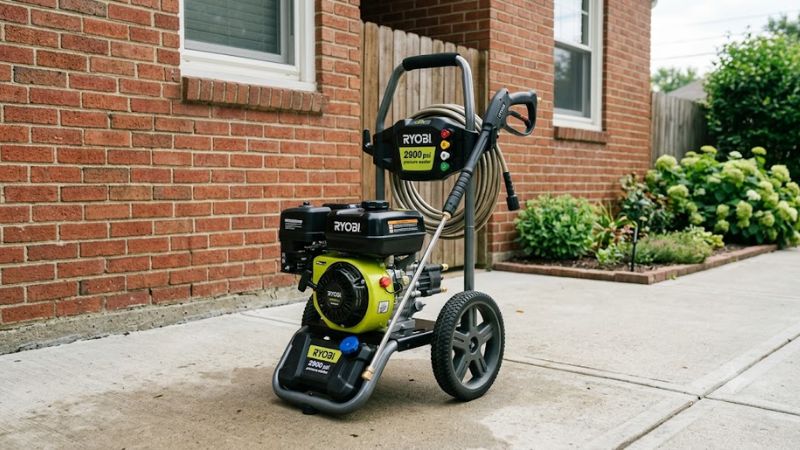
RYOBI 2900 PSI Gas Pressure Washer
$329
Listed U.S. price; subject to change
Worth considering
Best for: Homeowners who regularly clean concrete, sidewalks, outdoor masonry, and suitable exterior surfaces.
Main advantage: A useful combination of advertised pressure and water flow for general residential cleaning.
Main drawback: Gas-engine noise, fuel handling, maintenance, and the risk of surface damage if the wrong nozzle or pressure is used.
Buying recommendation: A reasonable choice for recurring outdoor cleaning when you need a gas-powered machine. If your main jobs are washing a car, cleaning patio furniture, or occasionally rinsing a small deck, a lower-powered electric model may be more convenient.
Ryobi 2900 PSI Pressure Washer Specifications
The RY802925 is a cold-water, gasoline-powered pressure washer designed for outdoor cleaning. Its specifications make it more appropriate for substantial residential jobs than for delicate cleaning that requires minimal pressure.
| Specification | RYOBI RY802925 |
| Product type | Gas pressure washer |
| Maximum advertised pressure | 2,900 PSI |
| Advertised flow rate | 2.5 GPM |
| Engine displacement | 212cc |
| Water type | Cold water |
| High-pressure hose | 25 feet |
| Included nozzles | 0°, 25°, 40°, and soap |
| Wand | Metal spray wand |
| Frame | Hand-truck style |
| Wheels | 12-inch, flat-free wheels |
| Warranty | 3-year limited warranty, according to RYOBI |
| Listed U.S. price | $329 |
| Manufacturer model | RY802925 |
Sources: RYOBI product information and Home Depot’s U.S. listing, checked October 20, 2026.
What do 2,900 PSI and 2.5 GPM mean?
These figures describe different aspects of cleaning performance.
- PSI (pounds per square inch) measures water pressure. Higher pressure can help remove stubborn deposits, but it also increases the potential to damage paint, soft wood, mortar, and other vulnerable surfaces.
- GPM (gallons per minute) measures water flow. More flow can help carry loosened dirt and rinse larger areas.
- 2,900 PSI and 2.5 GPM are the product’s advertised ratings, not a guarantee that every nozzle or operating condition delivers both figures simultaneously.
The combination should be useful for general outdoor maintenance, especially on suitable concrete and masonry. However, these specifications alone do not establish cleaning speed, fuel efficiency, durability, or superiority over another pressure washer. No independently verified, directly comparable performance measurements were established for this review.
Cleaning Performance: What Can It Handle?
The most important buying question is whether the RY802925’s output matches your cleaning jobs.
| Cleaning task | Suitability | Practical advice |
| Concrete sidewalks | Good candidate | Use an appropriate fan nozzle and maintain a consistent distance |
| Driveways | Good candidate | Consider a compatible surface-cleaner attachment for broad, even coverage |
| Brick and masonry | Suitable with care | Check mortar condition and start with lower-impact settings |
| Exterior siding | Conditional | Follow the siding manufacturer’s cleaning guidance and avoid forcing water behind panels |
| Wooden decks | Use caution | Start with low pressure and a wide spray; test an inconspicuous area |
| Cars and motorcycles | Not the first choice | Use a suitable low-pressure setting, keep a safe distance, and avoid seals, bearings, and electrical components |
| Outdoor furniture | Depends on material | Check the material’s pressure limits before cleaning |
These are task-based recommendations, not claims that the washer was personally tested on each surface.
Concrete and driveways
Concrete is one of the more practical applications for this pressure class. The machine’s advertised pressure and flow provide a useful starting point for removing ordinary outdoor dirt and grime.
For large, flat areas, a compatible pressure-washer surface cleaner may help produce a more uniform finish than moving a narrow spray nozzle across the surface. Confirm that the attachment’s pressure rating, connections, and instructions are compatible with the RY802925.
Decks, fences, and siding
More pressure is not always better. Softwood decking, painted surfaces, weathered fences, and vinyl siding can be damaged by an aggressive spray.
Start with a wider spray pattern, a lower-impact setting, and a greater distance from the surface. Increase cleaning intensity only when necessary and permitted by the material manufacturer’s guidance. Avoid directing the spray upward beneath siding or into gaps around windows and doors.
Vehicles and delicate surfaces
A gas-powered 2,900 PSI machine may be more power than you need for routine vehicle washing. Even if the pressure can be reduced through nozzle selection and distance, the operator must still control the spray carefully.
For automotive paint, use a vehicle-appropriate nozzle and detergent, keep the spray away from vulnerable components, and follow the vehicle and pressure-washer manufacturers’ instructions. A dedicated electric model may be a better fit if vehicle washing is your primary task.
Design, Handling, and Included Accessories
Hand-truck frame and wheels
The RY802925 uses a hand-truck-style frame and 12-inch flat-free wheels, according to RYOBI’s product description. This arrangement is intended to make moving the machine around a property easier than carrying it by hand.
However, the wheels do not make it effortless to transport across stairs, loose gravel, or uneven terrain. Check the unit’s actual weight and lifting requirements in the manual before deciding whether it suits your storage location.
Four quick-connect nozzles
The advertised package includes four nozzle tips:
- 0°: A concentrated stream that can cause serious surface damage. Avoid using it on ordinary household surfaces unless the manufacturer explicitly permits the application.
- 25°: A wider fan for suitable outdoor cleaning tasks.
- 40°: A broader spray that can be useful when a gentler cleaning approach is needed.
- Soap: Intended for detergent application according to the machine’s instructions.
The angle indicates the spray pattern, not a universal pressure level. A wider spray generally distributes the water across a larger area, reducing its concentration at a given distance. The appropriate nozzle still depends on the surface and the cleaning objective.
The included equipment listed by Home Depot also comprises a 25-foot hose, trigger handle, and metal wand. Verify the exact package contents when purchasing because listings and regional versions can differ.
Price and Value: Is $329 a Good Deal?
As of October 20, 2026, the RY802925 is listed at $329 in the United States by both RYOBI and Home Depot. This is a listed price, not a guarantee of local inventory or a promotional price available to every buyer.
The value depends on how often you will use it and whether you need a gas-powered machine.
| Purchase consideration | What to know |
| Listed purchase price | $329 |
| Fuel | Gasoline is an ongoing expense |
| Engine maintenance | Requires care beyond simply storing an electric washer |
| Accessories | Optional attachments may add to the total |
| Winter storage | May require fuel-system and pump-protection procedures specified in the manual |
| Warranty | RYOBI lists a 3-year limited warranty; confirm applicable terms and exclusions |
Is it worth the price?
It is a reasonable option at $329 if you regularly clean substantial outdoor areas and specifically want a gas-powered washer. The 2.5 GPM rating, wheeled frame, and included four-nozzle set make it a practical residential configuration on paper.
It is less compelling if you only clean a car occasionally, have limited outdoor storage, or want a machine that can be used without gasoline and engine maintenance. In those cases, an electric pressure washer may have a lower ownership burden even if its maximum advertised pressure is lower.
When comparing prices, make sure the alternatives are similar in pressure, flow rate, included accessories, and warranty. A lower purchase price does not necessarily mean a lower total cost of ownership.
Pros and Cons
Pros
- Useful advertised output: 2,900 PSI and 2.5 GPM suit a range of demanding household cleaning jobs.
- 212cc gasoline engine: No electrical outlet is needed to power the motor.
- Four included nozzle tips: Provides several spray patterns for different cleaning applications.
- Wheeled frame: Designed to help move the machine around the property.
- 25-foot pressure hose: Offers a reasonable working reach for many residential tasks.
- Three-year limited warranty: Provides a stated warranty period, subject to the applicable terms.
Cons
- Gas-engine maintenance: Requires fuel management and routine engine care.
- Noise and exhaust: Less suitable for enclosed spaces or situations where engine noise is a major concern.
- Potential for surface damage: Incorrect pressure, nozzle selection, or spray distance can damage delicate materials.
- Additional accessory costs: Surface cleaners and other attachments may be sold separately.
- No verified comparative benchmark: The advertised specifications do not prove that it cleans faster or lasts longer than similarly priced competitors.
- Not ideal for every household: Occasional light cleaning may not justify the extra maintenance of a gas-powered machine.
RY802925 vs. the Older RY802900
Buyers searching for the Ryobi 2900 PSI pressure washer may encounter both model numbers. They should not be treated as identical products.
| Feature | RY802925 | RY802900 |
| Advertised pressure | 2,900 PSI | 2,900 PSI |
| Advertised flow | 2.5 GPM | 2.3 GPM |
| Engine | 212cc | 173cc |
| Hose | 25 feet | 35 feet on the documented U.S. variant |
| Nozzle configuration | Four tips: 0°, 25°, 40°, soap | 5-in-1 change-over nozzle on the documented variant |
| Listed price found | $329 | $344 on the product listing reviewed |
| Purchase status | Listed by RYOBI and Home Depot | Availability and regional status may vary |
Sources: manufacturer and retailer product descriptions for the respective models.
The Home Depot
+3
The older model’s longer hose may matter if you frequently work around a large driveway or building. The newer RY802925 advertises a higher flow rate and a larger engine, but those differences alone do not establish which model cleans faster or is more reliable.
If you are considering a used RY802900, inspect the model and manufacturing number on the machine itself. Confirm replacement-part availability and condition before buying.
Safety and Maintenance Considerations
A gas pressure washer requires more care than a typical garden hose. Before operating the RY802925:
- Operate outdoors only. Gasoline-engine exhaust contains carbon monoxide, which can cause serious injury or death. Never run the machine in a garage, shed, or other enclosed or partially enclosed area.
- Wear suitable protection. Use eye protection, appropriate footwear, and hearing protection. High-pressure water can injure skin and eyes.
- Inspect the connections. Check the water supply, high-pressure hose, trigger handle, wand, and nozzle for damage or loose connections before starting.
- Supply water before operating the pump. Follow the manual’s priming and startup procedure. Do not run the pump without the required water supply.
- Control the spray. Keep hands and other body parts away from the nozzle. Never use your hand to locate a high-pressure leak.
- Shut down and release pressure safely. Follow the manufacturer’s shutdown procedure before disconnecting hoses, changing accessories, or performing maintenance.
- Store it correctly. Follow the manual for engine oil, fuel handling, pump protection, and cold-weather storage.
Never use a pressure washer to clean clothing or footwear while being worn. Do not point the wand at people or animals, and do not use the machine to spray electrical equipment.
Alternatives to Consider
The right alternative depends on the workload rather than PSI alone.
- A smaller electric pressure washer: Better suited to light cleaning, occasional vehicle washing, and buyers who prioritize simpler storage and maintenance.
- A higher-flow gas pressure washer: Worth considering for frequent cleaning of large paved areas, provided the higher purchase price and operating requirements are justified.
- A compatible surface cleaner: A useful accessory to investigate if driveways and broad concrete surfaces are your main concern. Verify the attachment’s specifications before purchasing.
The RYOBI 3300 PSI, 2.4 GPM gas pressure washer, model RY80589, is another model listed by RYOBI. It is advertised at $399, or $70 more than the RY802925’s listed price. That is a difference in advertised specifications and price, not proof of a particular improvement in real-world cleaning speed.
Frequently Asked Questions
1. How much does the Ryobi 2900 PSI pressure washer cost?
The RYOBI RY802925 is listed at $329 in the U.S. as of October 20, 2026. Actual prices, promotions, and availability may vary by retailer and location.
- Is the Ryobi 2900 PSI pressure washer good for driveways?
Yes, it is a reasonable candidate for suitable concrete driveways because it advertises 2,900 PSI and 2.5 GPM. Use an appropriate nozzle, test a small area first, and consider a compatible surface cleaner for more uniform results.
3. Can you use the Ryobi 2900 PSI pressure washer on a car?
Yes, but only with a suitable low-impact cleaning setup and careful technique. Avoid concentrated spray patterns and keep the nozzle away from paint damage, seals, electrical components, and other vulnerable areas. A lower-powered electric washer may be more convenient for routine vehicle washing.
4. What is the difference between the Ryobi RY802925 and RY802900?
The RY802925 is advertised with a 212cc engine, 2.5 GPM flow rate, a 25-foot hose, and four separate nozzle tips. The documented RY802900 variant has a 173cc engine, 2.3 GPM flow rate, a 35-foot hose, and a 5-in-1 nozzle. Confirm the exact regional model before ordering parts or accessories.
Final Verdict: Should You Buy the Ryobi 2900 PSI Pressure Washer?
The RYOBI RY802925 is worth considering for homeowners who need a gas-powered pressure washer for recurring driveway, sidewalk, and other outdoor cleaning jobs. Its advertised 2,900 PSI, 2.5 GPM flow rate, four-nozzle package, and $329 listed price give it a practical specification set for residential use.
It is not automatically the best option for every buyer. Gasoline, maintenance, engine noise, and careful pressure control are real trade-offs. The available specifications also do not establish superior cleaning speed or long-term reliability over competing machines.
Before purchasing, confirm the model number, package contents, current price, warranty terms, and availability. If you mainly wash cars or handle small, occasional jobs, compare electric models first. If you routinely clean large outdoor surfaces and prefer a gas engine, the RY802925 is a sensible candidate to shortlist.
Related guides
- DEWALT 3300 PSI Pressure Washer Review: Specs, Price, and Is It Worth Buying?
- Sun Joe Electric Pressure Washer: How to Choose, Use, and Troubleshoot One
- Greenworks 1800 PSI Pressure Washer Review: Price, Specs, and Is It Worth Buying?
- DEWALT 4400 PSI Pressure Washer Review: Price, Specs, and Is It Worth Buying?