
Key takeaways
- Compare five bearing and gear pullers for home and shop work, from compact jaw sets to splitters and axle pullers, and pick the right tool for the job.
As an Amazon Associate I earn from qualifying purchases. This post may contain affiliate links at no extra cost to you.
- Top Pick: Orion Motor Tech 4-Piece 3-Jaw Gear Puller Set S00400
- Runner-up: DURATECH 4-Piece 3-Jaw Gear Puller DT3JGP04S
- Also consider: ABN Bearing Puller 6878
A stuck bearing can turn a simple repair into a long afternoon. The right puller grips the part evenly, applies force along the shaft, and slides the bearing, gear, or pulley off without scoring the shaft or cracking the housing. Choosing well comes down to jaw spread, reach, jaw style, and the kind of parts you pull most often.
This guide covers five bearing and gear pullers that cover the common jobs in a home shop: multi-size jaw sets for gears and pulleys, a splitter for bearings that sit flush against a shoulder, and a dedicated set for rear axle bearings. Each pick is described from its published specifications only, so you can match the tool to the job in front of you.
As an Amazon Associate, we earn from qualifying purchases.
Quick answer
For most home shops, a four-piece three-jaw set with spreads from 3 to 8 inches covers gears, pulleys, bearings, and flywheels in one box. Add a bearing splitter when parts sit flush against a shoulder with no room for jaws, and a rear axle set when axle bearings are a regular job. Match jaw spread and reach to the largest part you expect to pull.
The 5 Best Bearing Pullers
1. Orion Motor Tech 4-Piece 3-Jaw Gear Puller Set S00400

The Orion Motor Tech set gives a home shop four pullers in one box, with maximum spreads of 3, 4, 6, and 8 inches. That range covers small pulleys and pilot bearings at the low end and larger gears and flywheels at the top, so one purchase handles most of the pulling jobs a DIY mechanic meets. The three smaller pullers reverse for inside or outside gripping, and the 8-inch puller adjusts through four positions, which helps when a part needs a different jaw angle to seat properly.
The jaws are heat-treated 45-number carbon steel with a galvanized black oxide coating for corrosion resistance. Reach grows with size, from 4.3 inches on the smallest puller to 9.2 inches on the largest, which matters when a bearing sits deep on a long shaft. The whole set weighs 10 pounds, so it stays put in a toolbox without being awkward to carry to the bench.
Specs: Four pullers with maximum spreads of 3, 4, 6, and 8 inches; reach of 4.3, 5, 7.3, and 9.2 inches; heat-treated 45-number carbon steel jaws with galvanized black oxide coating; reversible jaws for inside or outside grip; 8-inch puller with four jaw positions; set weight 10 pounds; model S00400; ton capacity not stated
2. DURATECH 4-Piece 3-Jaw Gear Puller DT3JGP04S
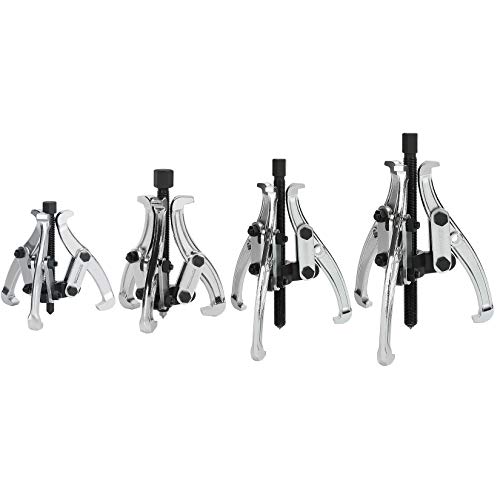
The DURATECH set is the budget-tier four-piece kit in this guide, and it arrives fully assembled, so there is no setup before the first pull. The four pullers cover spreads of 3, 4, 6, and 8 inches, and each one handles gears, pulleys, bearings, sprockets, and flywheels. Drop-forged chromium vanadium steel jaws are heat-treated for strength, with fine chrome plating for rust and corrosion protection, and the drive screw carries a black phosphatized coating for longevity.
Jaw reach runs 3-9/16 inches on the 3-inch puller, 4-29/32 inches on the 4-inch puller, 2-9/16 inches on the 6-inch puller, and 9-1/16 inches on the 8-inch puller. The jaws reverse through four or eight positions, giving an inside or outside grip with short, standard, long, or extra-long reach, which is useful when a part sits in a tight spot and only one jaw angle will seat.
Specs: Four pullers with maximum spreads of 3, 4, 6, and 8 inches; jaw reach of 3-9/16, 4-29/32, 2-9/16, and 9-1/16 inches; drop-forged chromium vanadium steel, heat-treated jaws with chrome plating; black phosphatized drive screw; reversible 4- or 8-position jaws for inside or outside grip; fully assembled, no assembly required; set weight 10.98 pounds; model DT3JGP04S
3. ABN Bearing Puller 6878

The ABN 6878 is a different kind of tool from the jaw sets above, and that is exactly why it earns a place here. It is a bearing splitter, built for parts that sit flush against a shoulder with no lip for a jaw to catch. Knife-like sharp angled edges on a tapered bevel slide behind the bearing even when clearance is extremely limited, and the bevel gets under the part far enough to pull without damaging the bearing itself.
The splitter halves include SAE threaded holes for pushing or pulling attachments, which are not included, so the tool pairs with a press or a puller yoke you already own. It handles pinions, differential bearings, shaft bearings, and gears, and it works for transmission rebuild work where a jaw puller cannot get a grip.
Specs: Bearing splitter with jaw opening from 1/2 inch to 4-5/8 inches; knife-edge tapered bevel for tight clearances; SAE threaded holes in splitter halves for pushing or pulling attachments, attachments not included; heat-treated chrome-plated steel with black oxide finish; weight 5.74 pounds; dimensions 9 by 7.5 by 1.25 inches; model 6878; pulling capacity not stated
4. GEARWRENCH 3-Piece Rear Axle Bearing Puller Set 41710

The GEARWRENCH 41710 is the specialist in this guide, built for one job and built to do it well. It removes semi-floating rear axle bearings on most domestic cars, and it comes as three pullers sized 1 to 1-7/8 inches, 1-15/16 to 2-3/8 inches, and 1-3/8 to 2-7/8 inches. Having three sizes in the box means the right puller is on hand whether the axle bearing is small or large, with no improvising around a single size.
The pullers are steel with a black oxide finish, and the set ships in a blow-molded case with laminated instruction cards built into the case design, so application information stays with the tool. The case lid is a removable hinged style that fits in a toolbox drawer, and the kit carries a lifetime warranty.
Specs: Three pullers sized 1 to 1-7/8 inches, 1-15/16 to 2-3/8 inches, and 1-3/8 to 2-7/8 inches; steel construction with black oxide finish; blow-molded case with laminated instruction cards; removable hinged case lid; lifetime warranty; weight 1.34 kilograms; made in Taiwan; model 41710
5. VEVOR 4-Piece Gear Puller Set 8625-4

The VEVOR set is a four-piece kit with spreads of 3, 4, 6, and 8 inches, and its jaws switch between two-jaw and three-jaw modes. That flexibility matters on the job: three jaws spread the load evenly on a round part, while two jaws fit where a third jaw has no room to seat. The jaws also reverse for internal or external pulling, and a double-hole adjustment widens the hook range, so one puller can grip parts of different depths.
Twelve locking nuts firm up the jaw connections, which helps keep the jaws from shifting under load. The set weighs 9 pounds, the lightest of the four-piece kits in this guide, and it works on pulleys, gears, bearings, and flywheels.
Specs: Four pullers with maximum spreads of 3, 4, 6, and 8 inches; 2- or 3-jaw reversible configuration; double-hole jaw adjustment; 12 locking nuts; set weight 9 pounds; model 8625-4; ton capacity not stated; steel grade not stated
How to choose
Match the puller to the part before you buy. Measure the outside diameter of the part you need to pull and the distance from the gripping surface to the end of the shaft. The puller needs a maximum spread larger than the part and a reach longer than that distance, with some margin left over. A puller that is too small will not seat, and a puller that is far too large is clumsy in tight spaces.
Jaw style decides which parts you can pull at all. Three-jaw pullers spread force evenly and suit round gears, pulleys, and bearings with a lip to grip. Two-jaw pullers fit where a third jaw has no room. A splitter is the answer when a bearing sits flush against a shoulder with no lip, and a dedicated axle set is the answer when rear axle bearings are a regular job. Sets that combine several sizes cover more jobs than a single puller, and reversible jaws double the ways each puller can grip.
Build quality shows up under load. Drop-forged and heat-treated steel jaws hold their shape when force rises, and a coated or plated finish resists rust in a damp shop. A forcing screw with a treated surface turns smoothly under load, and locking nuts or a firm jaw connection keep the jaws from shifting as pressure builds. Check the case as well: a set that lives in a fitted case stays complete, while loose pullers in a drawer tend to lose a jaw at the worst moment.
Who should skip
Skip the big four-piece sets if you only pull one size of part a few times a year, since a single puller in the right size does the same job and takes less shelf space. Skip jaw pullers entirely when the bearing sits flush with no lip to grip, since jaws need an edge to catch; a splitter is the right tool there. Skip hydraulic pullers for light home-shop work if a mechanical puller covers your sizes, since hydraulics add weight and upkeep for jobs a screw puller handles well.
Also skip any puller whose maximum spread is smaller than the part you need to remove, no matter how well made it is. A puller that cannot seat will slip, and a slipping jaw can damage the part and the shaft. Measure first, then buy the size that fits with margin.
FAQ
What size gear puller do I need for a small pulley?
Measure the outside diameter of the pulley and the distance from the gripping surface to the end of the shaft. Pick a puller with a maximum spread larger than the diameter and a reach longer than that distance. For most small pulleys, a 3-inch or 4-inch puller covers the job, and a four-piece set covers the range if you pull several sizes.
Can a jaw puller remove a bearing with no lip to grip?
A jaw puller needs an edge to catch, so it cannot grip a bearing that sits flush against a shoulder. A bearing splitter slides a tapered edge behind the part and lifts it from below, which is the right approach for flush bearings. The splitter then pairs with a press or a puller yoke to finish the job.
How do I keep a puller from slipping off the part?
Seat all jaws evenly around the part and center the forcing screw on the shaft end before applying force. Tighten gradually and check that each jaw stays seated as pressure rises. If a jaw slips, loosen the screw, reseat the jaws, and try again rather than forcing the puller harder.
Do I need a hydraulic puller for home shop work?
Most home shop jobs, from small pulleys to axle bearings, fall within the range of a mechanical screw puller. Hydraulic pullers suit heavy industrial work and badly seized large parts where a screw puller runs out of force. Match the puller to the size and condition of the parts you actually pull.
Final verdict
For most home shops, a four-piece three-jaw set is the best place to begin, and the Orion Motor Tech S00400 leads with four sizes, reversible jaws, and heat-treated steel across the range. The DURATECH set is the budget-tier alternative with the same size coverage and a fully assembled build. Add the ABN splitter when flush bearings are part of your work, and the GEARWRENCH axle set when rear axle bearings come up often. The VEVOR set rounds out the guide with flexible two- or three-jaw setup for tight spots. Measure the part, match the spread and reach, and the pull comes off clean.
Related guides
More from Amazon
Programs that pair well with the guide above. Offers and eligibility are set by Amazon and may change.
A free business account with business pricing and bulk-buying tools for work, shop or home office.
Create a business accountFree shipping on eligible items, Prime Video and more. Eligible new members can start with a free trial.
Start a Prime free trialAudiobooks and podcasts to listen to on the go. Eligible new members can start with a free trial.
Try Audible freeAd-free music streaming. Eligible new subscribers can start with a free trial.
Try Music Unlimited freeAs an Amazon Associate we earn from qualifying purchases.


Write Your Review
No reviews yet. Be the first to share your experience!