
Key takeaways
- Compare contractor table saws for renovation work: rip capacity, fence accuracy and motor power for ripping flooring, sheet goods and long boards on site.
What's inside
As an Amazon Associate I earn from qualifying purchases. This post may contain affiliate links at no extra cost to you.
Renovation ripping is unforgiving in a way shop woodworking is not. You are breaking down sheet goods in a gutted kitchen, ripping long flooring boards that must meet at a consistent width, and resizing trim stock in a room with no flat floor and no second chances on material the client already paid for. The real decision is not raw cutting power. It is whether the fence locks parallel every single time and whether the saw has the rip capacity to handle your longest, widest stock without a helper wrestling the far end.


This guide is for remodelers who have outgrown a small jobsite saw, flooring installers who rip material all week, and serious renovators setting up a semi-permanent saw station in a garage or on a long project. Every model below was picked from the names and specifications on its Amazon product page: contractor and hybrid saws on fixed stands, all with 10-inch blades.
Quick Picks
As an Amazon Associate we earn from qualifying purchases.
| Product | Best for | Key spec from title |
|---|---|---|
| Delta 36-725T2 | Everyday renovation ripping on a working crew’s budget of space | 30-inch rip capacity, steel extension wing |
| SawStop CNS175-TGP252 | Crews who want flesh-sensing blade braking on a full-size saw | 1.75 HP, 52-inch Professional T-Glide fence |
| Grizzly G0771Z | Wide rips and a big cast table in a project garage | 2 HP, T-shaped fence, 30-inch right rip |
| Shop Fox W1837 | Hybrid power on an open stand that still moves between jobs | 2 HP open-stand hybrid, 10-inch blade |
How to Choose
Rip Capacity Decides Which Jobs the Saw Can Take
Measure your material before you measure the saw. Ripping a full sheet of plywood crosswise is rare in renovation, but ripping flooring planks, wide shelving stock and long casing boards to a finished width is daily work. A 30-inch right-hand rip covers most of it. Stepping up to a 52-inch fence system turns the saw into a sheet-goods station, which only pays off if your projects regularly break down full panels. Buy for the widest rip you repeat weekly, not the widest you can imagine once.
The Fence Is the Accuracy, Not the Blade
A contractor saw earns its keep through its fence. T-square designs that clamp to a front rail at both ends of the measurement, like the systems on the Delta and Grizzly below, resist the slow drift that ruins a run of matching boards. Before the first cut on any job, rip a test strip, measure both ends with calipers, and nudge the fence until the numbers match. A fence that repeats that setting after being moved and reset is worth more than extra horsepower.
Motor Power and the Circuit You Actually Have
Most of these saws run on ordinary 120-volt circuits, which matters in older houses where the panel is already loaded. A 15-amp motor or a 1.75 HP unit rips framing lumber and hardwood flooring steadily if you feed at a pace the blade can clear. Two-horsepower hybrids wired for 120 volts ask more of the circuit, and some can be rewired for 240 volts if your project space has it. Match the saw to the wiring in the building, not the wiring you wish it had.
Weight, Stands and Living on a Jobsite for Weeks
Contractor saws sit between portable jobsite models and cabinet saws, and that middle ground is exactly their renovation value. At 260 to 335 pounds they stay put under long stock instead of skating across the floor, yet two people can still load one into a truck when the project ends. Open stands shed dust and are easier to level on uneven subfloors. Fully enclosed hybrid bases collect dust better through a 4-inch port but add bulk you must plan around.
The 4 Best Options
Delta 36-725T2 Contractor Table Saw
The 36-725T2 is the saw that fits how most renovation work actually flows: set it up in the garage or the largest gutted room, then rip flooring, shelving and trim stock for weeks without re-checking the fence every morning. Its 30-inch rip capacity swallows the wide boards remodels generate, the steel extension wing supports long pieces at the infeed side, and the T-square fence locks down with the repeatable feel crews rely on when ten boards must come out identical.
Specs
- Blade: 10 inches
- Motor: 15 amp, 120 volt
- Rip capacity: 30 inches
- Fence: T-square style
- Extension: steel extension wing
- Depth of cut: 3-1/8 inches at 90 degrees, 2-1/4 inches at 45 degrees
- Dado capacity: 13/16 inch by 8 inch stacked dado
Best for: Remodelers who need one dependable ripping station for flooring and sheet stock all project long.
Watch out for: Confirm the current listing’s included stand and wing configuration before ordering, since packages for this model have varied.
SawStop CNS175-TGP252 Contractor Saw
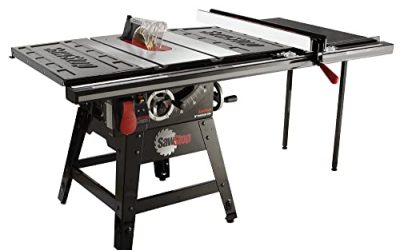
SawStop’s contractor saw answers a different renovation worry: the person feeding the saw may be you at hour nine of a flooring day, tired, in a dusty room. Its blade brake stops the blade on contact with skin, a feature no other saw in this roundup offers. Around that safety system sits a full-size contractor saw with a 52-inch Professional T-Glide fence, cast iron table and steel extension wings, giving it the widest rip capacity here and the table support to use it on full sheet goods.
Specs
- Motor: 1.75 HP, 120 volts, 14 amps, TEFC
- Blade: 10 inches, left tilt
- Fence: 52-inch Professional T-Glide fence system
- Max rip right of blade: 52-1/2 inches with 52-inch rails
- Table: cast iron, 20 inches wide by 27 inches deep
- Extension wings: steel, two included
- Overall weight: 335 lbs
Best for: Safety-first crews and solo remodelers who rip sheet goods and cannot accept blade-contact risk.
Watch out for: The brake cartridge is a consumable; a triggered brake or a dado setup needs the correct cartridge, so budget for a spare.
Grizzly G0771Z Hybrid Table Saw
The G0771Z puts a 2 HP motor and a cabinet-style T-shaped fence into a hybrid body that still runs on 120 volts, which suits a long renovation where the saw lives in one room for months. The 40-1/2 by 27-inch table gives long boards a stable landing, and the fence design borrows from Grizzly’s cabinet saws rather than from portable models. For renovators ripping hardwood flooring, stair parts and built-in shelving, that combination of table area and fence rigidity is the working surface the job keeps asking for.
Specs
- Motor: 2 HP, 120 volts (rewireable to 240 volts)
- Blade: 10 inches
- Fence: T-shaped fence
- Rip capacity: 30 inches right, 15 inches left
- Table: 40-1/2 inches by 27 inches
- Dust port: 4 inches
- Safety: riving knife and blade guard
Best for: Long projects with a fixed saw room, especially hardwood flooring and built-in work.
Watch out for: This is a heavy freight-delivered saw; confirm delivery arrangements and the assembled footprint against your room before ordering.
Shop Fox W1837 Open-Stand Hybrid Table Saw
The W1837 is the hybrid for renovators who still move between houses. Its open stand keeps the weight near 260 pounds, the lowest here, while the 2 HP motor and 10-inch blade handle the same ripping work as the heavier hybrids. It arrives with a 50-tooth alloy steel blade fitted, and the open base makes leveling on sloped garage floors and cleaning out dust buildup straightforward. If your renovation business runs one saw that must be a ripping station this month and load into a truck next month, this is the compromise that gives up the least.
Specs
- Motor: 2 HP
- Blade: 10 inches
- Design: open-stand hybrid table saw
- Included blade: 50-tooth alloy steel
- Weight: 260 lbs
Best for: Mobile remodelers who need hybrid ripping power without cabinet-saw weight.
Watch out for: The open stand collects less dust than an enclosed base, so plan on a shop vacuum routine around the saw on indoor jobs.
Which One Fits Your Situation
You Are Ripping Flooring and Trim in One House for a Month
Pick the Delta 36-725T2 or the Grizzly G0771Z. Both give you a 30-inch rip, a T-style fence that holds its setting, and enough table to support long boards without a roller stand army. The Delta suits a tighter setup space; the Grizzly’s larger table and 2 HP motor suit heavier hardwood and built-in work.
Your Crew Includes Newer Hands and Safety Drives the Purchase
Choose the SawStop CNS175-TGP252. It is the only saw here whose blade stops on skin contact, and renovation sites mix fatigue, dust and interruptions in ways that raise risk. The 52-inch fence and cast iron table also make it the strongest sheet-goods station in this group, so the safety purchase does not cost you capability.
The Saw Has to Move Between Projects Several Times a Year
Take the Shop Fox W1837. At roughly 260 pounds with an open stand, two people can load and re-level it without drama, and its 2 HP motor does not ask you to downsize the work when you arrive. Enclosed hybrids and the 335-pound SawStop are better saws to park than to transport.
You Break Down Full Sheet Goods on Site Regularly
The SawStop’s 52-1/2-inch rip is the only capacity here that centers a full sheet without flipping material or reaching for a track saw first. If panels are occasional rather than routine, any of the 30-inch saws here plus a straightedge guide covers the odd sheet at far less floor space and cost.
Common Mistakes
- Buying rip capacity for the biggest sheet imaginable instead of the boards you rip every week, then fighting an oversized saw in small rooms.
- Skipping the fence-parallel check after moving the saw; transport knocks fences out of square, and the first rip of the job reveals it.
- Feeding long flooring boards without infeed and outfeed support, which twists the stock against the fence and burns the cut edge.
- Running a 2 HP saw on a loaded household circuit shared with lights and chargers, then blaming the motor for nuisance breaker trips.
- Treating the included blade as a finish blade; most stock blades are general-purpose, and flooring work shows the difference.
Frequently Asked Questions
Is a contractor saw better than a jobsite saw for renovation work?
For a saw that stays set up through a project, usually yes. Contractor and hybrid models carry heavier tables, better fences and more weight, which keeps long boards tracking straight during rips. Jobsite saws still win when the saw rides in the truck daily. The deciding factor is how often the saw moves, not the badge on the motor.
What rip capacity do I need for ripping flooring and plywood?
Thirty inches to the right of the blade covers flooring planks, shelving and most cabinet parts used in renovation. You only need a 52-inch system if you routinely rip full 4-by-8 sheets down their length on the table saw itself. Many remodelers break sheets down with a circular saw first and reserve the table saw for final sizing.
Can these saws run on a normal household outlet?
The models here are built around 120-volt service, which is the point of the contractor class in older housing stock. A 15-amp or 1.75 HP saw runs comfortably on a standard circuit. Two-horsepower hybrids draw harder at startup, so give the saw its own circuit where possible and avoid sharing with heavy loads like space heaters.
Do I need to re-check the fence after moving the saw to a new house?
Yes, every time. Fences shift in transport, floors change the frame’s footing, and a fence that is a fraction out of parallel produces tapered boards you may not notice until installation. Rip one test board, measure both ends, and adjust before cutting project material. It takes minutes and saves the most expensive mistake in ripping work.
Related guides
More from Amazon
Programs that pair well with the guide above. Offers and eligibility are set by Amazon and may change.
A free business account with business pricing and bulk-buying tools for work, shop or home office.
Create a business accountFree shipping on eligible items, Prime Video and more. Eligible new members can start with a free trial.
Start a Prime free trialAudiobooks and podcasts to listen to on the go. Eligible new members can start with a free trial.
Try Audible freeAd-free music streaming. Eligible new subscribers can start with a free trial.
Try Music Unlimited freeAs an Amazon Associate we earn from qualifying purchases.

Write Your Review
No reviews yet. Be the first to share your experience!