
Key takeaways
- Compare the best contractor saws for professional shops and home workshops: induction motors, cast-iron tables, precise fences and flesh-sensing brakes.
What's inside
As an Amazon Associate I earn from qualifying purchases. This post may contain affiliate links at no extra cost to you.
A contractor saw sits between a portable jobsite saw and a full cabinet saw: heavy enough to stay put and cut accurately, light enough to move with a dolly and a second person, and usually able to run on a standard household circuit. The real decision is not the brand on the badge but how much rip capacity you need, whether the fence stays parallel after hundreds of cuts, and whether the motor keeps its speed when the blade meets dense hardwood.
This guide is for professional woodworkers, remodelers and serious home-shop owners who want one stationary saw for ripping sheet goods, cutting joinery and building cabinets. The three saws below were chosen from the names and specifications on their Amazon product pages, with a focus on induction motors, cast-iron tables and fence systems that hold their setting through years of daily use.
Quick Picks
As an Amazon Associate we earn from qualifying purchases.
| Product | Best for | Key spec from title |
|---|---|---|
| SawStop CNS175-TGP252 | Wide sheet goods and large panels | 52-Inch Professional T-Glide Fence System |
| SawStop CNS175-ATGP36 | Safety-first shops with limited space | 36” Professional T-Glide Advance Fence |
| Delta 36-5100 | A straightforward contractor saw on a standard circuit | 10-Inch Left Tilt Table Saw with 30-Inch RH Rip |
How to Choose
Motor type and power
Contractor saws usually run a 1.75 HP induction motor on a belt drive rather than the direct-drive universal motor in a portable saw. The belt drive runs quieter and with less vibration, and the induction motor holds its speed better when the blade meets dense stock. Check the voltage: most contractor saws run on a standard 120-volt circuit, while some can be rewired for 240 volts. A saw that needs a dedicated 240-volt line is a different purchase from one that plugs into a garage outlet, so match the motor to the power you already have before you fall in love with the fence.
Rip capacity and fence accuracy
Rip capacity decides the widest board you can cut between the blade and the fence. A 30-inch fence handles most cabinet parts and shelving, while a 52-inch fence lets you rip full sheets without a second setup. Fence accuracy matters more than the number: a fence that locks parallel to the blade every time saves hours of measuring and rework. T-square style fences and rack-and-pinion systems tend to hold their setting better than fences that clamp at one end only, so look for a fence that locks firmly, reads clearly along its rail and returns to the same setting after you move it aside.
Table size, weight and dust collection
A cast-iron table stays flat, dampens vibration and gives the saw the mass it needs to cut smoothly. Contractor saws weigh far more than portable saws, often well over 200 pounds, so plan for a permanent spot and a way to move the saw when it arrives. Check the dust port size and where it sits: a 4-inch port connects directly to a shop dust collector, while a smaller port needs an adapter. A saw that collects dust well keeps the cut line visible, keeps the table surface clean and leaves the shop easier to tidy between jobs.
Safety systems and blade changes
Every contractor saw should ship with a blade guard, a riving knife and anti-kickback pawls, and you should use them whenever the cut allows. SawStop adds a flesh-detection brake that stops the blade within milliseconds of skin contact, which changes the risk calculation for shops where several people use the same saw. Also check how the blade changes: a saw that needs a separate dado cartridge or a different throat plate for dado stacks adds cost and setup time, so confirm which accessories come in the box and which ones you will need to buy separately.
The 3 Best Options
SawStop CNS175-TGP252

The SawStop CNS175-TGP252 is the contractor saw for shops that rip full sheets and build large casework. Its 52-inch T-Glide fence gives you the widest rip capacity in this guide, and the 1.75 HP induction motor runs on a standard circuit while delivering steady power through hardwoods. The flesh-detection safety system is the reason many shops choose SawStop: the brake stops the blade within milliseconds of skin contact. At roughly 280 pounds with a cast-iron table, this is a saw that stays where you put it, and it rewards a permanent home with accurate, repeatable cuts.
Specs
- 10-inch blade
- 1.75 HP induction motor, 4,000 RPM
- 52-inch Professional T-Glide fence system
- 120/240-volt operation
- Cast-iron table, 20 x 27 inches
- SawStop Safety System flesh-detection brake
Best for: Shops that rip full sheets and need the widest fence in this guide.
Watch out for: The brake cartridge is a consumable; a brake activation means replacing the cartridge and usually the blade.
SawStop CNS175-ATGP36
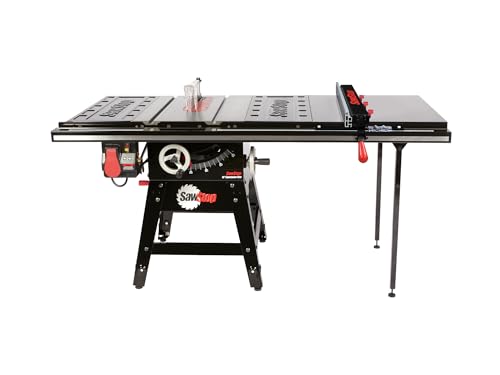
The CNS175-ATGP36 is the same 1.75 HP SawStop contractor saw with a shorter 36-inch T-Glide Advance fence, rails and extension table. It suits shops that want the flesh-detection brake and the cast-iron table but do not have room for a 52-inch fence rail. The shorter fence still handles cabinet parts, shelving and most sheet rips, and the extension table gives extra support for longer boards. If your shop is a single-car garage or a shared space, the smaller footprint makes the saw easier to live with while keeping the same motor and safety system as the larger configuration.
Specs
- 10-inch blade
- 1.75 HP induction motor, 4,000 RPM
- 36-inch Professional T-Glide Advance fence with rails and extension table
- 120/240-volt operation
- SawStop Safety System flesh-detection brake
- Part number CNS175-ATGP36-SI
Best for: Safety-first shops that need the SawStop brake in a smaller footprint.
Watch out for: The 36-inch fence will not rip a full sheet in one pass; plan for a track saw or a second setup for wide panels.
Delta 36-5100

The Delta 36-5100 is the straightforward choice in this guide: a 10-inch left-tilt contractor saw with a 30-inch rip capacity that runs on a standard 15-amp circuit. Its belt-driven induction motor keeps vibration low, and the tool-free split guard with a true rise-and-fall riving knife makes guard adjustments quick between cuts. There is no flesh-detection brake here, so the saw costs far less to buy and to keep running than the SawStop models, and it suits buyers who want a solid stationary saw without paying for a safety system they do not need or plan to maintain.
Specs
- 10-inch blade, left tilt
- 15-amp induction motor with belt drive
- 30-inch right-hand rip capacity
- Tool-free split guard design
- Rise-and-fall riving knife adjusted by a lever inside the throat plate
Best for: Buyers who want a simple, capable contractor saw on a standard household circuit.
Watch out for: The saw ships without a SawStop-style brake, so safe technique and the included guard and riving knife do the safety work.
Which One Fits Your Situation
You rip full sheets every week
Choose the SawStop CNS175-TGP252. The 52-inch fence lets you rip a full sheet without repositioning the fence or the material, and the cast-iron table supports long boards through the cut. The extra weight is a fair trade for a saw that stays square through a full day of sheet work.
Your shop is small and shared
Choose the SawStop CNS175-ATGP36. The 36-inch fence and extension table fit a single-car garage or a shared workshop, while the flesh-detection brake matters most where several people use the same saw. You give up full-sheet rips in one pass, but you keep the same motor and safety system.
You want the lowest running cost
Choose the Delta 36-5100. It runs on a standard 15-amp circuit, has no brake cartridge to replace, and its belt-driven induction motor is quiet and smooth. It is the simplest saw in this guide to own, and its 30-inch rip covers most cabinet and shelving work.
You cut hardwoods and joinery all day
Choose either SawStop configuration. The 1.75 HP induction motor holds speed through dense stock, and the cast-iron table keeps the cut steady from the first board to the last. Pick the 52-inch fence if you build large casework and rip wide panels often, or the 36-inch fence if your shop is tight and you want the same motor and brake in less floor space.
Common Mistakes
- Buying a contractor saw for a truck bed: these saws weigh well over 200 pounds and need a permanent spot, not a portable stand.
- Choosing by horsepower alone: fence accuracy and table flatness decide cut quality more than a small horsepower difference.
- Skipping the riving knife: removing it for convenience invites kickback on rip cuts.
- Ignoring the circuit: a saw that needs a dedicated 240-volt line is a different project from one that plugs into a garage outlet.
- Forgetting dado setup: check whether the saw needs a separate dado cartridge or throat plate before you plan dado joints.
Frequently Asked Questions
What is a contractor saw?
A contractor saw is a stationary table saw between a portable jobsite saw and a full cabinet saw. It usually has a 10-inch blade, a 1.75 HP belt-driven induction motor, a cast-iron table and an open or leg stand. It stays in one place in the shop, cuts more accurately than a portable saw, and usually runs on a standard household circuit.
Can a contractor saw cut full plywood sheets?
It can rip plywood into strips, but a full sheet crosscut is hard without outfeed support. A 52-inch fence helps on rips, while a 30-inch fence handles most cabinet parts. For full sheets, add roller stands or an outfeed table, or cut the sheet down with a track saw first, and always keep the sheet supported on both sides of the blade.
Do I need the SawStop brake?
The brake stops the blade within milliseconds of skin contact, which lowers the risk of a serious cut. It matters most in shared shops and for buyers who value the extra protection. It adds cost and the cartridge must be replaced after an activation, so weigh the safety benefit against the running cost.
What size dust port do contractor saws use?
Many contractor saws have a 4-inch dust port that connects directly to a shop dust collector. Smaller ports need an adapter or a shop vacuum with a reducer. Check the port size and location on the listing before you buy, so the saw fits the dust collection you already own and the port clears your outfeed table and mobile base.
Related guides
More from Amazon
Programs that pair well with the guide above. Offers and eligibility are set by Amazon and may change.
A free business account with business pricing and bulk-buying tools for work, shop or home office.
Create a business accountFree shipping on eligible items, Prime Video and more. Eligible new members can start with a free trial.
Start a Prime free trialAudiobooks and podcasts to listen to on the go. Eligible new members can start with a free trial.
Try Audible freeAd-free music streaming. Eligible new subscribers can start with a free trial.
Try Music Unlimited freeAs an Amazon Associate we earn from qualifying purchases.


Write Your Review
No reviews yet. Be the first to share your experience!