
What's inside
- What Is a Milwaukee M18 Circular Saw?
- Milwaukee M18 Circular Saw Models Compared
- How to Choose the Right Milwaukee M18 Circular Saw
- Choosing the Right Circular Saw Blade
- Safety Tips When Using a Milwaukee M18 Circular Saw
- Common Milwaukee M18 Circular Saw Buying Mistakes
- Frequently Asked Questions
- Final Thoughts
As an Amazon Associate I earn from qualifying purchases. This post may contain affiliate links at no extra cost to you.
A Milwaukee circular saw M18 is a cordless cutting tool designed for woodworking, framing, remodeling, and construction projects. However, the M18 range includes several models with different blade sizes, motor designs, cutting capacities, and performance levels. Choosing the right one depends on the materials you cut, how frequently you use the saw, and whether you prioritize portability or maximum cutting power.
For most buyers, a 7-1/4-inch model offers the greatest versatility for general construction and framing. The M18 FUEL 2834-20 is a strong choice for users who want a modern, high-performance sidewinder, while the 2930-20 suits professionals who prefer a rear-handle design. For lighter workloads and lower equipment costs, the 6-1/2-inch M18 2630-20 remains an option.
This guide explains the differences between Milwaukee M18 circular saw models, what their specifications mean, which batteries they support, and how to choose a saw for your actual workload.
As an Amazon Associate we earn from qualifying purchases at no extra cost to you.


Our Top Picks
What Is a Milwaukee M18 Circular Saw?
Milwaukee M18 circular saws are cordless power saws that operate on the manufacturer’s 18V M18 REDLITHIUM battery platform. They use a rotating circular blade to make straight, cross, rip, and bevel cuts in suitable materials.
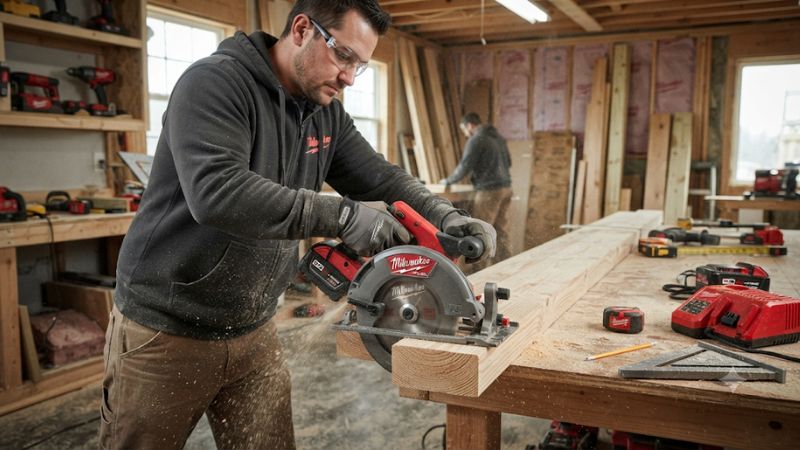
The M18 platform is particularly useful for contractors and DIY users who already own compatible Milwaukee cordless tools. Instead of maintaining separate battery systems for every tool, users can share compatible M18 batteries and chargers.
Milwaukee offers several circular saw configurations within this platform:
- Standard M18: Designed for general-purpose cordless cutting.
- M18 Brushless: Uses a brushless motor to improve efficiency and runtime compared with brushed designs.
- M18 FUEL: Combines Milwaukee’s POWERSTATE brushless motor, REDLINK PLUS electronics, and REDLITHIUM battery technology.
- Rear-handle M18 FUEL: Uses a different handle arrangement favored by some professional framers and contractors.
These categories are not interchangeable descriptions. A brushless M18 saw is not automatically an M18 FUEL model, and a larger blade does not necessarily mean better overall performance.
Milwaukee M18 Circular Saw Models Compared
The most useful way to compare Milwaukee circular saws is to look at blade diameter, motor technology, cutting capacity, and intended workload.
| Model | Blade Size | Motor Platform | No-Load Speed | Best For |
| 2630-20 | 6-1/2 inches | M18 brushed | 3,500 RPM | General DIY cutting |
| 2631-20 | 7-1/4 inches | M18 Brushless | 5,000 RPM | General construction |
| 2833-20 | 6-1/2 inches | M18 FUEL | 6,000 RPM | Professional lighter cutting |
| 2834-20 | 7-1/4 inches | M18 FUEL | 6,000 RPM | Professional framing and remodeling |
| 2930-20 | 7-1/4 inches | M18 FUEL rear-handle | 6,000 RPM | Heavy-duty construction |
Specifications are manufacturer-published no-load speeds. Actual cutting performance depends on the blade, material, battery condition, and operating technique.
1. Milwaukee M18 6-1/2-Inch Circular Saw – 2630-20
The 2630-20 is a conventional M18 circular saw designed for users who need cordless cutting without investing in a higher-performance FUEL model.
Its main specifications include:
- 6-1/2-inch blade diameter
- 3,500 RPM no-load speed
- 18V M18 battery platform
- Electronic blade brake
- Aircraft-aluminum shoe
- Magnesium upper blade guard
Its smaller blade makes the tool relatively convenient for general carpentry, plumbing, electrical work, and home improvement.
The 2630-20 can handle common wood-cutting tasks, but its brushed motor and lower rotational speed make it less attractive for demanding, repeated construction work than newer brushless alternatives.
Choose it if: You need an affordable M18 saw for occasional cuts and already own compatible batteries.
Avoid it if: You regularly cut thick lumber, work on demanding framing projects, or want the efficiency of a brushless motor.
2. Milwaukee M18 Brushless 7-1/4-Inch Circular Saw – 2631-20
The 2631-20 offers a larger blade and brushless motor while remaining below the FUEL product tier.
Its key specifications include:
- 7-1/4-inch blade
- 5,000 RPM no-load speed
- 2-1/2-inch cutting depth at 90 degrees
- Aluminum shoe
- Magnesium upper and lower guards
- Integrated LED light
- Electric blade brake
- Integrated rafter hook
The larger blade provides greater cutting capacity than the 6-1/2-inch 2630-20. This makes the 2631-20 more suitable for dimensional lumber and general construction.
Its brushless motor is also designed to improve efficiency and runtime compared with brushed alternatives.
However, it does not have all the performance features of the M18 FUEL models. Buyers should consider the difference in price and workload rather than assuming every brushless Milwaukee saw delivers identical performance.
Choose it if: You want a 7-1/4-inch blade, brushless efficiency, and a practical saw for regular DIY or construction work.
Avoid it if: Your workload requires the higher performance and additional features of an M18 FUEL model.
3. Milwaukee M18 FUEL 6-1/2-Inch Circular Saw – 2833-20
The 2833-20 is a more advanced option for users who want FUEL motor technology in a smaller circular saw.
Its POWERSTATE brushless motor delivers a manufacturer-rated 6,000 RPM no-load speed. Milwaukee also advertises up to 20% more power and up to 40% faster cutting compared with its stated comparison products. These are manufacturer claims, not independent performance measurements.
The tool-only package includes the saw, blade, blade wrench, and vacuum adapter.
Important features include:
- 6-1/2-inch blade
- POWERSTATE brushless motor
- REDLINK PLUS electronics
- M18 battery compatibility
- Vacuum adapter for dust extraction
- Compact blade configuration
The smaller blade can be useful when working in tighter spaces or handling lighter cutting jobs. However, its maximum cutting depth is lower than that of a 7-1/4-inch saw.
Choose it if: You want FUEL performance in a relatively compact circular saw and rarely need to cut thick lumber.
Avoid it if: Your projects regularly involve thick dimensional lumber or deeper bevel cuts.
4. Milwaukee M18 FUEL 7-1/4-Inch Circular Saw – 2834-20
Best all-around professional option
The 2834-20 is one of the most attractive options in Milwaukee’s M18 circular saw lineup for professional carpenters, remodelers, and contractors.
Its POWERSTATE brushless motor reaches 6,000 RPM without load. Milwaukee specifies a maximum cutting depth of 2-5/8 inches at 90 degrees, making it suitable for many common framing and construction applications.
Its main features include:
- 7-1/4-inch blade
- 6,000 RPM no-load speed
- 2-5/8-inch cutting depth at 90 degrees
- Bevel detents at 22.5 and 45 degrees
- Magnesium shoe and blade guards
- Integrated LED work light
- Electric blade brake
- Integrated rafter hook
- Dust port and vacuum adapter
The 2834-20 also includes depth detents for commonly used cutting positions. These features can make repeated adjustments more convenient during construction work.
Milwaukee states that the saw can deliver up to 750 cuts per charge when paired with an M18 REDLITHIUM FORGE HD12.0 battery. This is a manufacturer-reported figure, not a guaranteed result for every material, blade, or cutting condition.
Another advantage is its compatibility with the M18 REDLITHIUM battery system. Existing M18 users can potentially add the saw without purchasing an entirely separate battery platform.
The main consideration is the higher purchase cost compared with standard M18 models. It may also be more tool than occasional DIY users need.
Choose it if: You regularly cut framing lumber, plywood, and other construction materials and want a high-performance sidewinder.
Avoid it if: You only make occasional household cuts or prioritize the lowest initial equipment cost.
5. Milwaukee M18 FUEL 7-1/4-Inch Rear-Handle Circular Saw – 2930-20
The 2930-20 is designed for professionals who prefer a rear-handle circular saw configuration.
Unlike conventional sidewinder designs, its handle arrangement places the main grip behind the motor and blade assembly. Some experienced contractors prefer this layout for handling longer cuts and working with large construction materials.
Its specifications and features include:
- 7-1/4-inch blade
- 6,000 RPM no-load speed
- POWERSTATE segmented brushless motor
- 2-5/8-inch cutting capacity at 90 degrees
- 53-degree maximum bevel capacity
- REDLINK PLUS electronics
- LED work light
- Electric blade brake
- Magnesium shoe and guards
- Integrated rafter hook
The saw also includes depth detents and positive bevel detents. Milwaukee specifies up to 700 cuts per charge when paired with its REDLITHIUM FORGE HD12.0 battery.
The rear-handle arrangement is the biggest purchasing consideration. It is not automatically more accurate or comfortable for everyone. Grip preference, cutting position, workpiece size, and operator experience all influence handling.
Choose it if: You are a professional contractor who prefers rear-handle saws for demanding framing and construction work.
Avoid it if: You are accustomed to sidewinder saws and do not have a specific reason to change handle configurations.
How to Choose the Right Milwaukee M18 Circular Saw
Before purchasing, consider the following factors rather than choosing solely by motor speed or product category.
1. Choose the Correct Blade Size
Blade diameter determines the approximate cutting capacity of a circular saw.
The two common sizes in the Milwaukee M18 range are:
| Blade Size | Main Advantages | Typical Applications |
| 6-1/2 inches | Smaller cutting system and convenient handling | Plywood, thinner lumber, general carpentry |
| 7-1/4 inches | Greater cutting depth and wider blade selection | Framing, dimensional lumber, construction |
A 6-1/2-inch saw can be sufficient for many home improvement projects. However, a 7-1/4-inch saw offers greater flexibility when cutting thicker materials.
For example, if your projects regularly involve standard 2x lumber, the 7-1/4-inch category is generally the more versatile choice.
Remember that blade diameter alone does not determine cutting depth. The saw’s base design, blade position, and bevel setting also matter.
2. Understand Brushed, Brushless, and FUEL Motors
Motor technology affects efficiency, performance, and long-term ownership considerations.
Brushed motors use physical brushes to transfer electrical current to the motor’s rotating components. They are a conventional design and can be suitable for occasional work.
Brushless motors use electronic controls instead of traditional motor brushes. This design can reduce friction-related wear and improve electrical efficiency.
M18 FUEL is Milwaukee’s higher-performance product platform. Its tools combine POWERSTATE brushless motors, REDLINK PLUS electronics, and REDLITHIUM battery technology.
For frequent professional use, a FUEL saw may justify its higher initial cost. For occasional household projects, a standard M18 model may provide sufficient capability.
3. Consider Battery Capacity and Runtime
Every model discussed in this guide belongs to the M18 battery platform. However, not every M18 battery provides the same energy capacity or operating performance.
Battery capacity is measured in amp-hours (Ah). A higher Ah rating generally indicates more stored energy, although actual runtime also depends on the battery design, motor load, material, and cutting conditions.
Consider these general differences:
- Smaller-capacity batteries can help reduce the overall weight of the saw.
- Larger-capacity batteries can provide more energy for extended cutting sessions.
- High Output and FORGE batteries are designed for demanding M18 applications.
- Battery condition and temperature can affect available performance.
A particularly important distinction is that a manufacturer’s maximum cuts-per-charge figure is tied to a specific battery and test configuration. It should not be treated as a universal runtime estimate.
The 2834-20 and 2930-20 are compatible with M18 REDLITHIUM batteries, according to Milwaukee. Nevertheless, check the exact model’s manual for battery operating recommendations.
4. Evaluate Cutting Depth and Bevel Capacity
Cutting depth determines how thick a material the saw can cut in one pass.
For the 7-1/4-inch models:
| Model | Maximum Cutting Depth at 90 Degrees |
| 2631-20 | 2-1/2 inches |
| 2834-20 | 2-5/8 inches |
| 2930-20 | 2-5/8 inches |
These figures show why a 7-1/4-inch blade is useful for framing and construction.
Bevel capacity is another important consideration. It determines the maximum angle at which the blade can tilt relative to the base plate.
If your work involves angled roof framing, trim, or other bevel cuts, compare the manufacturer’s maximum bevel angle and available adjustment stops.
Do not assume every M18 model has identical bevel capacity or detent positions.
5. Check the Included Accessories
Tool-only and kit packages can have significantly different purchase costs.
A tool-only package generally excludes the battery and charger, even when the product description highlights compatibility with the M18 platform.
Before purchasing, check whether the package includes:
- Circular saw blade
- Blade wrench
- Battery
- Battery charger
- Carrying bag or case
- Dust extraction adapter
- Rip fence, if required
For example, the 2834-20 tool-only package includes a 7-1/4-inch 24-tooth framing blade, blade wrench, and vacuum adapter. It does not include a battery or charger.
If you already own compatible M18 batteries and chargers, purchasing a bare tool can reduce unnecessary equipment costs.
Choosing the Right Circular Saw Blade
Even a powerful Milwaukee M18 saw cannot deliver good results with an unsuitable blade. Blade selection should match the material, cutting operation, and saw specifications.
Blade Tooth Count
Different tooth counts serve different purposes:
- 24-tooth blades: Commonly used for framing and fast cuts in construction lumber.
- 40-tooth blades: Often suitable for cleaner general-purpose cuts in plywood and wood products.
- 60-tooth blades: Can provide finer finishes in suitable wood-cutting applications.
Tooth count is only one consideration. Blade geometry, carbide quality, kerf thickness, and material compatibility also influence cutting performance.
Check Blade Compatibility Before Installation
Before purchasing a replacement blade, verify:
- The blade diameter matches the saw’s specified size.
- The arbor hole matches the tool’s arbor.
- The blade is rated for the saw’s operating speed.
- The blade is designed for the material being cut.
- The blade thickness and configuration are permitted by the manufacturer.
Do not install a blade simply because it physically fits. An incompatible blade can create serious operating hazards.
Safety Tips When Using a Milwaukee M18 Circular Saw
Circular saws operate at high rotational speeds and can cause severe injuries when handled incorrectly. Battery power does not make a cordless saw safer than a corded equivalent.
Follow these precautions before and during operation.
Wear appropriate protective equipment. Use safety glasses or suitable eye protection, hearing protection, and respiratory protection appropriate to the material and dust exposure. Avoid loose clothing and jewelry that could become caught in moving components.
Inspect the lower blade guard. Check that it moves freely and returns to its protective position. Never operate the saw if the guard is damaged, stuck, or disabled.
Secure the workpiece. Use appropriate clamps or other suitable supports. Avoid holding small pieces by hand while cutting.
Watch for kickback. Kickback can occur when the blade binds, pinches, or becomes misaligned in the cut. Maintain a firm grip with both hands where the saw design allows, position your body away from the blade’s cutting path, and support the workpiece properly.
Keep the cutting area clear. Check for nails, screws, hidden electrical wiring, and other obstructions before cutting.
Manage dust exposure. Wood dust and dust from treated materials can create respiratory hazards. Use suitable dust extraction and protective equipment.
Remove the battery before adjustments. Disconnect the battery before changing blades, making adjustments, cleaning the tool, or performing maintenance.
Never defeat the blade guard, force the saw through a cut, or use a damaged blade. If the tool behaves unusually or a safety mechanism fails, stop using it and arrange appropriate service.
Common Milwaukee M18 Circular Saw Buying Mistakes
Even experienced DIY users can choose the wrong saw when comparing specifications without considering their actual projects.
Here are four mistakes worth avoiding.
Buying a 6-1/2-inch saw for frequent thick-lumber cutting: A smaller saw can handle many woodworking jobs, but its reduced cutting capacity may require additional passes or make certain applications unsuitable.
Assuming all brushless models are FUEL: Milwaukee’s M18 Brushless and M18 FUEL categories represent different product tiers. Check the exact model number rather than relying on the word brushless.
Ignoring battery and charger costs: A tool-only purchase may initially look inexpensive, but buyers starting a new M18 collection must account for compatible batteries and charging equipment.
Choosing a saw based only on RPM: No-load RPM does not tell the whole performance story. Motor design, electronics, blade selection, battery capability, and material conditions all affect actual cutting results.
Frequently Asked Questions
1. Is the Milwaukee M18 circular saw worth buying?
Yes, a Milwaukee M18 circular saw can be a worthwhile investment for users who need cordless cutting capability and already own compatible M18 batteries. The standard models suit general DIY work, while FUEL models are better suited to demanding professional applications.
2. What is the difference between Milwaukee M18 and M18 FUEL circular saws?
M18 identifies Milwaukee’s 18V cordless platform, while M18 FUEL identifies a higher-performance product category combining POWERSTATE brushless motors, REDLINK PLUS electronics, and REDLITHIUM battery technology. FUEL models generally target more demanding workloads.
3. Can I use any Milwaukee M18 battery with an M18 circular saw?
Milwaukee identifies M18 REDLITHIUM batteries as compatible with the 2834-20 and 2930-20. However, battery capacity and performance vary, and users should follow the recommendations in the exact tool manual. M12 batteries are not interchangeable with M18 tools.
4. Is a 6-1/2-inch or 7-1/4-inch Milwaukee circular saw better?
A 7-1/4-inch saw is generally more versatile for framing and thicker lumber because it offers greater cutting depth. A 6-1/2-inch model can be sufficient for plywood, thinner materials, and general household projects where maximum cutting capacity is less important.
Final Thoughts
Choosing the right Milwaukee circular saw M18 comes down to matching the tool’s capabilities to your workload.
The 2630-20 is a practical option for occasional cutting, while the 2631-20 offers a larger blade and brushless motor for more regular construction work. The 2833-20 provides FUEL performance in a smaller blade configuration.
For users who regularly work with framing lumber and need greater cutting capacity, the 2834-20 is an excellent all-around option. Contractors who prefer a rear-handle design should also consider the 2930-20.
Before making a purchase, compare the exact model number, cutting depth, battery requirements, included accessories, and total ownership cost. A properly selected circular saw will make woodworking and construction tasks more manageable while helping you avoid paying for capabilities you rarely use.
Related guides
More from Amazon
Programs that pair well with the guide above. Offers and eligibility are set by Amazon and may change.
A free business account with business pricing and bulk-buying tools for work, shop or home office.
Create a business accountFree shipping on eligible items, Prime Video and more. Eligible new members can start with a free trial.
Start a Prime free trialAudiobooks and podcasts to listen to on the go. Eligible new members can start with a free trial.
Try Audible freeAd-free music streaming. Eligible new subscribers can start with a free trial.
Try Music Unlimited freeAs an Amazon Associate we earn from qualifying purchases.






Write Your Review
No reviews yet. Be the first to share your experience!