What's inside
As an Amazon Associate I earn from qualifying purchases. This post may contain affiliate links at no extra cost to you.
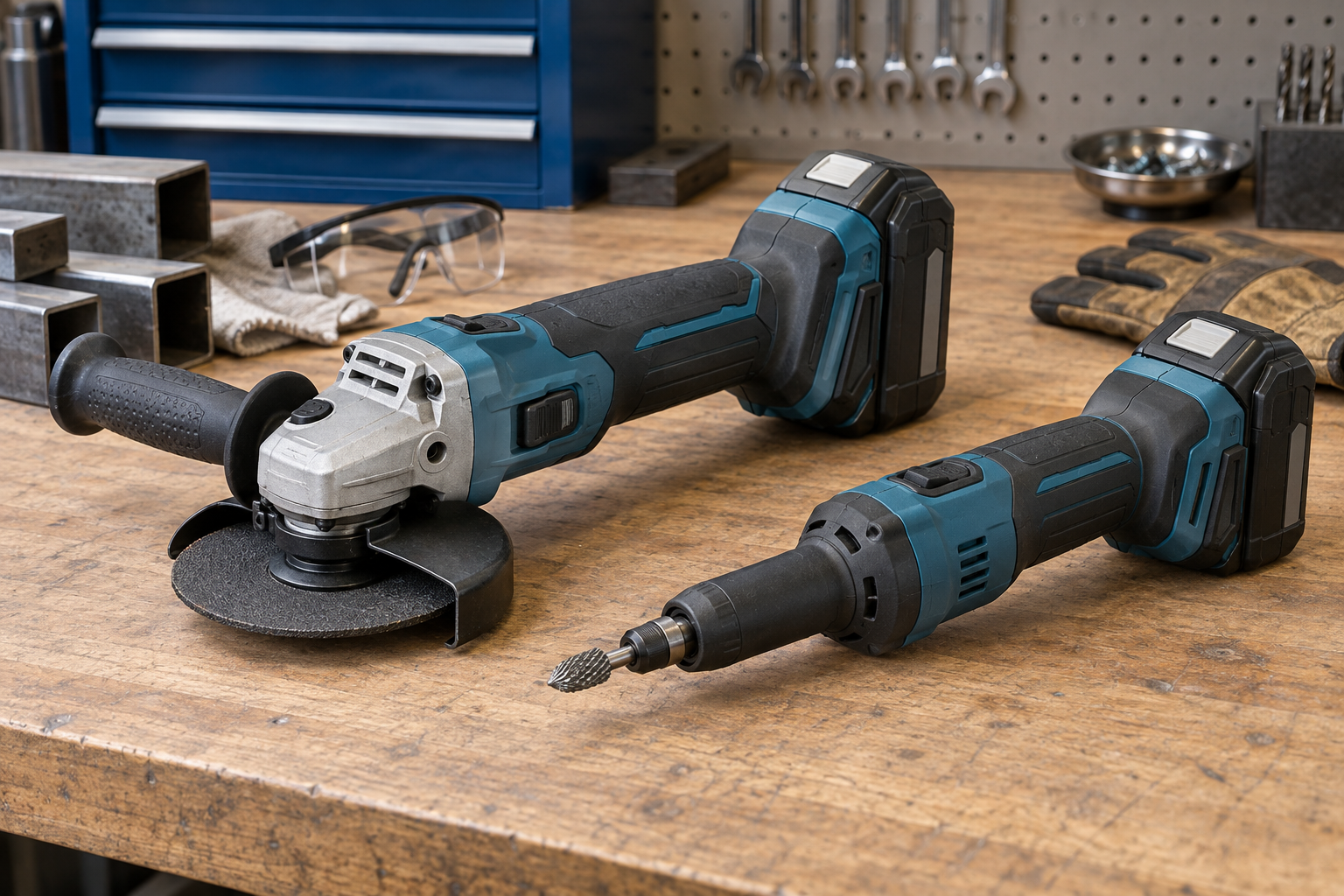
A cordless die grinder is useful for deburring when the work is too awkward for a bench grinder or a file. It can clean up cut tube, knock down weld spatter, and ease sharp edges without a cord dragging across the job. The trade-off is control: a small burr can remove metal quickly, and a high-speed grinder can snag an edge or throw chips.
As an Amazon Associate we earn from qualifying purchases at no extra cost to you.


What to buy for deburring
For general metalwork, start with a 1/4-inch collet grinder with variable speed and a brake. Variable speed makes it easier to start gently on thin sheet or a sharp corner; a brake helps limit coast-down after you release the trigger. A paddle or lock-off trigger is a useful safety feature, especially if you work in cramped positions.
Check the tool’s rated speed against the accessory’s maximum RPM. Die grinders commonly run at tens of thousands of RPM, and a burr or mounted point must be rated for at least the grinder’s speed. Never use a damaged, bent, or poorly seated accessory. If the tool offers multiple speed settings, use the lowest setting that cuts cleanly rather than pressing harder.
For a first cordless setup, compare a variable-speed cordless die grinder on a battery platform you already own. If you only deburr occasionally, a basic single-speed tool may be enough; spend the savings on suitable carbide burrs and eye protection.
Choosing between tool types
| Option | Best fit | Trade-off |
|---|---|---|
| Compact straight grinder | Open edges, short welds, general shop work | Harder to reach around corners |
| Right-angle grinder | Inside corners and restricted access | Head can obscure the cut; less room for some accessories |
| Single-speed grinder | Occasional deburring on robust parts | Less control on thin or delicate work |
| Variable-speed grinder | Mixed materials and edge conditions | Usually costs more; speed control does not replace a light touch |
A straight tool is the sensible default if most edges are exposed. A right-angle head is worth considering when access is the real problem, but check its overall length and head clearance before buying. Search for a cordless right-angle die grinder only if your work regularly demands one.
Battery and platform trade-offs
Battery compatibility is often more important than a small difference in tool features. A grinder that shares packs with your drill and impact driver avoids buying another charger and battery. Check the exact platform and battery generation: packs from a brand are not always interchangeable across every tool line.
Die grinders draw substantial power under load. A compact 2.0Ah pack keeps the tool light for brief cleanup, but may run down quickly during sustained grinding. A larger 4.0Ah or 5.0Ah pack generally gives more working time, at the cost of extra weight and bulk. That extra weight matters when you are holding the grinder away from your body or working overhead. For production work, two batteries and a charger are more practical than one large pack if downtime is costly.
Do not assume a larger battery will make a grinder cut faster. Cutting rate depends on the tool, accessory, material, and pressure. If the tool bogs down, ease off and let the burr work. Forcing it can overheat the motor, chew up the accessory, or catch the edge and kick the tool sideways.
Choose the right accessory
Carbide burrs are effective for removing welds and shaping heavier steel, but they are aggressive and can leave grooves. Use a fine or single-cut burr for more controlled work; a coarse double-cut burr removes stock quickly but can chatter if pushed into a thin edge. For light edge breaking, a mounted abrasive point or suitable flap-style accessory may leave a smoother finish. Confirm the shank size, collet fit, accessory RPM rating, and any restrictions in the grinder manual.
For a clean, even deburr, hold the tool so the accessory meets the edge at a shallow angle and keep it moving. Start on a scrap piece. A couple of light passes usually beat one heavy pass: the latter can round over the edge, thin a corner, or gouge a finished surface. Secure the work in a vise where possible, and keep sparks and hot chips away from batteries, solvents, and people.
Safety and common problems
Wear safety glasses plus a face shield when practical, hearing protection, and appropriate gloves that do not risk catching in rotating parts. Keep loose clothing and long hair clear. Clamp small parts rather than holding them in your hand. A burr can grab a sharp edge, and the reaction can pull the tool out of line in an instant. Do not use a die grinder as a cutoff tool unless the grinder and accessory are specifically designed for that job.
If the accessory vibrates, stop and check for a bent shank, damaged burr, debris in the collet, or poor seating. If the edge turns blue, you are generating too much heat: reduce pressure, pause, or use a more appropriate accessory. A battery or motor that becomes unusually hot also needs a break. Brush dust from vents after use, inspect the collet for wear, and remove the battery before changing accessories.
Choose based on the work you actually do: a platform-matched straight grinder is enough for most exposed edges, while variable speed and a right-angle head earn their cost when control or access is a recurring issue. A cheaper single-speed option is fine for occasional cleanup on sturdy parts, provided its rated speed and collet suit the accessories you plan to use.
Related guides
- Longest Lasting Lawn Mower Battery: AGM vs Lithium vs Flooded Lifespan and Cost per Season
- Duralast Gold Lawn Mower Battery Review: U1 Fit, CCA and When to Pay for AGM
- Greenworks Pro 80V 21-Inch Mower Review: Runtime Math, Push vs Self-Propelled and Yard Fit
- Bosch High Pressure Washer Gun Replacement: Fittings, Adapters and What Fits Your Model