What's inside
As an Amazon Associate I earn from qualifying purchases. This post may contain affiliate links at no extra cost to you.
What matters on large fasteners
Trailer lugs, suspension hardware, hitch components and equipment bolts can be stubborn, corroded or simply too large for a compact impact wrench. The right cordless tool can save time, but a high torque rating does not guarantee that every fastener will come loose. Rust, thread damage, long-term over-tightening and the way a joint is secured all matter.
For regular work on heavy trailers or equipment, look at a 1/2-inch high-torque impact wrench with a brushless motor and a large battery from a platform you already own. If the work includes very large fasteners or repeated removal of severely seized hardware, a 3/4-inch drive may make sense. For occasional wheel changes and ordinary trailer maintenance, a mid-torque 1/2-inch wrench is often the better-value choice.
As an Amazon Associate we earn from qualifying purchases at no extra cost to you.


Choose a drive size and torque class
| Tool type | Best fit | Trade-off |
|---|---|---|
| 1/2-inch mid-torque | Occasional trailer service, passenger vehicles and moderate fasteners | Lighter and often cheaper, but may stall on seized or oversized hardware |
| 1/2-inch high-torque | Regular trailer, truck and equipment work | More capable, but heavier and bulkier; still needs a suitable socket and battery |
| 3/4-inch high-torque | Large fasteners, heavy equipment and frequent demanding work | More tool than many owners need; larger drive sockets and higher purchase cost |
Manufacturers often advertise breakaway or nut-busting torque, measured under particular test conditions. It is useful for comparing tools from the same brand, but it is not a reliable prediction of performance on a corroded fastener in the field. Tightening torque is a separate figure and should not be treated as a safe setting for installing wheel nuts.
What to buy
A 1/2-inch high-torque cordless impact wrench is the practical starting point for demanding trailer work. Check the tool’s bare weight and the weight of the recommended battery: a large battery improves runtime and can help maintain power under load, but it also makes overhead or awkward work tiring. A 5.0 Ah pack is a useful general-purpose size; a high-output pack may perform better on sustained heavy fastening, depending on the platform.
Consider a 3/4-inch cordless impact wrench if your regular jobs involve large axle, suspension or equipment fasteners and you already have the correct 3/4-inch impact sockets. The larger drive is not automatically stronger in every situation, and adapters can become a weak point. Avoid using a 1/2-to-3/4-inch adapter to make an undersized tool do a job it cannot handle.
If you already own batteries and chargers, staying on that platform can be more economical than buying into a new one for one wrench. Compare bare-tool and kit prices, battery capacity, warranty terms and availability of replacement batteries. A 1/2-inch mid-torque impact wrench is a sensible cheaper option for occasional service, especially when a breaker bar is available for the few fasteners it cannot move.
Sockets, controls and fit
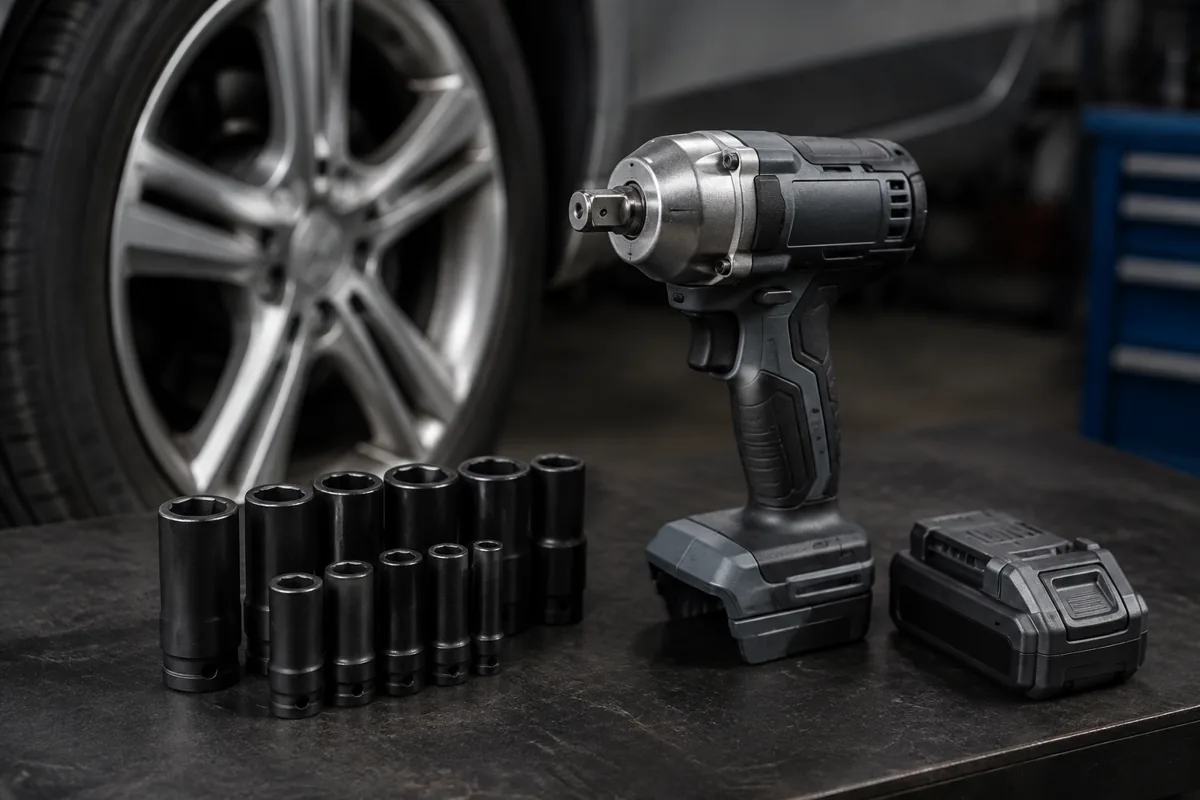
Use impact-rated sockets, not ordinary chrome hand sockets. Impact sockets are designed for the repeated shock loads an impact wrench produces. Match the socket to the fastener exactly; a loose fit can round corners, particularly on rusted nuts. Deep sockets are often necessary for wheel studs, while thin-wall sockets may be needed where a wheel opening is tight. Check that a thin-wall socket is impact-rated.
Useful features include several speed or power modes, a brake or stop function that reduces socket run-on, and a forward/reverse control that is easy to distinguish with gloves on. A mode intended to reduce over-tightening can help with removal or snugging, but it does not replace a torque wrench. Check overall length if you need to reach between frame members or around suspension parts.
Use it without damaging the job
Before loosening, secure the trailer or equipment on firm, level ground, chock wheels and support raised loads with rated stands. Never rely on a jack alone. Confirm whether a fastener has a left-hand thread or a locking feature before applying force. If a nut begins to turn but the stud turns with it, stop and address the joint rather than continuing to hammer.
For installation, start nuts by hand and use the impact only to bring them close to seated. Finish with a calibrated torque wrench to the specification for that particular wheel, axle or assembly. Tightening by impact can stretch studs, damage threads, distort a wheel or leave clamping force uneven. Recheck wheel fasteners at the interval specified by the trailer or equipment manufacturer.
If a fastener does not move after several short bursts, stop rather than holding the trigger indefinitely. Long impact sessions heat the tool, battery and fastener, and can break a stud or damage the drive. Apply a suitable penetrant, allow time for it to work, clean exposed threads where possible, and try again. If the tool still stalls, use a longer breaker bar, controlled heat where safe, or a repair shop. Keep heat away from tires, bearings, fuel, wiring and flammable residue.
Make the choice fit the work
Buy for the fasteners you face most often, not the single worst bolt you have ever encountered. A high-torque 1/2-inch wrench suits many owners who regularly service trailers and equipment; a mid-torque model is enough for lighter, occasional jobs. Step up to 3/4 inch when large fasteners and frequent heavy use justify the extra size and cost. In every case, correct sockets, a charged battery and a torque wrench for installation matter as much as the impact wrench itself.
Related guides
- Longest Lasting Lawn Mower Battery: AGM vs Lithium vs Flooded Lifespan and Cost per Season
- Duralast Gold Lawn Mower Battery Review: U1 Fit, CCA and When to Pay for AGM
- Greenworks Pro 80V 21-Inch Mower Review: Runtime Math, Push vs Self-Propelled and Yard Fit
- Bosch High Pressure Washer Gun Replacement: Fittings, Adapters and What Fits Your Model