What's inside
As an Amazon Associate I earn from qualifying purchases. This post may contain affiliate links at no extra cost to you.
What matters for removing lug nuts
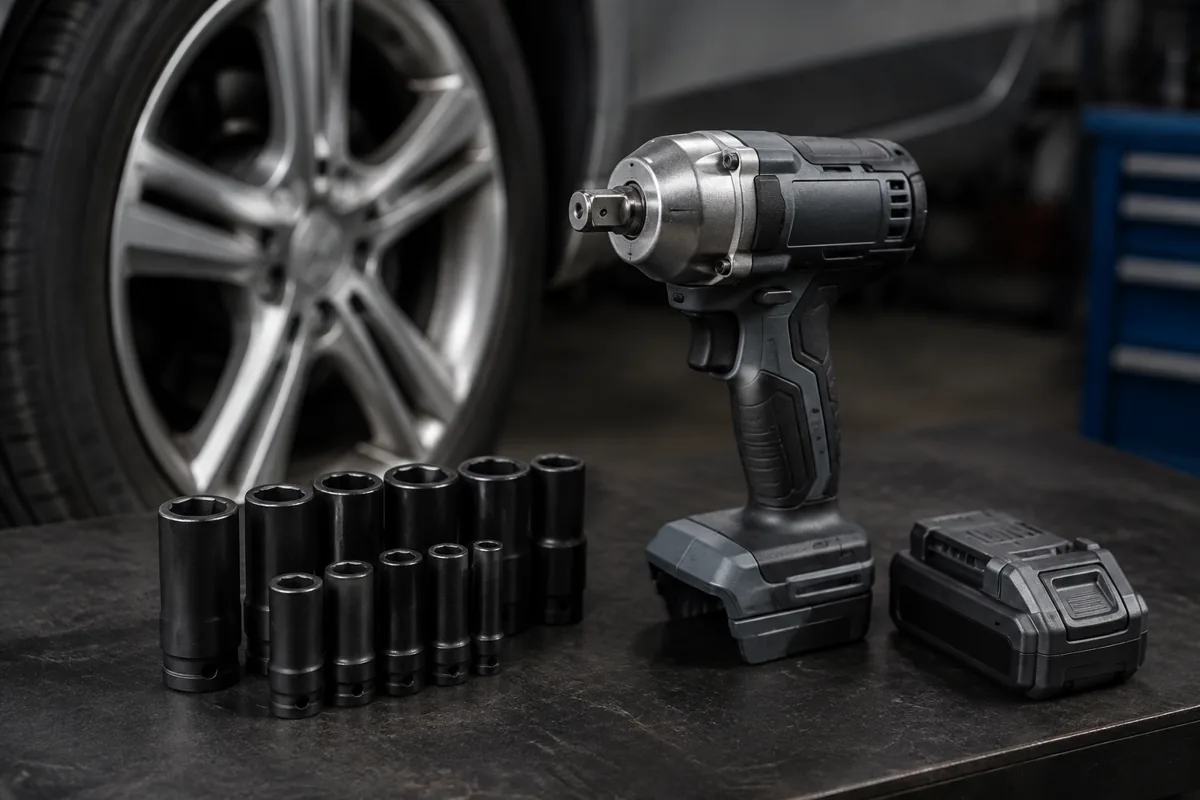
For a home garage, a cordless impact wrench should remove properly installed wheel lug nuts without being so large or powerful that it is awkward around the car. The useful middle ground is usually a 1/2-inch-drive mid-torque wrench with a brushless motor and a battery around 4.0 to 5.0 Ah. A compact 3/8-inch wrench can work for passenger cars, especially if the nuts are not heavily corroded, but it has less reserve when a fastener is stubborn.
Manufacturers quote breakaway or fastening torque under different conditions, so those figures are not directly comparable. A high advertised number does not guarantee that a tool will loosen every rusted lug nut. Battery charge, socket fit, fastener condition and how tightly the nuts were installed all matter. For a typical garage, a mid-torque model is a better balance than a heavy high-torque wrench meant for larger vehicles or frequent shop use.
As an Amazon Associate we earn from qualifying purchases at no extra cost to you.


Choose the right size and drive
A 1/2-inch square drive is the most practical choice if you already own impact-rated 1/2-inch sockets or work on more than one vehicle. It is also easier to find suitable thin-wall impact sockets for wheels. A 3/8-inch model is smaller and lighter, but you may need to buy new sockets, and it is more likely to stall on an over-tightened or corroded nut.
Look for variable-speed control, a brake or auto-stop mode for loosening, and a low-power mode for running nuts off and on. These features reduce the chance of spinning a nut across the wheel or hammering it against the stud. A friction-ring anvil makes socket changes quick; a pin-detent anvil holds the socket more securely but can be slower to swap. Neither style is essential for occasional tire changes.
Quick comparison
| Type | Best fit | Trade-off |
|---|---|---|
| Compact 3/8-inch impact wrench | Passenger cars, light use, tight spaces | Lighter and cheaper, but less reserve and may require different sockets |
| Mid-torque 1/2-inch impact wrench | Most home garages and mixed vehicle work | Heavier than compact models; usually the best all-around choice |
| High-torque 1/2-inch impact wrench | Frequent heavy work, trucks, badly seized fasteners | Bulkier, often more expensive, and excessive for routine wheel changes |
Factor in the battery platform
If you already own cordless tools, staying on that battery platform can make more sense than buying a new ecosystem for one wrench. Check that the wrench is compatible with the batteries you have, and compare bare-tool and kit prices. A bare tool is the cheaper choice when you already have a healthy battery and charger; a kit can be better value if it includes a useful battery and fast charger.
Very small batteries can make the wrench lighter, but may limit sustained performance or run time. For wheel changes, a 4.0 Ah pack is a sensible starting point; a larger pack adds weight but can be useful for repeated work. Cold batteries also deliver less power. If the wrench struggles, charge the pack, try a second battery, and make sure the socket is fully seated before assuming the tool lacks torque.
If you are buying your first tool in a platform, compare the broader range of cordless hand tools and batteries, not just the impact wrench. A platform with useful drills, lights and garden tools may be a better long-term buy than one with a slightly cheaper wrench. Browse 1/2-inch mid-torque cordless impact wrenches and compare bare-tool and kit versions.
Use it without damaging the wheel or studs
Use an impact-rated, preferably thin-wall, socket that fits the lug nut exactly. A regular chrome socket can crack under impact use. Put the vehicle on firm, level ground, secure it against rolling, and use a jack stand if a wheel is off the ground. Never rely on the jack alone. Keep the socket square to the nut; a tilted socket can round the corners or damage the wheel’s lug recess.
Use the impact wrench to loosen the nuts, then finish removal by hand. When fitting the wheel, start each nut by hand for several turns so it cannot cross-thread. Use the wrench’s low setting only to snug the nuts, not to set final tightness. Finish with a calibrated torque wrench to the vehicle maker’s specification, usually found in the owner’s manual or on a service label. Passenger-car values commonly fall around 80–100 lb-ft, but that is not a substitute for checking the correct specification.
Repeatedly hammering a nut after it has stopped moving can stretch studs, damage threads or overheat the tool. If a nut will not loosen after a few short bursts, stop and check for a locking nut, the correct socket and a fully charged battery. A breaker bar can provide controlled leverage; penetrating oil may help on exposed, corroded threads, but keep lubricant off brake parts and wheel seating surfaces. If a stud turns, a nut is rounded, or the wheel is stuck to the hub, switch to a more careful repair rather than applying more impact.
When a cheaper wrench is enough
A compact or lower-cost wrench is reasonable if you only change wheels on one small car, have impact-rated sockets, and the lug nuts are maintained and torqued correctly. It may take longer on stubborn fasteners, but occasional home use rarely justifies the weight and price of a high-torque tool. Check current torque-test reviews and warranty terms, and avoid choosing by peak torque claims alone. For most buyers starting from scratch, a kit on an existing or broadly useful battery platform is a practical buy; for someone already invested in a platform, a bare mid-torque 1/2-inch wrench is often enough.
Compare compact 3/8-inch cordless impact wrenches if low weight and access matter most, or look at 1/2-inch thin-wall impact socket sets if your current sockets are ordinary chrome. The right wrench is the one that fits your battery plan and loosens the fasteners without replacing a torque wrench or safe lifting equipment.
Related guides
- Longest Lasting Lawn Mower Battery: AGM vs Lithium vs Flooded Lifespan and Cost per Season
- Duralast Gold Lawn Mower Battery Review: U1 Fit, CCA and When to Pay for AGM
- Greenworks Pro 80V 21-Inch Mower Review: Runtime Math, Push vs Self-Propelled and Yard Fit
- Bosch High Pressure Washer Gun Replacement: Fittings, Adapters and What Fits Your Model