What's inside
- Best Replacement Head Straps for Meta Quest: Which Style Fits Your Sessions?
- Start with compatibility, not comfort claims
- Head-strap styles compared
- Choose by your use case
- Fit matters more than maximum tightness
- Battery trade-offs and a simple runtime estimate
- What wears out—and how to make it last
- Bottom line
- Best Replacement Head Straps for Meta Quest: Which Style Fits Your Sessions?
- Start with compatibility, not comfort claims
- Head-strap styles compared
- Choose by your use case
- Fit matters more than maximum tightness
- Battery trade-offs and a simple runtime estimate
- What wears out—and how to make it last
- Bottom line
As an Amazon Associate I earn from qualifying purchases. This post may contain affiliate links at no extra cost to you.
Best Replacement Head Straps for Meta Quest: Which Style Fits Your Sessions?
The best replacement head strap for Meta Quest depends on your headset and how you use it: choose a rigid, adjustable strap for stable positioning, a rear battery strap for longer sessions, or a low-profile fabric strap when compact storage matters. Before buying, confirm the exact Quest model—Quest 2, Quest 3, and Quest 3S straps are not universally interchangeable.
Start with compatibility, not comfort claims
Quest 2 uses a different facial-interface and attachment layout from Quest 3 and Quest 3S. Quest 3 and 3S share some accessory dimensions, but their front housings and included interfaces differ; a strap advertised for one should not be assumed to fit the other unless its manufacturer explicitly lists both. Check the product’s compatibility list and photographs of the side connectors. If you wear glasses, also check whether your facial interface has enough depth and whether the strap allows the headset to move forward for fitting.
As an Amazon Associate we earn from qualifying purchases at no extra cost to you.

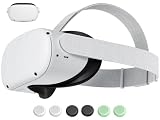


Head-strap styles compared
| Style or example | Compatibility to verify | Adjustment and weight distribution | Battery | Best fit |
|---|---|---|---|---|
| Meta Quest Elite Strap | Buy the version specified for Quest 2 or Quest 3/3S; versions are not interchangeable | Rigid side arms and rear dial; more consistent tension than a basic elastic strap | No battery in standard version; a separate battery version is available for supported models | People who want a familiar, simple dial adjustment |
| BOBOVR M2 Plus | Quest 2 | Halo-style support rests around the forehead and rear of the head; less facial pressure for some users, but fit depends on head shape | Optional detachable B2 battery; capacity is 5,200 mAh | Quest 2 owners who want a halo fit and swappable power |
| BOBOVR M3 Pro | Quest 3; confirm any listed 3S support and required fittings | Halo-style cradle with rear adjustment; shifts some load away from the face | Detachable B2 battery, 5,200 mAh | Quest 3 users who value rear-mounted battery swapping |
| KIWI design Comfort Battery Head Strap | Choose the model explicitly listed for Quest 3/3S or Quest 2 | Rigid arms, rear dial, and padded rear support; battery weight counterbalances the visor | Integrated battery; capacity and runtime vary by model | Frequent players who prefer an all-in-one strap over removable packs |
| Replacement fabric or elastic strap | Exact headset model; check connector shape | Lightweight and foldable, but tension is less repeatable and the face may carry more load | Usually none | Travel, low cost, or users who prioritize minimal bulk |
Weights and runtime differ between revisions, and manufacturers do not always publish comparable measurements. The 5,200 mAh figure above is the B2 pack’s stated capacity, not a guaranteed number of extra headset hours. Battery age, screen brightness, game load, and whether the headset is charging while in use all affect runtime.
Choose by your use case
- Mostly short sessions, limited budget: Keep the stock strap if it fits, or choose a compatible fabric replacement. Spend first on correct fit and a clean facial interface rather than extra battery capacity.
- Long sessions and frequent movement: Consider a rigid strap with a rear dial. A stable adjustment is easier to reproduce between sessions; a rear battery can act as a counterweight as well as extend play time.
- Pressure at the face is your main complaint: Try a halo-style strap, such as the model-specific BOBOVR option. It may redistribute contact toward the forehead and rear of the head, but can shift during active games and may not suit every head shape.
- You share the headset: A dial-adjusted strap is quicker to resize than elastic webbing. Note your preferred dial setting or reset it between users, and clean padding before another person uses it.
- You travel or use a compact case: A fabric strap or a rigid strap with folding arms may pack more easily. Check the finished headset dimensions against your case; rear batteries and tall adjustment dials often determine whether it fits.
Fit matters more than maximum tightness
To set up a rigid strap, loosen the rear dial, place the rear cradle low enough to support the back of your skull, and position the headset so the lenses sit comfortably in front of your eyes. Tighten only until the image stays stable when you turn your head. If the visor presses hard into your cheeks, loosen the strap and reposition the rear cradle rather than tightening further. For halo straps, adjust the forehead support and rear cradle first, then bring the facial interface close enough to block distracting light without forcing it against your face.
Take a short break after the first few minutes to check for slipping, pressure points, and whether you can still reach the headset controls. A strap that feels secure while standing still may move during fast turns. If you use glasses, follow the headset maker’s guidance and avoid forcing the lenses against your frames.
Battery trade-offs and a simple runtime estimate
A rear battery adds weight, but placing it behind the head can balance the front-heavy headset. That balance may feel better than the same added weight mounted at the front; it does not make the headset lighter. A detachable pack is convenient if you can swap a charged spare, while an integrated pack keeps the setup simpler but may mean replacing the strap or battery when the cell degrades.
For a rough estimate, divide usable battery capacity by the headset’s average power draw. For example, if a 5,200 mAh pack delivers an estimated 4,000 mAh in practice after conversion losses, and the headset averages 2,000 mA, the added runtime is about 4,000 ÷ 2,000 = 2 hours. This is an illustration, not a promise: voltage conversion, battery condition, charging limits, and workload change the result. Treat advertised runtime as a best-case reference, and check whether the pack can charge the headset while you play.
What wears out—and how to make it last
Common wear points are foam or silicone padding, elastic that gradually loses tension, plastic adjustment joints, and battery connectors. Sweat and skin oils speed up padding wear. Wipe non-electronic surfaces with a soft cloth after use, following the manufacturer’s cleaning instructions; do not soak padding or spray cleaner into dials, hinges, or charging ports. Let parts dry fully before storage.
Avoid carrying the headset by its strap, forcing adjustment arms past their stops, or storing it with a cable bent sharply at the battery connector. For removable-battery designs, detach the pack for storage if the manufacturer recommends it, and use a compatible charging cable and power source. If the strap develops a crack near a side connector or no longer holds adjustment, stop using it: a loose headset can be distracting and may be damaged in a fall.
Bottom line
For Quest 2, compare the BOBOVR M2 Plus with a model-specific Elite Strap based on whether you prefer halo support and a swappable battery or a conventional dial fit. For Quest 3, the BOBOVR M3 Pro and Quest 3-compatible KIWI design battery strap are options for people who play often; a standard Elite Strap suits those who want fewer battery components. For Quest 3S, verify explicit compatibility before ordering rather than relying on a Quest 3 label. The right choice is the one that fits your exact headset, stays stable at comfortable tension, and matches how long you actually play.