What's inside
As an Amazon Associate I earn from qualifying purchases. This post may contain affiliate links at no extra cost to you.
Cordless cutoff tool vs. angle grinder
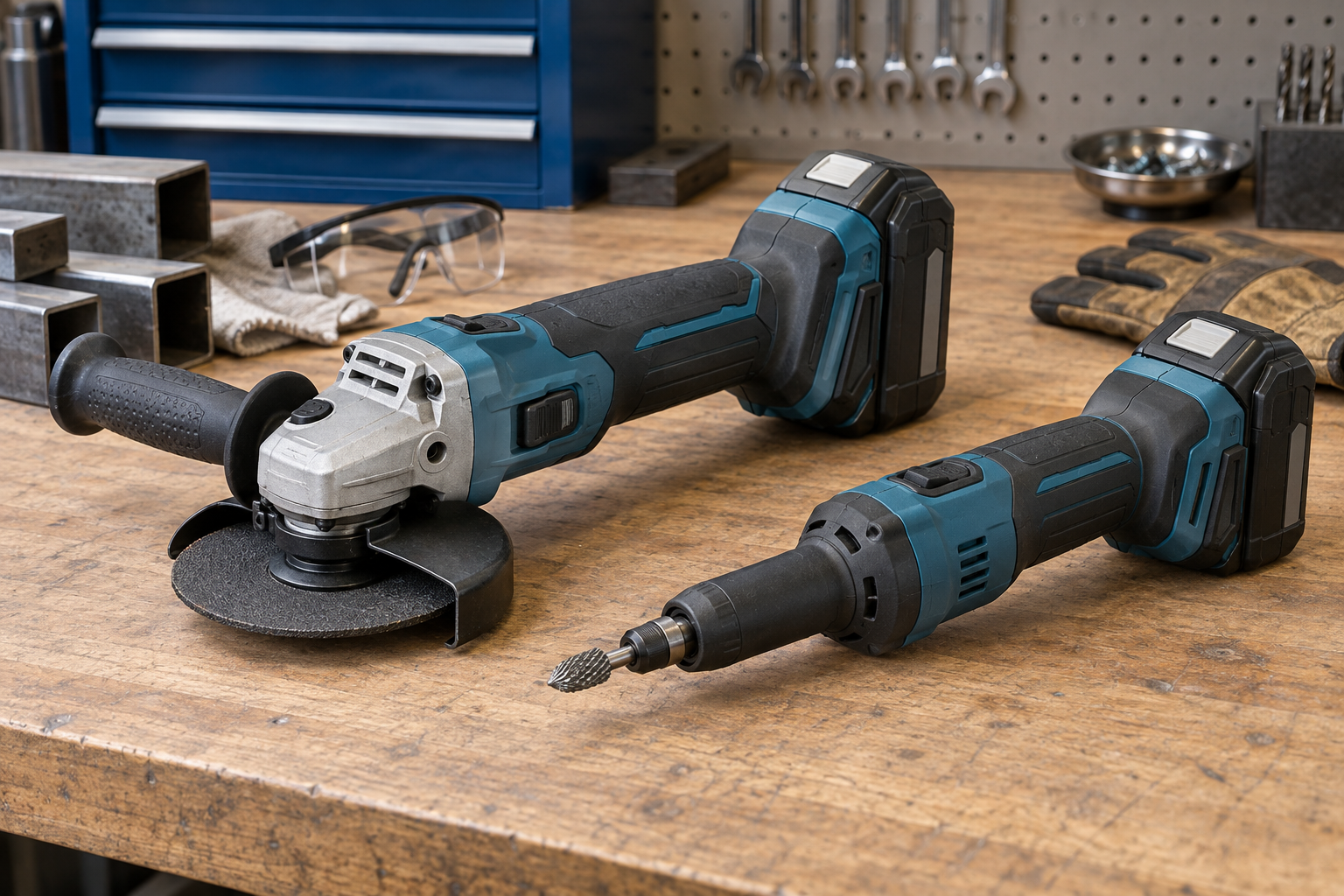
For cutting thin metal, a cordless cutoff tool is usually faster to control, while a cordless angle grinder is more versatile. The right choice depends on whether you mainly need clean, straight cuts or one tool that can also grind, sharpen, remove rust, and use flap discs.
Both tools use thin abrasive cutoff wheels, commonly 3 inches for compact cutoff tools and 4-1/2 or 5 inches for small angle grinders. On sheet metal, tubing, threaded rod, brackets, and light angle iron, either can work well. The differences show up in access, runtime, wheel life, handling, and what happens when the wheel binds.
As an Amazon Associate we earn from qualifying purchases at no extra cost to you.


How the tools differ
| Feature | Cordless cutoff tool | Cordless angle grinder |
|---|---|---|
| Typical wheel size | 3 inches | 4-1/2 to 5 inches |
| Best at | Quick, controlled cuts in thin material | Cutting, grinding, flap-disc work, rust removal |
| Access | Good in tight spaces and flush cuts | Needs more room around the guard and handle |
| Cut depth | Usually about 3/4 to 1 inch, depending on wheel and guard | Usually about 1-1/4 to 1-1/2 inches |
| Handling | Compact, but often requires a two-handed grip | More substantial and stable under load |
| Other uses | Limited | Grinding, sanding, wire brushing, polishing with the correct accessories |
A cutoff tool’s small wheel reaches full speed quickly and gives you a clear view of the cut. It is convenient for trimming bolts, cutting metal strapping, opening exhaust clamps, and slicing thin-wall square tubing. The narrow body also fits between vehicle parts or inside a metal frame more easily than an angle grinder.
An angle grinder takes a little more practice, but its larger wheel cuts deeper and lasts longer in many jobs. It is the better single-tool purchase if you expect to bevel edges, remove welds, clean up cut ends, or switch to a flap disc. If cutting is only one part of your work, look at a cordless angle grinder that matches batteries you already own.
Which cuts thin metal better?
For metal under roughly 1/8 inch thick, the cutoff tool often feels easier. Its smaller wheel removes less material, and the compact nose makes it simple to start a cut without dragging a heavy motor across the work. On 20-gauge sheet metal, around 0.036 inch thick, a sharp wheel can cut quickly with very light pressure.
For thicker tubing or angle iron, the angle grinder has the advantage. A 4-1/2-inch wheel can cut through common 1/8-inch wall tubing in one pass or nearly one pass, whereas a 3-inch tool may require cutting from both sides. That extra repositioning increases the chance of an uneven joint or a wheel snag.
Do not force either tool. If the wheel slows noticeably, back out and let it recover. Excess pressure overheats the wheel, drains the battery, and can cause the abrasive disc to fracture. A thin cutoff wheel is designed to cut on its edge. Twisting it sideways, prying in the kerf, or using it as a grinding disc is a common failure mode.
Battery platform and runtime
Cutting metal is a high-load job. Compact 12V systems are handy for occasional sheet metal and small fasteners, but a brushless 18V or 20V-class tool is a better choice for repeated cuts. A 2.0Ah battery keeps the tool light; a 4.0Ah or 5.0Ah pack provides more runtime and usually maintains power better during long cuts.
The larger battery is not automatically better. It adds weight at the rear of a cutoff tool, which can make precise work awkward. For a handful of cuts, use the smallest pack that delivers the required power. For dismantling, fencing, automotive work, or repeated tubing cuts, the larger pack reduces battery changes.
Stay within one battery ecosystem when possible. The battery, charger, and tool cost more as a group than a single corded tool, but shared packs make later purchases cheaper. If you already have compatible batteries, a cordless cutoff tool bare tool can be a sensible low-cost addition. Check whether your batteries are physically compatible; voltage labels alone do not guarantee that packs fit across a brand’s product lines.
Safety and cut quality
Wear safety glasses plus a face shield when practical, hearing protection, and gloves that do not have loose cuffs. Abrasive wheels throw hot sparks and sharp fragments. Secure the work in a vise or with clamps, and keep the cut-off section from pinching the wheel. A pinched wheel can kick the tool toward you or break apart.
Inspect every wheel before fitting it. Reject discs that are cracked, damp, warped, or past their marked expiration date. Use only a cutoff wheel rated for the tool’s maximum revolutions per minute. The guard must remain installed and positioned between you and the wheel.
Mark the cut with a scribe or permanent marker. Let the wheel’s edge do the work and use a shallow entry angle until the kerf is established. For sheet metal, support the metal close to the cut so vibration does not tear the edge. Afterward, remove the burr with a file, deburring tool, or flap disc. A cutoff wheel leaves a sharper edge than many first-time users expect.
What should you buy?
Buy a cutoff tool if your jobs are mostly thin sheet, small tubing, bolts, threaded rod, and flush trimming. It is easier to maneuver and often less tiring for quick cuts. A cheaper brushed version is fine for occasional household work, provided replacement wheels are readily available and the battery platform suits your other tools.
Buy an angle grinder if you need one cordless tool for cutting and material removal. It costs more in weight and learning curve, but it can replace several specialty tools. For frequent metalwork, choose a brushless grinder with a spindle lock, a tool-free or easily adjustable guard, and a side handle that can be fitted on either side. A brushless 18V cordless angle grinder is generally the better long-term platform choice.
If you already own an angle grinder, do not buy a cutoff tool just because it looks more specialized. Add a cutoff tool when tight access, lower fatigue, or frequent small cuts justify it. Otherwise, the grinder and a supply of quality thin wheels will handle most thin-metal cutting jobs.
FAQ
Which cuts thin metal better?
What should you buy?
Related guides
- Longest Lasting Lawn Mower Battery: AGM vs Lithium vs Flooded Lifespan and Cost per Season
- Duralast Gold Lawn Mower Battery Review: U1 Fit, CCA and When to Pay for AGM
- Greenworks Pro 80V 21-Inch Mower Review: Runtime Math, Push vs Self-Propelled and Yard Fit
- Bosch High Pressure Washer Gun Replacement: Fittings, Adapters and What Fits Your Model