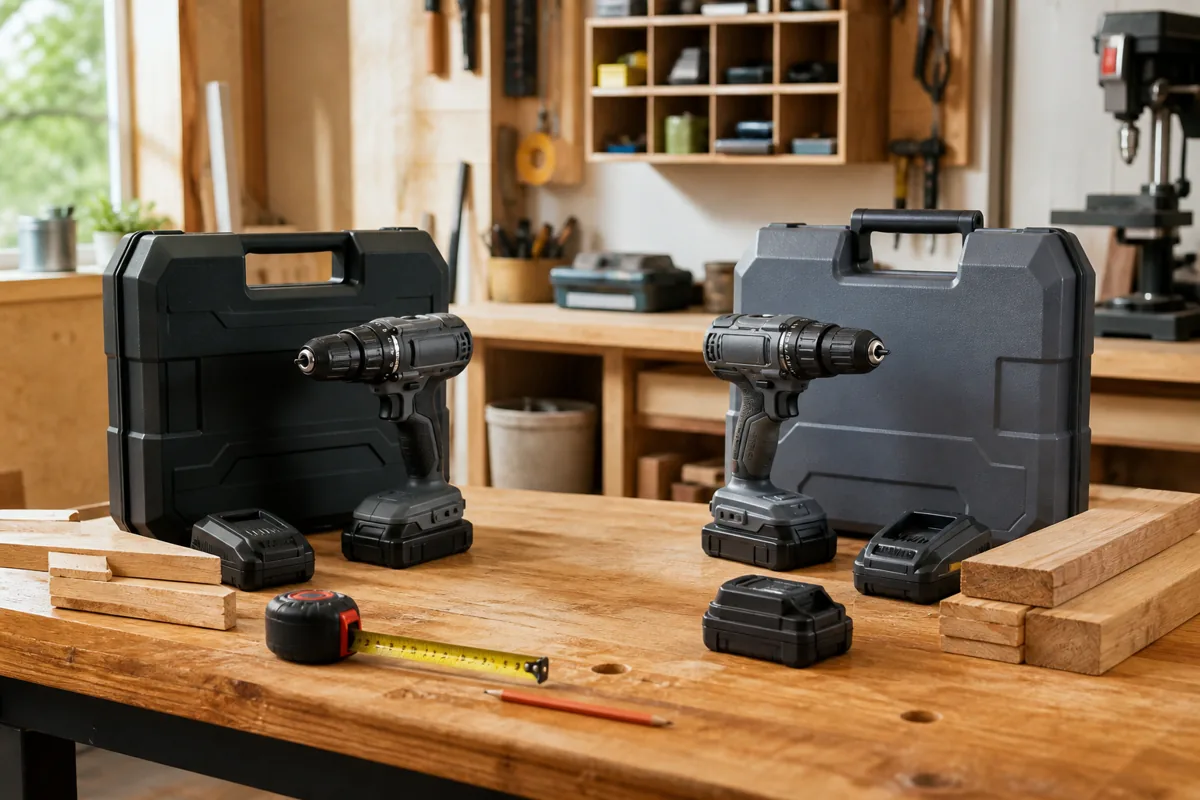
What's inside
As an Amazon Associate I earn from qualifying purchases. This post may contain affiliate links at no extra cost to you.
The real difference: what comes in the box
A cordless tool kit usually bundles a tool with one or more batteries and a charger. A bare tool is the same kind of tool sold without those power-system parts. The choice is straightforward if you already own batteries: a bare tool can save money and avoid another charger. If you are starting from scratch, a kit is often the more practical purchase because batteries and chargers cost enough to change the total.
Check the listing carefully. “Kit” does not guarantee two batteries, a fast charger, or even a battery suitable for demanding work. Some bundles include a small-capacity battery; some bare-tool listings include a case or accessories. Compare the exact contents and final prices, not just the product names.
As an Amazon Associate we earn from qualifying purchases at no extra cost to you.


Compare the complete cost
Use the prices you can actually buy at, including sales. A rough example shows why the answer depends on what you already have: if a tool is $100 bare and $160 with a battery and charger, the kit costs $60 more. If buying those power-system parts separately would cost $100, the kit is the better deal for a new user. But if you already own compatible batteries and a charger, that extra $60 buys little.
| Situation | Usually makes more sense | Why |
|---|---|---|
| You own compatible batteries and charger | Bare tool | Avoid paying again for parts you can use. |
| You are entering a platform | Kit | One purchase gets the tool and the essentials to run it. |
| You need another battery for long jobs | Kit, if its battery is useful and the price is right | A spare can keep work moving while the other battery charges. |
| You need a low-demand tool for occasional use | Bare tool, if you can borrow or already own a battery | There is little reason to buy a second charger for a tool used rarely. |
For a new platform, compare the kit against the bare tool plus the same battery and charger bought separately. Don’t value an included charger at full retail price if you would never buy that charger on its own.
Check compatibility before buying bare
“Same brand” is not enough. Brands may sell more than one voltage family, and a battery from one family may not fit a tool from another. Even within a platform, a compact battery can work in a high-demand tool but deliver less runtime or power than a larger pack. Check the manufacturer’s compatibility information for the exact tool and battery family.
Also check what the job demands. A drill driving a few pilot holes may run happily on a small pack. A circular saw cutting sheet goods, or an angle grinder used for sustained work, can drain a compact battery quickly and may feel less capable under load. Battery capacity, usually stated in amp-hours (Ah), is useful for comparing runtime within a compatible voltage platform, but it is not a guarantee of runtime: material, tool, and work rate all matter.
If you want a first battery set for a platform, compare cordless tool battery starter kits with the tool bundle. A starter kit may give you more battery capacity or a better charger, but only if its batteries fit the tools you plan to own.
When a kit is the better buy
A kit is the simple choice when this is your first tool on a platform. It avoids a common failure: buying a bare tool, then discovering that the battery you have is incompatible or too small for the job. A kit is also useful when you need to work continuously. With two batteries, you can use one while the other charges, although charging time and workload determine whether the rotation actually keeps up.
Look for a charger that matches how you work. A basic charger is fine for occasional home repairs. If you use several tools through the day, a faster charger can reduce downtime, though it does not replace having enough batteries. A kit with two small packs may suit light drilling better than a kit with one larger pack—or the reverse, if low weight matters more than uninterrupted runtime.
For someone building a system around a specific brand, a cordless combo kit with batteries and charger can be economical when it includes tools you will genuinely use. Don’t pay for a multi-tool bundle just because the per-tool price looks low; an unused tool is not a saving.
When a bare tool is the better buy
Bare tools make sense once you have a working battery supply on the correct platform. A second drill, work light, or occasional-use tool usually does not need its own charger. The savings can be substantial when a kit repeats batteries you already own, and fewer chargers also mean less bench clutter.
There are exceptions. If your only battery is needed for another tool, one extra pack may be worth buying even if the new tool is sold bare. Likewise, a small battery may technically fit but be a poor match for a saw or other tool that pulls high current. Compare the cost of a compatible larger pack with the bundle price before deciding.
A practical decision rule
Make a short list: the tool’s bare price, the kit price, the batteries you already own, and what it would cost to buy any missing battery and charger. If you own compatible packs and have enough capacity for the job, buy bare. If you lack either essential part, price a complete setup—and favor a kit when it costs less than assembling that setup separately. For occasional light work, a cheaper bare tool is perfectly reasonable if you already have a suitable battery. For demanding work, don’t save money by relying on an undersized pack that forces frequent stops.
Finally, treat battery-platform commitment as part of the purchase. Batteries and chargers are reusable across compatible tools, which can make later bare-tool purchases economical. But a bargain on a new platform is less attractive if you will need to buy several batteries just to use it. Choose around the tools you expect to run, not around the number of pieces in the box.
Related guides
- Longest Lasting Lawn Mower Battery: AGM vs Lithium vs Flooded Lifespan and Cost per Season
- Duralast Gold Lawn Mower Battery Review: U1 Fit, CCA and When to Pay for AGM
- Greenworks Pro 80V 21-Inch Mower Review: Runtime Math, Push vs Self-Propelled and Yard Fit
- Bosch High Pressure Washer Gun Replacement: Fittings, Adapters and What Fits Your Model