
What's inside
- What Is a 1/2-Inch Cordless Impact Wrench?
- Key Specifications to Check Before Buying
- Choosing the Right 1/2-Inch Anvil Type
- Selecting the Correct Impact Sockets and Accessories
- Which 1/2-Inch Cordless Impact Wrench Is Right for Your Work?
- How to Compare Cordless Impact Wrench Kits
- Safe Operating Practices for a 1/2-Inch Cordless Impact Wrench
- Common Mistakes When Buying a 1/2-Inch Cordless Impact Wrench
- Frequently Asked Questions
- Final Thoughts
As an Amazon Associate I earn from qualifying purchases. This post may contain affiliate links at no extra cost to you.
Learn how to choose a cordless impact wrench 1/2 inch by comparing torque, battery platforms, speed, anvil types, sockets and practical applications.
How to Choose a Cordless Impact Wrench 1/2 Inch: A Practical Buying Guide
A cordless impact wrench 1/2 inch is a versatile tool for automotive maintenance, construction, equipment assembly, and demanding fastening jobs. Its 1/2-inch square drive accepts compatible impact-rated sockets, while its battery-powered motor delivers repeated rotational impacts to tighten or loosen threaded fasteners. However, choosing the right model involves more than looking for the highest advertised torque. Battery compatibility, fastening control, breakaway performance, tool weight, socket retention, and the type of work you perform all affect whether a particular wrench is suitable. This guide explains the important specifications, common applications, safety considerations, and purchasing decisions to help you select a practical tool.
What Is a 1/2-Inch Cordless Impact Wrench?
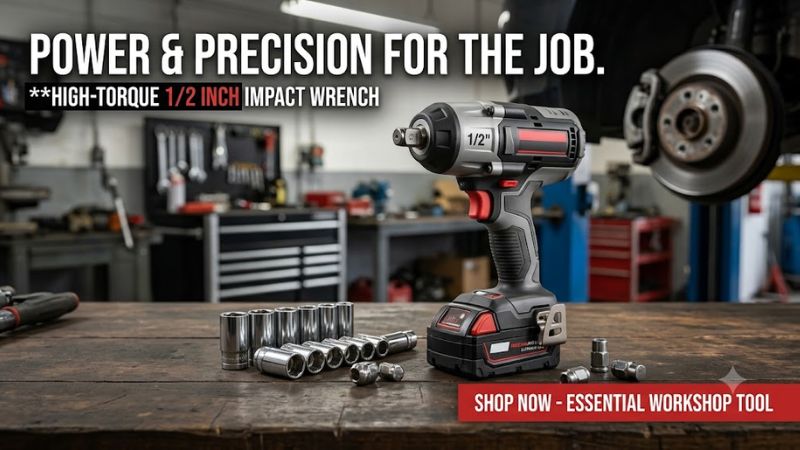
A 1/2-inch cordless impact wrench is a battery-powered fastening tool with a 12.7 mm square-drive anvil. The anvil connects directly to an appropriately sized impact socket, allowing the tool to apply rotational force through repeated internal hammering impacts.
Unlike a conventional drill or impact driver, an impact wrench is designed primarily for turning nuts and bolts. Its square drive accommodates sockets rather than standard screwdriver bits, making it particularly useful for automotive and mechanical work.
The 1/2-inch measurement refers to the square-drive connection, not the diameter of the bolt the wrench can handle. A wrench with this drive size can work with different fastener dimensions when the appropriate socket and tool capacity are used.
How Does the Impact Mechanism Work?
An impact wrench uses a motor and internal hammer-and-anvil mechanism to deliver repeated rotational blows. When resistance increases, the mechanism produces impacts that help rotate the fastener without relying entirely on continuous motor torque.
This operating principle offers several practical advantages:
- Helps loosen stubborn nuts and bolts.
- Reduces the continuous twisting reaction associated with some conventional fastening tools.
- Speeds up repetitive fastening and removal.
- Supports a broad range of automotive and construction applications.
- Allows cordless operation without an air compressor or extension cord.
Impact wrenches are not interchangeable with torque-controlled hand tools. Their advertised maximum torque does not establish the correct tightening torque for a particular fastener.
Key Specifications to Check Before Buying
The specifications on an impact wrench determine its suitability for different fastening jobs. Understanding how manufacturers describe these numbers helps prevent purchasing a tool that is either underpowered or unnecessarily large.
1. Fastening Torque and Breakaway Torque
Torque is one of the most important specifications when comparing cordless impact wrenches. It describes the rotational force applied to a fastener.
Manufacturers commonly publish two different torque figures:
- Fastening torque: The manufacturer’s stated maximum or rated torque for tightening applications under specified conditions.
- Breakaway torque: A manufacturer’s stated figure for loosening fasteners. Some manufacturers use terms such as nut-busting torque or maximum reverse torque.
These measurements are not automatically interchangeable. A wrench advertised with 700 ft-lb of fastening torque and another rated at 700 ft-lb of nut-busting torque cannot be assumed to deliver equivalent performance.
For practical selection, consider these general workload categories:
| Workload | Suitable tool characteristics |
| Light automotive maintenance | Compact wrench with moderate torque and variable speed |
| Passenger vehicle wheel service | Adequate fastening and loosening capacity with good control |
| Suspension and mechanical repairs | Higher torque capacity and multiple operating modes |
| Heavy equipment maintenance | High-torque construction and suitable battery capacity |
| Construction and structural fastening | Manufacturer-approved fastener and application compatibility |
These are selection categories, not universal torque requirements. Actual suitability depends on bolt diameter, grade, thread condition, joint material, corrosion, and the manufacturer’s application guidance.
For example, Makita’s XWT19 is an 18V LXT brushless 1/2-inch impact wrench listed with 780 ft-lb fastening torque and 960 ft-lb nut-busting torque. Those are manufacturer specifications for that particular model, not guaranteed results for every bolt or working condition.
2. Battery Voltage and Capacity
Cordless impact wrenches commonly operate on 12V, 18V, 20V MAX, or higher-voltage battery platforms, depending on the manufacturer and market.
Voltage identifies the electrical platform, while amp-hours (Ah) describe battery capacity.
A higher Ah rating generally means more stored energy within the same battery platform, although actual runtime depends on workload, tool efficiency, battery condition, and operating temperature.
Consider these factors:
- 12V platforms: Often suitable for compact tools and lighter mechanical work.
- 18V platforms: Offer a broad selection of professional and general-purpose impact wrenches.
- 20V MAX platforms: Commonly used in cordless tool systems marketed in North America.
- 40V-class platforms: Available for certain high-demand tools and specialized applications.
An 18V battery and a 20V MAX battery should not be treated as automatically interchangeable. Manufacturers may use different nominal and maximum voltage conventions, battery connections, and electronic systems.
Choose a wrench that matches your existing battery ecosystem where practical. Check the exact model’s compatibility documentation rather than relying on brand names alone.
3. Brushless vs. Brushed Motors
A brushless motor uses electronic controls rather than traditional carbon brushes to commutate the motor.
Its potential advantages include:
- Reduced brush-related maintenance.
- Improved electrical efficiency in suitable operating conditions.
- Better electronic control of speed and power.
- Potentially longer motor service life.
Brushed models can still be practical for occasional maintenance and less demanding workloads. They may also cost less.
However, motor type alone does not establish which wrench delivers better fastening performance. Compare the complete tool, including torque ratings, battery requirements, operating modes, weight, and warranty.
4. Speed and Impact Rate
Two additional specifications deserve attention:
No-load speed (RPM): Indicates how quickly the anvil rotates without a fastening load.
Impact rate (IPM): Indicates the number of impacts delivered per minute under the manufacturer’s stated measurement method.
Higher RPM can help speed up fastener installation and removal. A higher impact rate does not necessarily mean the wrench produces more useful torque.
Variable-speed triggers and selectable operating modes are particularly valuable because different jobs require different levels of control.
For example, removing a stubborn suspension bolt may require a different operating mode from installing smaller automotive fasteners.
5. Weight and Overall Dimensions
An impact wrench’s weight affects fatigue, especially when working overhead, underneath vehicles, or in restricted spaces.
Check whether the advertised weight includes the battery. Bare-tool weight and operating weight can differ considerably.
Also consider:
- Overall tool length.
- Grip circumference.
- Handle position.
- Balance with the intended battery.
- Clearance around the fastener.
- Accessibility in engine compartments and wheel wells.
A compact mid-torque wrench may be more useful for frequent automotive maintenance than a heavier high-torque model, even if the latter has a substantially higher maximum rating.
Choosing the Right 1/2-Inch Anvil Type
The anvil connects the wrench to its socket. Two common retention designs are friction-ring and detent-pin systems.
Friction-ring anvil
A friction-ring anvil uses a retaining ring to help hold the socket in position. It is popular among automotive technicians because sockets can generally be changed quickly.
Advantages include:
- Convenient socket changes.
- Practical operation when switching between fastener sizes.
- Compatibility with appropriately designed impact sockets.
The retaining ring can wear over time, so inspect it if sockets become loose.
Detent-pin anvil
A detent-pin anvil uses a spring-loaded pin to retain a compatible socket.
Its advantages include more secure socket retention in applications where accidental socket loss is a concern.
However, socket removal may take longer than with a friction-ring system, depending on the design.
Neither system is universally superior. Choose based on how frequently you change sockets and whether secure retention or quick changes are more important for your work.
Selecting the Correct Impact Sockets and Accessories
A 1/2-inch square drive does not mean every 1/2-inch socket is suitable for an impact wrench.
Use sockets specifically rated for impact-wrench applications. They are designed for the repeated loading associated with impact mechanisms.
Important considerations include:
| Accessory | What to check |
| Impact sockets | Correct 1/2-inch square-drive connection and fastener size |
| Deep impact sockets | Clearance around longer nuts and exposed bolt threads |
| Socket extensions | Impact rating and manufacturer’s compatibility |
| Universal joints | Impact rating and expected reduction in transmitted fastening force |
| Socket adapters | Drive compatibility, load limits, and retention |
| Battery | Exact supported voltage platform and model compatibility |
| Charger | Manufacturer-approved battery and charger combination |
Avoid ordinary chrome hand sockets unless their manufacturer explicitly rates them for impact use. A socket that fits the anvil is not necessarily designed to withstand impact loading.
Makita’s impact-wrench manuals also explain that incorrect or worn sockets can reduce fastening performance. Extensions and universal joints can affect the force transmitted to the fastener.
cdn.makitatools.com+1
Which 1/2-Inch Cordless Impact Wrench Is Right for Your Work?
The best choice depends on the type of work, operating environment, and frequency of use.
For Homeowners and Occasional Automotive Repairs
A compact or mid-torque model is often a sensible starting point.
Look for:
- A manageable operating weight.
- Variable-speed control.
- A compatible battery platform.
- Sufficient manufacturer-rated fastening capacity.
- An easy-to-use friction-ring or detent-pin anvil.
You may not need a high-torque professional wrench for occasional vehicle maintenance.
For Automotive Technicians
Frequent automotive work benefits from a versatile mid-torque or high-torque impact wrench.
Consider models with multiple speed settings, forward and reverse control, and automatic stopping or reduced-power modes where available.
These features can improve control when removing wheel nuts, working on suspension components, and handling different fastener sizes.
For Construction and Equipment Maintenance
Choose a tool based on the fastener specifications and workload rather than assuming the highest torque rating is always best.
High-torque models can be appropriate for demanding mechanical applications, but their size and weight may reduce convenience in confined spaces.
Check whether the manufacturer approves the tool for the intended fastener type and application.
How to Compare Cordless Impact Wrench Kits
A cordless impact wrench can be sold as a bare tool or as a complete kit. This distinction matters when calculating the actual purchase cost.
Bare Tool vs. Complete Kit
A bare-tool package generally includes the wrench without a battery or charger. It can be economical if you already own compatible batteries and charging equipment.
A complete kit may include:
- One cordless impact wrench.
- One or two rechargeable batteries.
- A compatible battery charger.
- A carrying case or storage bag.
- A belt hook or other included accessories.
Always check the exact package contents. Two listings for the same tool model can represent different purchasing configurations.
Consider Battery Capacity Carefully
A larger battery may provide more operating time, but it can also increase the tool’s overall weight.
For example, a 5.0Ah battery generally stores more energy than a 2.0Ah battery within the same compatible voltage platform. However, actual runtime cannot be calculated reliably from Ah alone because impact load, motor efficiency, battery condition, and usage patterns vary.
If you use an impact wrench throughout the working day, having a second compatible battery can reduce interruptions while the first battery charges.
Evaluate the Total Ownership Cost
The purchase price is only one part of the decision.
Consider the cost of:
- The impact wrench.
- Compatible batteries.
- A suitable charger.
- Impact-rated socket sets.
- Replacement batteries when existing packs eventually wear out.
- Storage and maintenance accessories.
If you already own a compatible professional battery system, purchasing a bare tool may offer better value than buying another complete kit.
Safe Operating Practices for a 1/2-Inch Cordless Impact Wrench
Impact wrenches generate repeated mechanical impacts, noise, vibration, and substantial rotational force. Incorrect use can damage fasteners, components, accessories, or cause personal injury.
Follow the manufacturer’s instructions for the exact tool.
Wear Appropriate Personal Protective Equipment
Before operating the wrench:
- Wear safety glasses or suitable eye protection.
- Use hearing protection appropriate to the exposure.
- Wear suitable work gloves when consistent with the manufacturer’s instructions and safe handling requirements.
- Wear protective footwear in automotive and construction environments.
- Secure loose clothing and keep hair away from moving components.
Do not assume gloves eliminate vibration-related risks. Limit unnecessary exposure and follow the manufacturer’s operating guidance.
OSHA identifies noise, vibration, awkward handling, and repetitive tool operation as potential workplace hazards.
Occupational Safety and Health Administration+1
Use the Correct Socket
Inspect the socket before installation.
Check for:
- Cracks or visible deformation.
- Worn internal surfaces.
- Damage to the square-drive connection.
- Incorrect socket dimensions.
- Incompatible retention features.
Install the socket securely and confirm that it is properly retained before applying power.
Never use a damaged socket or an unsuitable adapter to compensate for an incompatible connection.
Tighten Fasteners Using the Correct Method
An impact wrench should not be treated as a calibrated torque wrench.
This distinction is particularly important for automotive wheel nuts, suspension components, engine assemblies, and structural fasteners.
A sensible procedure is:
- Check the manufacturer’s specified torque for the fastener.
- Confirm that threads and mating surfaces are in the required condition.
- Start the fastener correctly to avoid cross-threading.
- Use the impact wrench only when the application permits it.
- Stop before the fastener is unintentionally overtightened.
- Complete the tightening process with an appropriate calibrated torque wrench when a specified torque is required.
DEWALT explicitly warns in its impact-wrench instruction manual that impact wrenches are not torque wrenches. It recommends an independent calibrated torque-measuring device when incorrect tightening could cause joint failure.
dewalt.com
Avoid Excessive Fastening Time
Holding the trigger longer does not automatically produce a correct or safe fastening result.
Excessive impact operation can overstress threads, damage fasteners, or affect the connected components.
Stop if the socket slips, the fastener becomes damaged, the tool behaves abnormally, or the battery or tool shows signs of overheating.
Handle Batteries Correctly
Lithium-ion batteries require appropriate storage, charging, and handling.
- Use the manufacturer’s specified charger.
- Do not charge visibly damaged battery packs.
- Keep battery contacts clean and dry.
- Avoid exposing batteries to excessive heat.
- Do not open, modify, or bypass battery protection systems.
- Follow the manufacturer’s temperature and storage instructions.
If a battery becomes unusually hot, swollen, damaged, or produces an unusual odor, stop using it and follow the manufacturer’s battery safety instructions.
Common Mistakes When Buying a 1/2-Inch Cordless Impact Wrench
Even experienced DIY users can make purchasing mistakes when focusing on only one specification.
| Common mistake | Why it matters | Better approach |
| Choosing the highest torque rating | Maximum ratings may describe different measurements | Compare fastening and breakaway figures separately |
| Ignoring battery compatibility | Batteries may belong to incompatible platforms | Verify the exact battery model |
| Buying ordinary sockets | They may not withstand impact loading | Choose impact-rated sockets |
| Ignoring tool weight | Heavy tools can increase fatigue | Compare weight with the intended battery |
| Assuming RPM equals power | Speed and rotational force are different measurements | Evaluate both specifications |
| Using the wrench for final torque | Impact operation does not guarantee accurate tightening | Use a calibrated torque wrench |
| Buying without checking package contents | Battery and charger may be excluded | Compare bare-tool and kit configurations |
The most useful purchasing decision is one that balances capability, control, compatibility, and cost rather than maximizing a single advertised number.
Frequently Asked Questions
1. Is a 1/2-inch cordless impact wrench powerful enough for changing car tires?
Yes, many 1/2-inch cordless impact wrenches are suitable for removing passenger-vehicle wheel nuts when their specifications and operating conditions match the application. However, the correct tool depends on fastener condition, vehicle requirements, and manufacturer guidance. Always finish tightening with a calibrated torque wrench using the vehicle manufacturer’s specified torque.
2. How much torque should a 1/2-inch cordless impact wrench have?
There is no universal torque requirement. Compact models suit lighter fastening work, while mid-torque and high-torque models provide greater capacity for demanding automotive and mechanical applications. Compare fastening torque and breakaway torque separately, and verify the manufacturer’s intended applications before purchasing.
3. Is a brushless cordless impact wrench better than a brushed model?
A brushless model generally offers advantages in motor efficiency, electronic control, and reduced brush maintenance. However, a brushed model can still be suitable for occasional DIY work. Compare actual specifications, operating weight, battery compatibility, and overall cost rather than choosing based on motor type alone.
4. Can I use regular sockets with a 1/2-inch cordless impact wrench?
You should use impact-rated sockets designed for the tool’s 1/2-inch square drive. Ordinary chrome hand sockets are not necessarily suitable for repeated impact loading and may crack or break. Check socket markings, drive compatibility, and manufacturer specifications before use.
Final Thoughts
Choosing the right cordless impact wrench 1/2 inch requires balancing torque, battery compatibility, motor design, speed control, anvil type, and operating weight. A compact model may be sufficient for occasional automotive maintenance, while professional technicians and equipment maintenance workers may benefit from a more capable mid-torque or high-torque option.
Before purchasing, identify your most demanding regular application, check the exact battery platform, and confirm that suitable impact-rated sockets are available. Most importantly, remember that advertised torque is not a substitute for accurate fastener tightening.
A well-matched impact wrench should provide sufficient working capacity without adding unnecessary weight, expense, or complexity to your tool collection.

Write Your Review
No reviews yet. Be the first to share your experience!