What's inside
As an Amazon Associate I earn from qualifying purchases. This post may contain affiliate links at no extra cost to you.
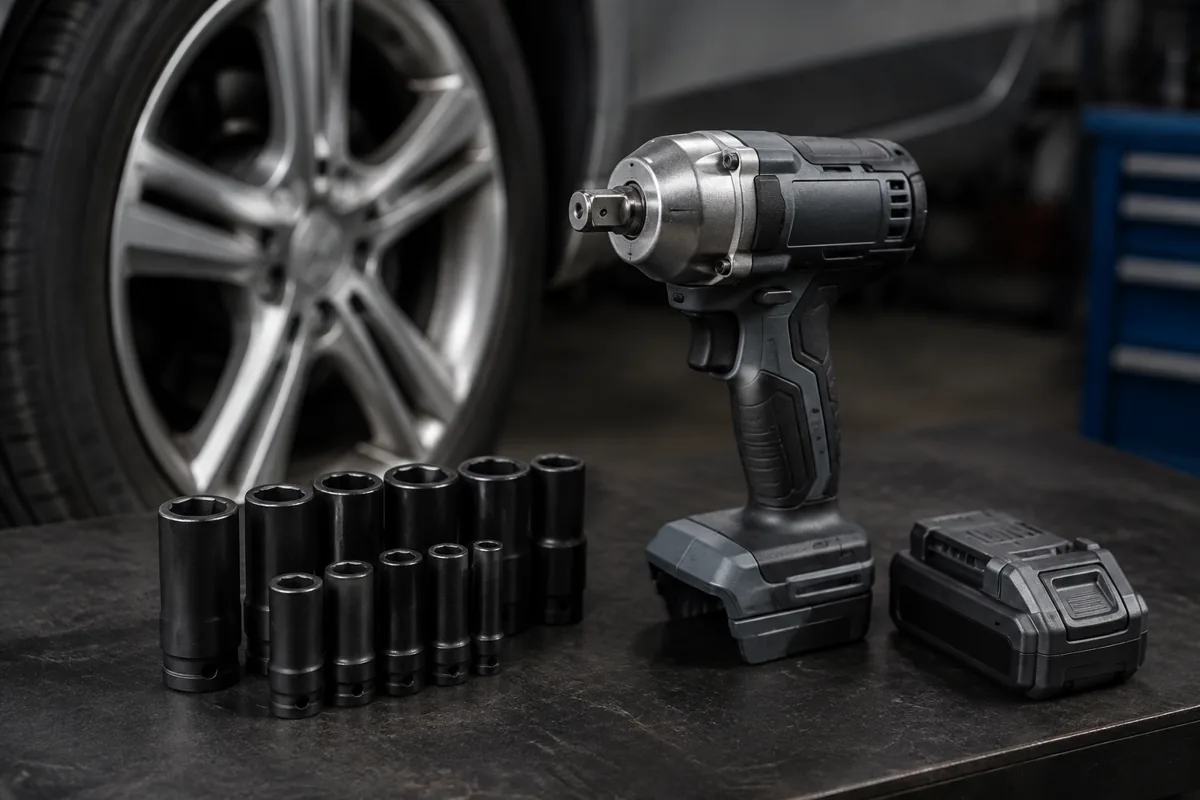
Choosing the anvil size for a cordless impact wrench is mainly a matter of matching the drive to the fasteners, sockets, and access you already use. The anvil is the square drive that accepts the socket. A larger anvil does not automatically make a tool better, but it usually supports larger sockets, higher torque, and a heavier-duty mechanism.
For most vehicle work, a 1/2-inch impact wrench is the safest default. A 3/8-inch model is more compact and better for smaller fasteners. A 3/4-inch or 1-inch wrench is intended for large equipment, trucks, and industrial fasteners rather than routine car maintenance.
Match the Anvil to the Fastener
Anvil size should follow the socket size you need, not the battery voltage printed on the tool. A high-voltage cordless wrench with a 1/2-inch drive can deliver more than enough power for many jobs, while a compact 3/8-inch tool may be the better choice where space and control matter.
| Anvil size | Typical fasteners and jobs | Main advantages | Common limitations |
|---|---|---|---|
| 1/4-inch hex | Small screws, light-duty bolts, trim and assembly work | Smallest and lightest; uses impact-driver bits | Not suitable for regular lug nuts or heavily rusted bolts |
| 3/8-inch square | Engine-bay work, motorcycles, brake hardware, smaller automotive fasteners | Compact, easier to control, good access | Less maximum torque and fewer large socket options |
| 1/2-inch square | Wheel lug nuts, suspension, trailers, general vehicle repair | Best all-around socket availability and torque range | Larger and heavier than a 3/8-inch wrench |
| 3/4-inch square | Heavy trucks, agricultural equipment, large structural fasteners | Handles high torque and larger sockets | Expensive, heavy, and excessive for passenger cars |
| 1-inch square | Construction equipment, industrial machinery, very large fasteners | Maximum capacity for cordless wrench designs | Bulky and difficult to justify for occasional home use |
When a 3/8-Inch Wrench Makes Sense
Choose a 3/8-inch cordless impact wrench if you mostly work on smaller bolts, confined spaces, or light vehicles. It is useful for removing underbody fasteners, suspension components, engine brackets, and motorcycle hardware. The shorter head and lower weight reduce wrist fatigue, particularly when working above shoulder height.
A 3/8-inch wrench is also easier to use without damaging fasteners. Smaller bolts can be snapped or stretched by excessive impact force. Look for a tool with multiple speed or torque settings, and use the lowest useful setting for reassembly. For this category, compare cordless 3/8-inch impact wrenches by bare-tool weight, head length, and control features rather than peak torque alone.
The trade-off is socket capacity. A 3/8-inch socket set usually tops out around 19 or 22 mm, though larger sockets exist. Adapters can let you use a 1/2-inch socket, but they do not turn a compact tool into a full-size wrench. The adapter becomes a weak point, and the smaller anvil and mechanism may not handle high load reliably.
Why 1/2 Inch Is the Default
A 1/2-inch impact wrench is the practical choice for most homeowners, mechanics, and DIY vehicle owners. It accepts the sockets used for common wheel lugs, axle nuts, suspension bolts, trailer hardware, and larger structural fasteners. A typical cordless 1/2-inch wrench may cover roughly 300 to 1,000 foot-pounds of advertised breakaway torque, depending on the model and battery.
Those numbers need careful interpretation. Breakaway torque is a marketing and test figure, not a guaranteed removal force on every rusted bolt. Actual results vary with battery condition, socket quality, fastener corrosion, joint design, and how long the tool can deliver impact energy. For shopping, high-torque 1/2-inch impact wrenches make sense for trucks, seized suspension bolts, and frequent work. A mid-torque model is usually enough for wheel changes and ordinary repairs.
Do not use the impact wrench as the final tightening tool for wheel lugs or critical bolts. Run the fastener down gently, then finish with a calibrated torque wrench to the vehicle or equipment specification. An impact wrench can easily over-tighten a lug, damage wheel studs, distort brake components, or make later removal harder.
When to Buy 3/4 Inch or 1 Inch
Move to a 3/4-inch wrench when your routine work includes medium-duty and heavy trucks, farm machinery, large trailers, or fasteners above about 27 to 32 mm. These tools generally have more mass, stronger anvils, and higher sustained output. They also require larger impact sockets, which cost more and weigh more.
A 1-inch model is justified for construction equipment, industrial machinery, and very large bolts where a 1/2-inch or 3/4-inch wrench repeatedly stalls. For occasional repairs, renting one is often cheaper than buying the tool, battery, charger, and a 1-inch socket set. Search for cordless 3/4-inch impact wrenches only if your work genuinely includes those fasteners.
Account for the Battery Platform and Sockets
If you already own cordless tools, staying within that battery platform can outweigh a modest difference in wrench performance. A bare tool is cheaper only when you already have compatible batteries and a charger. Otherwise, include the cost of a battery, charger, impact-rated sockets, and possibly a protective case.
Use impact-rated sockets, not chrome hand-tool sockets. Standard chrome sockets can crack under repeated impact loading, and fragments can be hazardous. A six-point socket grips the flats better than a twelve-point socket, especially on partly rounded or corroded fasteners. A retaining ring holds sockets securely for heavy work; a friction ring is faster when you change sockets often. A pin-detent anvil holds very securely but can be less convenient.
Check Clearance and Control
Compare the tool’s head length, height, and weight with the space around your fasteners. A shorter 3/8-inch wrench may reach a recessed bolt that a powerful 1/2-inch model cannot. Conversely, a long anvil or bulky battery can prevent access behind a wheel or inside an engine bay.
Electronic modes are valuable, but they do not replace judgment. A low-speed mode can prevent over-tightening, while an automatic shutoff may stop the tool after a brief impact period. Test the setting on a spare fastener before using it on a critical assembly. If you regularly work on both cars and heavy equipment, owning a compact 3/8-inch wrench and a 1/2-inch high-torque wrench is often more useful than buying one oversized tool.
Related guides
- Longest Lasting Lawn Mower Battery: AGM vs Lithium vs Flooded Lifespan and Cost per Season
- Duralast Gold Lawn Mower Battery Review: U1 Fit, CCA and When to Pay for AGM
- Greenworks Pro 80V 21-Inch Mower Review: Runtime Math, Push vs Self-Propelled and Yard Fit
- Bosch High Pressure Washer Gun Replacement: Fittings, Adapters and What Fits Your Model