What's inside
As an Amazon Associate I earn from qualifying purchases. This post may contain affiliate links at no extra cost to you.
A Sun Joe electric pressure washer is designed for outdoor cleaning tasks such as washing patio furniture, rinsing vehicles, cleaning outdoor equipment, and removing dirt from suitable hard surfaces. The right model depends on the cleaning job, water flow, pressure requirements, and included accessories—not just the advertised PSI rating.
Sun Joe has sold several electric pressure washer models with different specifications. For example, the SPX3000 is rated at 2,030 PSI maximum pressure and 1.76 GPM maximum flow, while the SPX2004-SJG is rated at 2,100 PSI maximum pressure and 1.8 GPM maximum flow. These are model-specific maximum ratings, not guarantees of pressure and flow at the nozzle during every cleaning task.
This guide explains how to select a suitable model, set it up correctly, choose an appropriate spray pattern, troubleshoot common problems, and maintain the washer safely. Always follow the operator’s manual for your exact model because specifications, controls, accessories, and maintenance instructions can differ.
What Is a Sun Joe Electric Pressure Washer Used For?
A Sun Joe electric pressure washer uses an electric motor and pump to deliver pressurized water through a spray gun and nozzle. It is generally suited to routine residential cleaning where a garden hose alone is not effective enough.
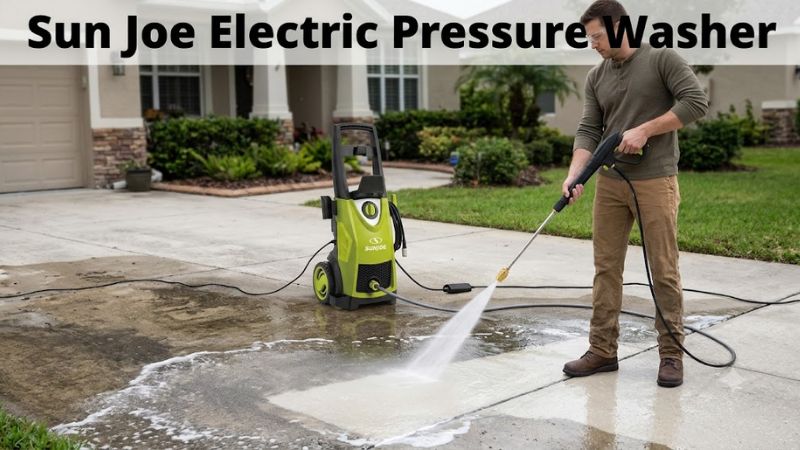
Common applications include:
- Vehicles: Rinsing road grime from car exteriors, provided the pressure and nozzle distance are appropriate for the finish.
- Patios and walkways: Removing loose dirt and surface grime from compatible concrete, pavers, and other hard surfaces.
- Outdoor furniture: Cleaning suitable plastic, metal, and weather-resistant furniture.
- Decks and fences: Washing compatible surfaces with a sufficiently gentle spray to avoid damaging wood, coatings, or paint.
- Garden equipment: Rinsing mud and dirt from appropriate equipment while keeping water away from electrical components, bearings, and other vulnerable areas.
A consumer electric washer is not automatically suitable for every surface. Old mortar, deteriorated concrete, soft wood, vehicle paint, window seals, and delicate finishes can be damaged by an aggressive jet. Start with a wider spray pattern, keep the nozzle farther away, and test an inconspicuous area before cleaning the full surface.
How to Choose a Sun Joe Electric Pressure Washer
Before buying, match the washer’s rated performance to the surfaces you intend to clean. Pressure, water flow, electrical requirements, hose reach, and nozzle options all affect practical usefulness.
Understand PSI and GPM
Two specifications matter most when comparing electric pressure washers.
- PSI (pounds per square inch): Measures water pressure. Higher pressure can help remove stubborn deposits, but it can also damage paint, wood, sealants, and other vulnerable materials.
- GPM (gallons per minute): Measures water flow. More flow can help rinse away loosened dirt and detergent, although actual cleaning performance also depends on the nozzle, surface, and technique.
Do not compare models using only their maximum advertised PSI. Sun Joe’s SPX3000 manual, for example, lists 2,030 PSI maximum pressure at initial discharge but a rated pressure of 1,450 PSI under typical load. Its maximum flow is 1.76 GPM, compared with a rated flow of 1.24 GPM under typical load.
The distinction matters because maximum figures obtained under specified test conditions are not necessarily representative of sustained cleaning performance.
Check the Model Specifications
Sun Joe has offered several models and variants, so confirm the complete model number on the product label and in the corresponding manual.
| Model | Published pressure and flow | Notable consideration |
| SPX3000 | 2,030 PSI maximum; 1.76 GPM maximum | Dual detergent tanks and multiple quick-connect nozzles on the documented configuration |
| SPX2004-SJG | 2,100 PSI maximum; 1.8 GPM maximum | Verify the included accessories and configuration for the exact variant |
| SPX3000-MAX | 2,200 PSI rated pressure; 1.1 GPM rated flow | Different rated figures; do not compare its rated values directly with another model’s maximum values |
Sources: the relevant SPX3000, SPX2004-SJG, and SPX3000-MAX operator manuals.
These figures illustrate why model identification matters. They are not a current ranking of product availability or independently measured cleaning performance.
Before purchasing, check:
- The exact model and regional electrical rating.
- The rated pressure and rated flow, not only the maximum figures.
- The high-pressure hose length and power-cord reach.
- Which spray nozzles, detergent containers, and accessories are included.
- The warranty terms applicable to the exact model and purchase.
- Whether replacement parts and manufacturer support are available for your unit.
For US models, verify the nameplate voltage and frequency. The documented SPX3000, for example, is rated for 120 V AC at 60 Hz. Do not assume a US-market unit is suitable for a different country’s electrical supply simply because a plug adapter fits.
Choose a Model for Your Cleaning Tasks
Cars, motorcycles, and outdoor furniture
Favor a wide spray pattern and controlled technique. A 40-degree nozzle is a sensible starting point on compatible surfaces, but maintain a safe distance from paint, seals, electrical components, and delicate trim.
Concrete paths and patios
A 25-degree nozzle may be suitable for compatible hard surfaces. Stubborn deposits may require repeated passes or an appropriate detergent rather than a narrower, more aggressive spray.
Decks, fences, and painted surfaces
Use extra caution. Begin with a wider spray at a greater distance and test a hidden area. Even a fan nozzle can scar soft wood, strip coatings, or force water into joints.
The nozzle guidance above follows the SPX3000 manual’s descriptions of its spray tips, but the appropriate choice depends on the exact model and surface.
How to Set Up and Use a Sun Joe Electric Pressure Washer
Use the manual for your specific model as the controlling instruction. The following procedure provides a general setup sequence for a compatible residential electric washer.
Before You Start
Prepare the following:
- The pressure washer, matching spray gun, wand, and high-pressure hose.
- A compatible garden hose and adequate water supply.
- The correct quick-connect nozzle for the task.
- Manufacturer-approved detergent, if needed.
- Safety glasses, suitable footwear, and clothing that protects against spray and flying debris.
- An appropriate outdoor electrical receptacle and the washer’s specified electrical protection.
Keep children, pets, and bystanders away from the cleaning area. Never direct the spray at a person or animal. High-pressure water can cause serious injection injuries even when an external wound looks minor.
Step 1: Inspect the Washer and Connections
With the machine switched off and unplugged, inspect the power cord, plug, GFCI protection, water inlet, high-pressure hose, gun, and fittings.
Do not use the machine if the cord is damaged, the housing is cracked, a pressure hose is compromised, or a connection cannot be secured properly. Use only compatible replacement components.
Connect the high-pressure hose to the designated washer outlet and spray gun. Connect the garden hose to the water inlet, following the manual’s instructions for the inlet adapter and seals.
Step 2: Connect the Water Supply and Remove Air
Turn on the water supply before starting the motor.
With the power disconnected, direct the spray gun toward a safe, unobstructed area and squeeze the trigger to allow water to flow through the system. Continue until the flow is steady and trapped air has been purged, following the manual’s priming procedure.
Check that the garden hose is not kinked and that the inlet filter is clear. Do not operate the pump without an adequate water supply.
Step 3: Install the Correct Nozzle
Switch off and unplug the washer before changing a nozzle. Release any residual pressure according to the manual and secure the gun’s safety lock.
Fit the correct quick-connect nozzle and check that it is locked securely in place. Do not force an incompatible accessory onto the wand.
Start with a wider spray pattern for unfamiliar surfaces. Never begin by testing a concentrated jet on paint, glass, wood, seals, or other delicate materials.
Step 4: Connect Power Safely
Use the voltage and frequency specified on the washer’s rating label. Inspect the GFCI-equipped power cord, and test the GFCI using the manufacturer’s procedure before operation.
Keep electrical connections away from standing water and spray. Use an appropriate outdoor receptacle and follow the manual’s instructions for extension cords; avoid an extension cord whenever practical. Never remove the grounding prong, splice the power cord, or use damaged electrical equipment.
The SPX3000 manual identifies a GFCI-equipped power cord as part of its configuration. Electrical protection does not make wet electrical connections safe.
Step 5: Start Cleaning Gradually
Switch on the washer as instructed by the manual, keeping a firm grip on the spray gun. Aim at the intended surface before operating the trigger.
Begin at a conservative distance and move the nozzle closer only if the surface tolerates the spray. Use smooth, overlapping passes rather than holding the jet in one place. When washing walls or other vertical surfaces, work from the top downward when appropriate.
For vehicles and furniture, rinse loose grit away first. Apply only compatible detergent through the designated detergent system, then rinse thoroughly. Do not use the pressure washer to clean people, pets, energized equipment, or items that could be damaged by water intrusion.
Step 6: Shut Down and Release Pressure
When finished:
- Switch off the washer and unplug it.
- Turn off the water supply.
- Squeeze the trigger to release residual pressure, following the manual.
- Engage the gun’s safety lock.
- Disconnect the hoses only after pressure has been relieved.
- Drain the system and prepare the washer for storage as directed by the manufacturer.
Never disconnect a pressurized hose or loosen a fitting to release pressure. The SPX3000 manual specifically includes depressurization in its shutdown procedure.
Sun Joe Electric Pressure Washer Troubleshooting
If the washer does not start, pulses, loses pressure, or stops during use, begin with external checks. A symptom alone does not establish that the motor or pump has failed.
Switch off and unplug the washer before cleaning a nozzle, inspecting a filter, or disconnecting components. Never open energized equipment or bypass electrical protection.
| Problem | Possible causes | Safe first checks |
| Washer will not start | No power, tripped GFCI, faulty receptacle, or circuit overload | Check the power supply, inspect the cord, follow the GFCI reset instructions, and reduce other loads on the circuit |
| Pressure fluctuates | Air in the pump, restricted water supply, blocked nozzle, or a leaking connection | Check the water supply, straighten the inlet hose, inspect accessible connections, and purge air according to the manual |
| Motor runs but water does not spray | Water supply disconnected, clogged nozzle or inlet filter, or frozen components | Turn off and unplug the unit; check the supply and clean accessible components as instructed |
| Washer stops during operation | Thermal protection, blocked nozzle, electrical supply problem, or another fault | Switch off, disconnect power, check the manual’s troubleshooting instructions, and allow the unit to cool if specified |
| Washer repeatedly starts and stops | Leaking hose, gun, or connection, or a trigger or pump fault | Check for external leaks; stop using the washer if cycling continues with the trigger released |
| Detergent does not dispense | Incorrect nozzle, empty detergent container, blocked intake, or incompatible detergent | Check the model’s detergent instructions, nozzle requirements, container, and accessible intake components |
These are possible causes, not confirmed diagnoses. They are consistent with troubleshooting guidance in Sun Joe’s SPX3000 and SPX2004-SJG manuals.
What to Do If the Pressure Is Weak
Follow this sequence before assuming the pump is defective:
- Check the water supply. Confirm the tap is fully open and the hose provides adequate flow.
- Inspect the inlet hose. Straighten kinks and check for restrictions.
- Purge trapped air. Follow the model’s water-priming procedure with the motor off and power disconnected.
- Inspect the inlet filter. Clean it only as directed in the manual.
- Clean the nozzle. With the machine unplugged and pressure released, use the supplied cleaning tool if specified.
- Inspect for leaks. Check the hose, fittings, and gun for visible water leakage.
If pressure remains unstable, the pump may have an internal valve or seal problem. Stop using the washer and contact authorized service rather than dismantling the pump without the necessary instructions and expertise.
What to Do If the GFCI Trips
A GFCI trip may indicate an electrical fault or an unsafe condition. Disconnect power and inspect the exterior cord and plug for damage or moisture.
Follow the manufacturer’s reset procedure only after the cause has been addressed. If the GFCI trips repeatedly, stop using the washer and have the equipment and electrical supply checked by a qualified professional. Never bypass the GFCI or substitute an ordinary plug to keep the machine running.
If a breaker trips repeatedly, do not keep resetting it without investigating the cause.
Maintenance and Storage
Proper maintenance helps keep the water path clear and reduces the risk of damage from leaks, corrosion, and freezing. Use the maintenance instructions for your specific Sun Joe model.
After Each Cleaning Session
- Switch off and unplug the washer before cleaning or inspecting it.
- Relieve pressure and disconnect the water supply according to the manual.
- Inspect the high-pressure hose, fittings, spray gun, and power cord for damage.
- Clean the nozzle and inlet filter when required.
- Empty detergent containers if the manual calls for it.
- Drain water from the washer and hoses as directed.
- Store the equipment indoors in a dry location.
Do not use solvents or corrosive cleaners on the washer. Avoid spraying water directly into electrical components or openings that are not designed for water exposure.
Prevent Freeze Damage
Water left inside a pump or hose can freeze, expand, and cause damage. Store the washer where it will not freeze, and drain the water from the pump, hoses, and detergent containers as instructed.
The SPX3000 manual warns that freezing can permanently damage the pump and states that freeze damage is not covered by its warranty. It also recommends a pump protector for cold-weather storage. Check the exact instructions and approved product requirements for your model before using one.
1.76 GP
When to Seek Professional Service
Stop using the washer and arrange qualified service if you find:
- A damaged power cord, plug, or electrical housing.
- A leaking pump or a cracked pressure-bearing component.
- Persistent pressure fluctuations after basic checks.
- Repeated GFCI trips or unexplained circuit-breaker trips.
- Abnormal mechanical noises, burning smells, or recurring overheating.
- A gun or trigger mechanism that fails to control the spray reliably.
Do not attempt repairs that require opening energized equipment, defeating a safety device, or improvising pressure-rated fittings.
Frequently Asked Questions
Is a Sun Joe electric pressure washer good for home use?
Yes, a suitable Sun Joe electric pressure washer can handle many routine residential cleaning tasks, including rinsing vehicles, outdoor furniture, and compatible patios. Choose the model based on its rated pressure, flow, included nozzles, and the surfaces you need to clean.
What PSI Sun Joe pressure washer do I need?
The required PSI depends on the surface and the dirt you need to remove. A lower-pressure approach with a wide spray is generally more appropriate for delicate finishes, while compatible hard surfaces may tolerate more aggressive cleaning. Do not select a washer by maximum PSI alone; consider rated pressure and GPM as well.
Why does my Sun Joe pressure washer keep losing pressure?
Common possible causes include trapped air, insufficient water supply, a kinked hose, a blocked nozzle, a dirty inlet filter, or leaking connections. Check these external issues first with the washer switched off and unplugged. Persistent pressure loss may require professional service.
Can I use any detergent in a Sun Joe electric pressure washer?
No. Use only cleaning agents recommended or permitted by the manual for your exact model. Some Sun Joe manuals prohibit bleach, chlorine products, solvents, acids, ammonia products, and other incompatible chemicals because they can damage the washer or the surface being cleaned. Check your model’s instructions before adding detergent.
1.76 GP
Final Verdict
A Sun Joe electric pressure washer can be a practical choice for routine home cleaning when its pressure, water flow, nozzle options, and electrical requirements match the job. The SPX3000 is one documented example, with a 2,030 PSI maximum rating, a 1.76 GPM maximum flow rating, and multiple detergent and nozzle features.
Before purchasing or operating any Sun Joe model, verify its exact model number and manual. Use rated performance figures to make meaningful comparisons, start with a conservative spray pattern, follow the correct startup and shutdown procedure, and protect the pump from freezing.
For more reliable cleaning and fewer avoidable problems, prioritize appropriate nozzle selection, an adequate wate
Related guides
- DEWALT 3300 PSI Pressure Washer Review: Specs, Price, and Is It Worth Buying?
- Greenworks 1800 PSI Pressure Washer Review: Price, Specs, and Is It Worth Buying?
- DEWALT 4400 PSI Pressure Washer Review: Price, Specs, and Is It Worth Buying?
- Ryobi 2000 PSI Pressure Washer Review: Price, Specs, and Is It Worth Buying?