What's inside
- Best Budget Cordless Angle Grinders: Which One Fits Your Work?
- Shortlist by situation
- What budget grinders can—and can’t—do
- Comparison: what to check before buying
- Features that make a real difference
- Decision matrix: choose for your actual workload
- Safety features worth paying for
- What wears first—and how to avoid premature replacement
- Bottom line
- Best Budget Cordless Angle Grinders: Which One Fits Your Work?
- Shortlist by situation
- What budget grinders can—and can’t—do
- Comparison: what to check before buying
- Features that make a real difference
- Decision matrix: choose for your actual workload
- Safety features worth paying for
- What wears first—and how to avoid premature replacement
- Bottom line
As an Amazon Associate I earn from qualifying purchases. This post may contain affiliate links at no extra cost to you.
Best Budget Cordless Angle Grinders: Which One Fits Your Work?
The best budget cordless angle grinder for most DIYers is a brushless 4½-inch model from the same battery platform as their drill or saw; it keeps disc costs and tool size manageable without committing to a larger, heavier grinder. Choose a compact 4-inch grinder for tight spaces and occasional cuts, or a 5-inch model when deeper cuts matter more than weight. At budget prices, compare guard adjustment, vibration control, battery compatibility, and the cost of a second battery—not just motor speed.
Shortlist by situation
- Occasional home repairs: A 4½-inch brushed grinder is usually the lowest-cost entry, especially if you already own compatible batteries. Expect slower work under load and greater battery drain than with a brushless model.
- Frequent cutting and grinding: Look for a brushless 4½-inch grinder with a two-position or tool-free adjustable guard, a side handle, and an electronic brake. It costs more initially but is better suited to repeated jobs.
- Tight spaces and lighter work: A compact 4-inch grinder is easier to control overhead or in confined areas. Check that the discs you need are readily available and that its cutting depth is sufficient.
- Deeper cuts in one pass: Consider a 5-inch model only if its extra capacity solves a recurring need. Larger discs and tool bodies can add weight, and compatible accessories may cost more.
What budget grinders can—and can’t—do
Cordless grinders are useful for trimming metal, removing rust, smoothing welds, and making short cuts without dragging out an extension cord. They can also cut masonry with the correct, grinder-rated diamond disc. They are less appealing for long, continuous cutting: high-load work drains batteries quickly, and frequent pauses to swap packs can erase the convenience.
As an Amazon Associate we earn from qualifying purchases at no extra cost to you.


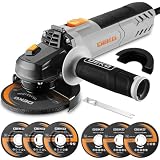
Disc diameter sets the maximum cutting depth, but the actual depth is less than the disc radius because the center hub, guard, and workpiece position take up space. A 4½-inch disc does not provide a full 2¼ inches of usable cut. For thick material, plan on cutting from both sides where practical—or use a tool intended for the depth and duration of the job.
Comparison: what to check before buying
The figures below are typical buying ranges, not specifications for every model. Published tool-only weights and run times vary with battery size, accessory, material, and manufacturer measurement method. Verify the exact model’s manual before choosing discs or guards.
| Grinder type | Disc size | Typical bare-tool weight | Best fit | Main compromise |
|---|---|---|---|---|
| Compact cordless | 4 inches | About 3–4 lb | Light trimming, small repairs, restricted access | Less cutting depth; fewer accessory choices in some areas |
| General-purpose cordless | 4½ inches | About 4–5 lb | Home metalwork, rust removal, occasional masonry cuts | Battery life can be short under sustained heavy load |
| Higher-capacity cordless | 5 inches | About 5–6 lb | More cutting depth and larger surface work | More bulk and weight; confirm disc and guard compatibility |
These weights exclude the battery. A larger pack can improve runtime but adds heft at the handle, which matters during overhead grinding. Compare complete tool-and-battery weights where manufacturers provide them.
Features that make a real difference
Guard adjustment and disc fit
A guard that rotates without tools makes it easier to keep the deflecting side between you and the disc’s open edge as the working angle changes. Some budget models use a clamp that requires a wrench; this is acceptable if it locks securely, but awkward if frequent repositioning is part of the job. Never remove the guard to make a disc fit, and never fit a disc larger than the tool’s rated size.
Check the arbor and disc thickness listed in the manual. Cutting discs are thin and intended for cutting; grinding discs are thicker and intended for surface work. Using a cutting disc to grind its side can cause it to break.
Vibration, handle, and control
Vibration varies between models and accessories. A side handle that can be fitted on either side improves control for left- or right-handed use, while a well-shaped grip and lower vibration help reduce fatigue. If vibration figures are published, compare them within the same measurement standard; figures from different methods may not be directly comparable. A grinder that feels easier to hold is not a reason to skip breaks or protective equipment.
Battery drain and ownership cost
Battery runtime is difficult to compare from headline claims because cutting steel, brushing rust, and grinding a weld put very different loads on the motor. A small battery may be fine for a few short cuts but can become a bottleneck during extended work. If you already own batteries, staying on that platform often saves more than choosing a slightly cheaper bare tool from another system.
As a simple planning example, a job that takes 20 minutes of active grinding may require more than one pack: the motor is drawing heavily while engaged, and real work includes repositioning and interruptions. For repeated jobs, budget for a second compatible battery or a charger that can replenish packs during breaks. Treat runtime estimates as planning aids, not guarantees.
Decision matrix: choose for your actual workload
| Your situation | Best starting choice | Why |
|---|---|---|
| First grinder, occasional repairs, limited budget | 4½-inch brushed model with a secure guard | Lower entry cost and widely used disc size; buy from a battery platform you may use again. |
| New user or limited work space | Compact 4-inch model with a two-position handle | Smaller format can be easier to position; confirm its disc range and cutting depth first. |
| Regular cutting and grinding | Brushless 4½-inch model with brake and overload protection | Better suited to frequent use; protection features can help manage stalls and stopping time. |
| Thicker stock or broader surface work | 5-inch model, if the extra capacity is specified for your task | More reach per pass, balanced against added weight, accessory cost, and battery demand. |
Safety features worth paying for
A paddle switch that stops when released can make it easier to shut down quickly; a lock-on switch may suit longer jobs but requires deliberate attention to shutoff. An electronic brake reduces coast-down time on models that include one. Overload protection can cut power when a motor is stressed, but it does not prevent kickback or make an unsuitable disc safe.
For any grinder, use the specified guard and side handle, inspect discs for damage, and let the tool reach operating speed before contacting the work. Keep the work secured, stand clear of the disc’s rotation path, and avoid twisting a cutting disc in the kerf. Wear eye and hearing protection, suitable gloves, and respiratory protection appropriate to the material; control sparks away from people, flammables, and finished surfaces. Follow the tool and accessory manuals.
What wears first—and how to avoid premature replacement
On a budget grinder, the consumable disc is usually the first expense, not a failure. Abrasive discs wear faster when forced into the material, used at the wrong angle, or selected for the wrong task. Let the accessory do the work, and replace it if cracked, chipped, expired where an expiry date applies, or otherwise questionable.
Dust is a longer-term concern. Fine metal and masonry particles can collect around vents and switches, so disconnect the battery and clean the tool according to its manual after dusty jobs. Don’t direct high-pressure air into the housing unless the manufacturer permits it. Store batteries dry and away from extreme heat, and avoid running a pack until it repeatedly trips from overload.
Bottom line
For a practical balance of disc availability, control, and price, start with a 4½-inch cordless grinder that shares batteries with tools you already own. Choose brushless and a quick-adjust guard if you work often; choose compact size if access and fatigue matter more than depth. Before buying, confirm the tool’s rated disc size, guard arrangement, complete weight with battery, and safety features—and remember that a second battery may be more useful than a small increase in advertised power.