What's inside
As an Amazon Associate I earn from qualifying purchases. This post may contain affiliate links at no extra cost to you.
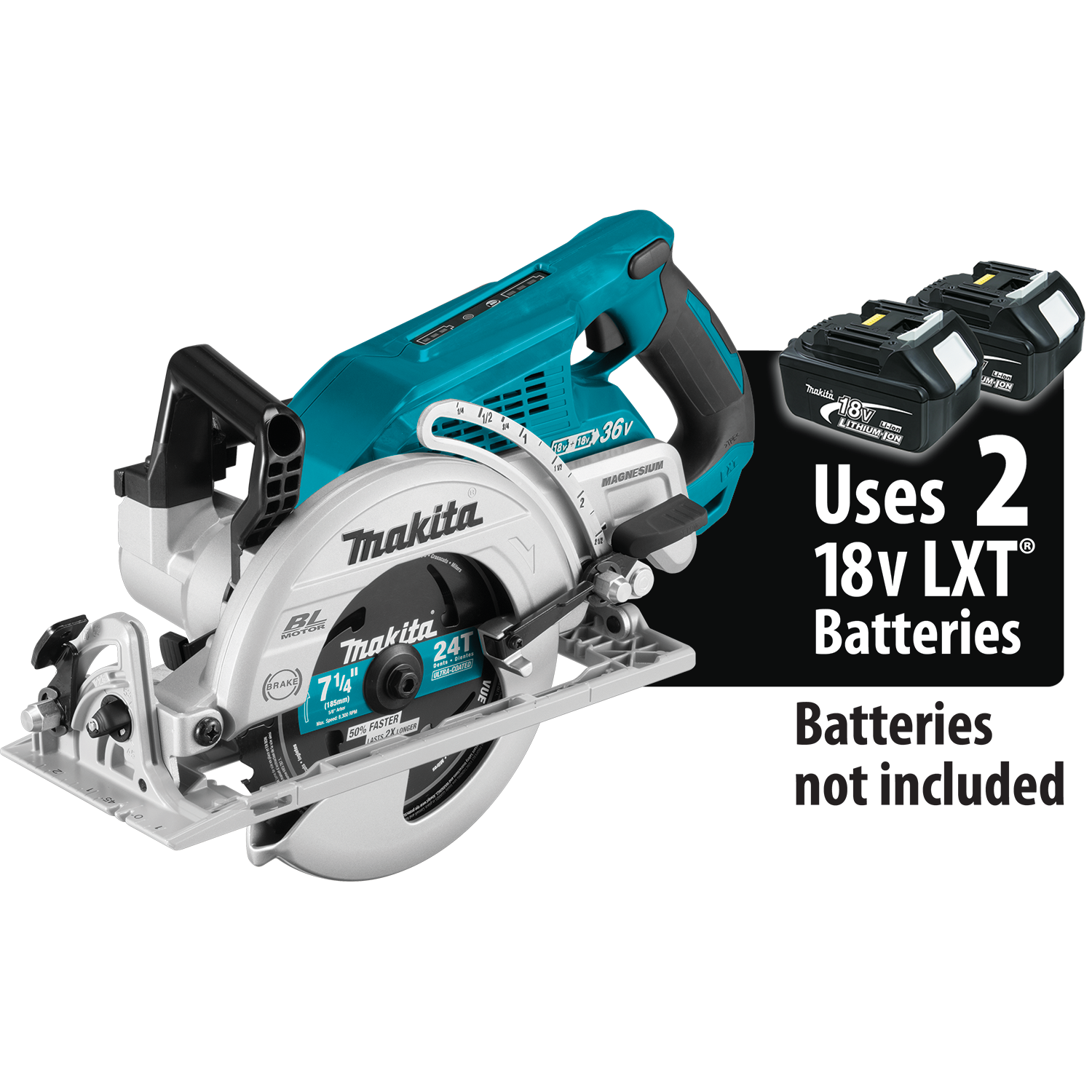
Long framing cuts are where a rear-handle saw earns its name. The motor and battery sit behind the blade, giving the saw a more conventional balance and better control when cutting 8-foot sheets, rafters, subfloor, and stacked framing lumber. A good cordless model can track straighter than a compact sidewinder, but it also weighs more and demands a larger battery.
For most builders, the best choice is a 7-1/4-inch saw on a high-output 18V/20V platform or a 36V/40V system. The right saw depends less on the maximum advertised cutting depth than on battery availability, charger speed, blade quality, and how often you make long cuts.
As an Amazon Associate we earn from qualifying purchases at no extra cost to you.


What to look for in a cordless rear-handle saw
Blade size: A 7-1/4-inch blade is the useful middle ground. It normally cuts about 2-1/2 inches deep at 90 degrees, enough for dimensional lumber and two layers of 3/4-inch sheet goods. Some saws cut slightly less or more depending on the shoe design. A 6-1/2-inch saw is lighter, but its roughly 2-1/8-inch capacity can be limiting when cutting 2-by material at a bevel.
Battery voltage and capacity: High-output 5.0Ah packs are a sensible minimum for production work. Compact batteries reduce weight but can trigger overload protection during long rip cuts. A 8Ah or 9Ah pack typically provides better runtime and less voltage sag, at the cost of several additional pounds. On a roof or ladder, that difference matters.
Brushless motor and electronic protection: Look for a brushless motor, electronic brake, overload protection, and a blade-stop system that does not feel excessively abrupt. Electronic protection is useful when the blade binds, but it can also interrupt a cut if you push too hard with a dull blade.
Shoe and sightline: A rigid magnesium or aluminum shoe is preferable to a thin stamped shoe for long cuts. Check that the front notch lines up with the blade’s actual kerf. Rear-handle saws often have a clear sightline, but dust can still cover it within seconds when cutting treated lumber or fiber-cement products.
The best cordless platform options
| Platform type | Best use | Main advantage | Main drawback |
|---|---|---|---|
| 18V/20V high-output | General framing and remodeling | Large tool and battery selection | Runtime can be marginal with compact packs |
| 36V/40V | Frequent long cuts and heavy framing | Strong sustained power without a cord | Heavier, more expensive battery ecosystem |
| 60V-class | Production framing and thick stock | Closest cordless feel to a corded saw | Bulky packs and higher tool cost |
| Compact 18V | Occasional framing and punch-list work | Lower weight and cheaper batteries | More likely to slow or stop under load |
For a new cordless collection, a 7-1/4-inch cordless rear-handle saw is usually the most versatile starting point. Buy into the platform you already use if possible. A bare tool may look inexpensive, but adding two high-capacity batteries and a rapid charger can cost more than the saw.
High-output 18V/20V systems are fine for most residential framing. They cut 2-by lumber quickly when fitted with a sharp framing blade and a sufficiently large battery. The cheaper option is not a mistake if your work consists of a few dozen cuts at a time, followed by other tasks while the battery charges.
A 36V/40V or 60V-class saw makes more sense when you are repeatedly ripping plywood, cutting wet pressure-treated lumber, or working through a full day of framing. These saws maintain blade speed better, which reduces wandering and the need to force the tool. The trade-off is weight: a saw with a large battery can approach or exceed 14 pounds, compared with roughly 10 to 12 pounds for a smaller cordless setup.
Battery runtime and charging
Do not compare amp-hour numbers across different voltage systems as if they were equal. Approximate energy is voltage multiplied by amp-hours: an 18V 5Ah pack stores about 90 watt-hours, while a 40V 5Ah pack stores about 200 watt-hours. Real cutting time varies widely, but this explains why higher-voltage saws can sustain heavy cuts longer.
As a practical planning number, one fully charged 5Ah 18V-class battery may handle roughly 100 to 200 crosscuts in ordinary 2-by lumber, or much less continuous sheet-goods ripping. Dull blades, cold batteries, wet wood, and pinched cuts can cut that figure sharply. Keep a second battery available rather than relying on the tool’s battery gauge.
A high-output battery and rapid charger are often better upgrades than buying the most powerful saw. Charging packs in a hot truck, leaving them discharged for weeks, or using a battery that repeatedly trips overload protection shortens useful life. Let a hot pack cool before charging.
How to make long, straight cuts
Use a sharp 18-tooth or 24-tooth framing blade for dimensional lumber. A 40-tooth blade leaves a cleaner edge on plywood but cuts slower and uses more power. Mark both ends of the cut, support the work every 2 to 3 feet, and keep the offcut from pinching the blade. Pinching is the most common cause of stalls, crooked cuts, and damaged blade guards.
For sheet goods, clamp a straightedge or use a dedicated clamp-on circular saw edge guide. Set the blade only about 1/8 inch below the material. Too much exposed blade increases kickback risk and makes the saw harder to control. Start with the shoe fully supported, wait for full blade speed, and advance at a steady pace without twisting the rear handle.
Common buying mistakes
Do not choose solely by no-load RPM. A saw that spins fast in the air can still bog down if its battery cannot deliver current. Also check the bevel range, included rafter hook, guard operation, and whether replacement blades are easy to find.
Finally, remember that rear-handle saws are not automatically safer or straighter. They are easier to control during long cuts, but a crooked guide, unsupported sheet, or dull blade defeats that advantage. If you only make occasional cuts, a less expensive 18V model with a good battery and guide is enough. If the saw will work continuously on framing crews, spend the extra money on sustained power, a second large battery, and a charger that can keep up.
Related guides
- Longest Lasting Lawn Mower Battery: AGM vs Lithium vs Flooded Lifespan and Cost per Season
- Duralast Gold Lawn Mower Battery Review: U1 Fit, CCA and When to Pay for AGM
- Greenworks Pro 80V 21-Inch Mower Review: Runtime Math, Push vs Self-Propelled and Yard Fit
- Bosch High Pressure Washer Gun Replacement: Fittings, Adapters and What Fits Your Model