What's inside
As an Amazon Associate I earn from qualifying purchases. This post may contain affiliate links at no extra cost to you.
Capturing dust at the hand tool is far more effective than sweeping it up later. A cordless vacuum connected to a sander, router, circular saw, or oscillating tool can keep fine dust out of the air and off your workbench. The best choice depends less on maximum suction than on hose fit, filter design, battery runtime, and whether the vacuum works with batteries you already own.
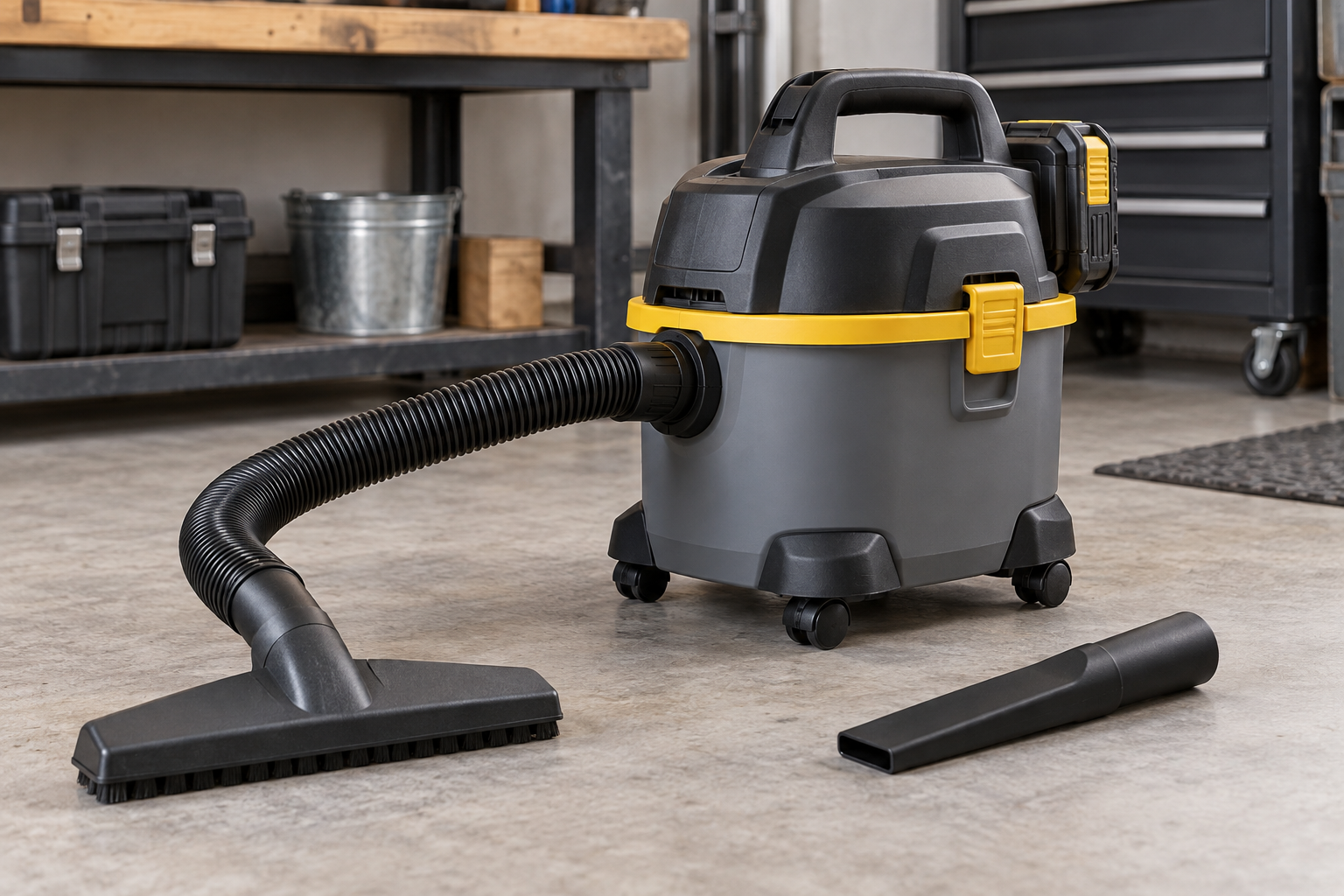
For most workshops, a compact 18V or 20V wet/dry vacuum is the practical starting point. It is easy to carry to a job, does not need an extension cord, and can handle cleanup as well as tool extraction. If you regularly sand drywall, concrete, or hardwood, step up to a model with a sealed HEPA-rated filtration system and automatic filter cleaning.
As an Amazon Associate we earn from qualifying purchases at no extra cost to you.



What to look for in a cordless dust extractor
Check the vacuum’s airflow, sealed suction, hose diameter, filter, and battery system. Airflow is usually listed in cubic feet per minute (CFM), while sealed suction may be listed as water lift. CFM matters when pulling chips and dust through a hose; water lift matters when overcoming restrictions at a tool port and filter. Neither number tells the whole story, but a compact extractor producing roughly 40 to 70 CFM at the hose is useful for hand tools.
A 1-1/4-inch hose is easier to connect to sanders and small dust ports. A 1-7/8-inch or 2-1/2-inch hose moves more air and is better for sawdust and chips, but adapters may be needed. Before buying, measure the dust outlet on your tool. A vacuum with excellent suction is still frustrating if its hose requires several loose adapters.
For fine dust, look for a sealed HEPA filter rather than simply a washable cartridge. “HEPA filter included” is not always the same as a fully sealed HEPA vacuum: air can bypass a poorly sealed lid, hose connection, or filter mount. A good unit should also have a disposable fleece bag or liner option. Bags protect the filter and make drywall or concrete dust less likely to escape during emptying.
Best cordless vacuum categories
| Vacuum type | Best use | Main advantage | Main limitation |
|---|---|---|---|
| Compact 18V/20V wet-dry vacuum | Small repairs, vehicle work, light tool cleanup | Portable and usually inexpensive if you own the batteries | Short runtime and small dust capacity |
| Backpack cordless extractor | Sanders, overhead work, punch-list jobs | Leaves both hands available and is easy to carry upstairs | Higher cost; battery and filter weight are on your back |
| Dual-battery 18V extractor | Continuous sanding, sawing, and renovation work | More airflow, capacity, and runtime than compact units | Heavier and often requires two batteries |
| Small cordless dust extractor with auto-start | Professional sanding and routing | Starts with the tool and may clean the filter automatically | Costs more and can be overkill for occasional cleanup |
For general DIY use, compare compact cordless wet-dry vacuums within the battery platform you already use. A bare tool is often the cheaper option if you have two or more compatible batteries. Buying into a new platform just for a vacuum can erase that savings quickly.
Match the vacuum to your battery platform
Battery compatibility is usually the deciding factor. DeWalt 20V MAX, Milwaukee M18, Makita 18V LXT, Bosch 18V, and other systems use proprietary battery electronics. A battery from one brand will not safely run a vacuum from another without an approved solution. Avoid cheap mechanical adapters for high-draw vacuums; they may defeat temperature monitoring or create a poor connection.
Runtime varies widely with the tool and battery. As a practical estimate, a compact vacuum may run for about 15 to 30 minutes on a 5.0Ah battery under continuous load. A dual-battery extractor can use two 5.0Ah packs in roughly 20 to 45 minutes, depending on suction mode and filter loading. Intermittent trigger use lasts longer than continuous extraction, but a sander running for an entire work session can drain batteries surprisingly fast.
Two smaller batteries are not always equivalent to one larger pack. Some vacuums need two batteries to reach full performance, while others run from one pack and simply gain runtime from a larger capacity. Check whether the vacuum accepts high-output batteries and whether both battery bays must be filled.
Connecting hand tools without losing suction
Use the shortest practical hose. Every extra foot, sharp bend, reducer, and loose adapter reduces airflow. A 5-foot hose is convenient for a sander on a bench; an 8- to 10-foot hose gives more reach around a jobsite but is easier to kink and drag across the work.
Sanders need steady airflow, not just high peak suction. If the tool’s dust box still fills quickly, the problem may be a blocked sanding pad, clogged paper holes, or a leaking adapter. Routers and circular saws produce larger chips and may need a wider hose. A tiny 1-1/4-inch hose can plug when connected to a saw even if it works well with a random-orbit sander.
Automatic tool activation is useful but not essential. It starts the vacuum when the connected tool runs and shuts it off after a short delay. This saves battery power and reduces noise. On cordless tools, however, the vacuum’s auto-start feature may not communicate with the tool; many systems require a remote switch or a compatible corded tool connection. Confirm how the feature works before paying extra for it.
Filters, bags, and common failure modes
The most common performance failure is a loaded filter. Fine sanding dust can reduce airflow long before the canister looks full. If suction drops, stop and check the filter, hose, tool port, and inlet screen. Do not keep running the vacuum with a clogged filter; the motor works harder, battery life falls, and dust capture gets worse.
Use a fleece collection bag for drywall, cement-board, and heavy sanding dust when the vacuum supports one. A bag costs more than emptying the canister, but it keeps the main filter cleaner and makes disposal safer. For wood chips and occasional garage cleanup, skipping the bag is usually fine.
Never assume a wet-dry vacuum can safely collect every liquid or combustible dust. Remove the dry filter or follow the manufacturer’s wet-pickup instructions before collecting water. Do not use a standard shop vacuum for flammable liquids, hot ash, or explosive dust. For large amounts of silica or lead dust, use a properly rated extractor, suitable bags, and respiratory protection rather than relying on a small cordless vacuum alone.
What to buy for different jobs
Choose a cordless backpack vacuum when portability matters more than capacity, especially for trim work, staircases, and overhead drilling. Choose a dual-battery dust extractor for repeated sanding or remodeling where a compact vacuum would require constant emptying and battery swaps.
The cheaper compact vacuum is fine for drilling, short cuts with a circular saw, car interiors, and occasional cleanup. Spend more for sealed fine-dust filtration, automatic filter cleaning, larger capacity, and tool-trigger operation only when you will use those features regularly. In practice, the best cordless vacuum is usually the one that fits your existing battery system, accepts the right hose size, and can be emptied without releasing the dust you just captured.
Related guides
- Longest Lasting Lawn Mower Battery: AGM vs Lithium vs Flooded Lifespan and Cost per Season
- Duralast Gold Lawn Mower Battery Review: U1 Fit, CCA and When to Pay for AGM
- Greenworks Pro 80V 21-Inch Mower Review: Runtime Math, Push vs Self-Propelled and Yard Fit
- Bosch High Pressure Washer Gun Replacement: Fittings, Adapters and What Fits Your Model