What's inside
As an Amazon Associate I earn from qualifying purchases. This post may contain affiliate links at no extra cost to you.
High-draw rotary hammers and concrete tools are hard on cordless batteries. Drilling a few holes in block is easy; continuous work with a large rotary hammer, core bit, or concrete breaker can expose every weakness in a battery pack: voltage sag, heat buildup, short runtime, and slow charging.
The best battery is not always the one with the highest amp-hour rating. For this work, you need a pack with strong current delivery, effective cooling, a rigid cell layout, and enough capacity that you are not running it flat on every hole. The battery must also match the tool’s platform and physical clearance.
As an Amazon Associate we earn from qualifying purchases at no extra cost to you.


What matters most in a concrete-tool battery
Power delivery comes first. A rotary hammer draws heavily when the bit binds, encounters rebar, or runs in hammer-only mode. A battery with high capacity but modest power cells may show a good runtime figure yet bog down sooner than a smaller, high-output pack.
Capacity determines runtime. Battery energy is roughly voltage multiplied by amp-hours. A 36-volt, 5Ah pack stores about 180 watt-hours under nominal conditions. An 18-volt, 8Ah pack stores about 144 watt-hours. Real runtime is lower because tools do not convert battery energy perfectly, and concrete work produces considerable heat.
Heat is the limiting factor. Battery electronics may reduce output or shut the pack down when cells become too hot. This is normal protection, not necessarily a defective battery. The risk is highest when using a large bit, drilling deep holes, or running a tool continuously in hot weather.
Cell layout and contacts matter. High-output packs use cells and internal connections designed to carry more current. Clean tool and battery contacts are important; concrete dust, moisture, or a loose pack can increase resistance and create heat at the terminals.
Which battery type makes sense?
| Battery type | Best use | Main advantage | Main drawback |
|---|---|---|---|
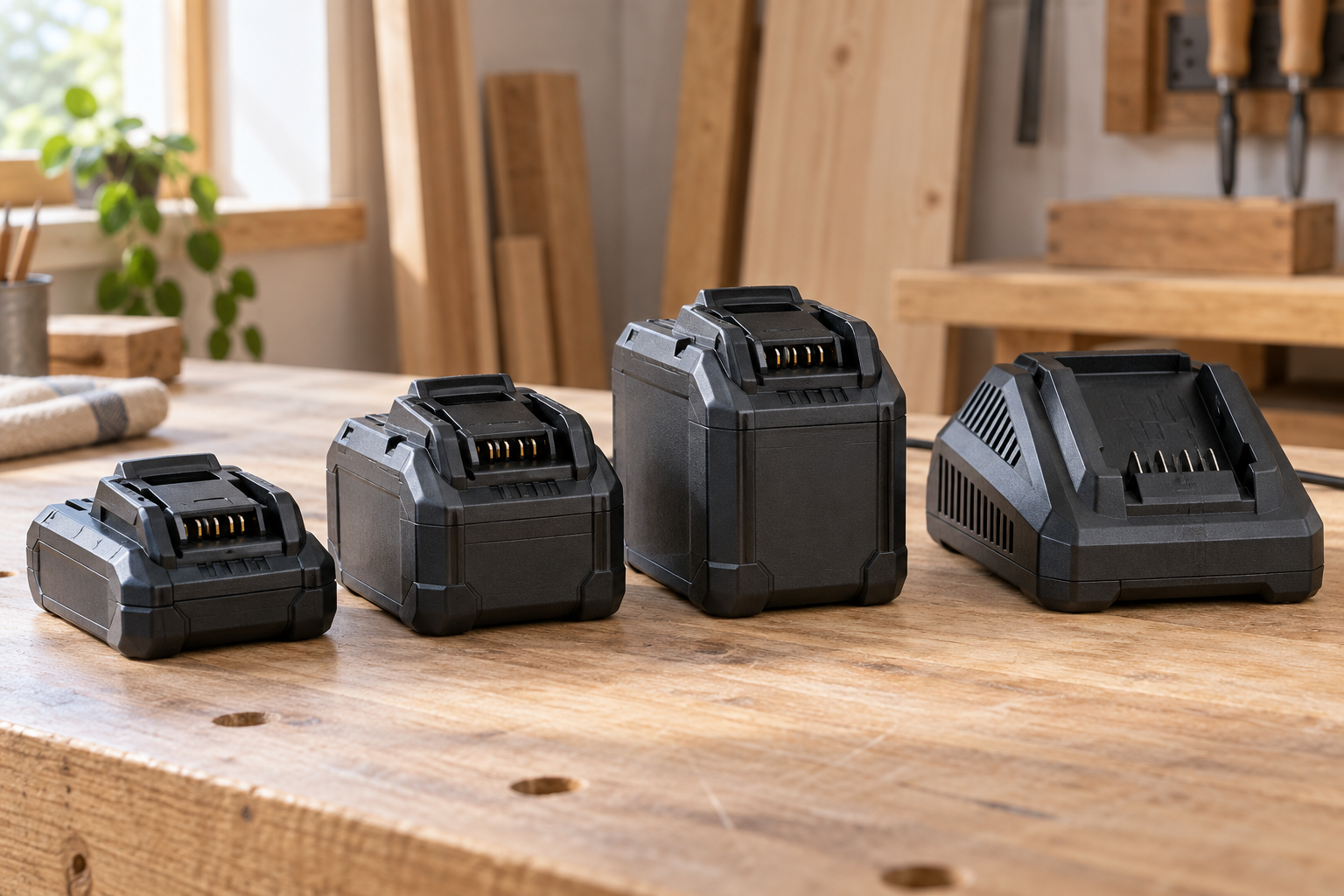
| Compact high-output pack, roughly 3–5Ah | Short drilling sessions and overhead work | Lower weight and better handling | Shorter runtime; heats faster under continuous load |
| High-output pack, roughly 6–8Ah | General rotary-hammer and anchor work | Good balance of output, runtime, and size | Heavier and more expensive |
| Large 9–12Ah pack | Large holes, breakers, and extended drilling | Longest runtime and usually better sustained output | Heavy, bulky, and slower to cool and recharge |
| Higher-voltage platform pack | Large rotary hammers and concrete breakers | More available power with lower current for a given output | Separate battery ecosystem and higher tool cost |
For most cordless rotary hammers, a 6Ah to 8Ah high-output battery is the practical starting point. It provides substantially more working time than a compact pack without making the tool as unwieldy as a very large battery. If the tool accepts a high-voltage platform, that option is often better for heavy chiseling or large-diameter drilling.
Comparing the major cordless platforms
Milwaukee’s M18 system has a broad selection of high-output batteries and concrete tools. Its larger packs are a sensible choice for M18 rotary hammers, especially when the tool has a brushless motor and is rated for substantial drilling capacity. The trade-off is noticeable weight at the wrist when working overhead. Look for M18 high-output battery options when comparing pack sizes and kits.
DeWalt’s 20V MAX platform offers compact high-output packs that are useful for overhead anchor drilling, along with larger batteries for longer sessions. A smaller pack may be the better choice for dozens of shallow holes, where fatigue matters more than maximum runtime. For repeated large holes, choose the highest-output pack your tool manufacturer recommends. Search DeWalt high-output rotary-hammer batteries by capacity and kit contents rather than choosing by price alone.
Makita’s 18V LXT system is extensive, but its higher-voltage XGT platform is the more natural fit for demanding concrete work where a compatible tool is available. XGT tools and batteries cost more and cannot be used as ordinary LXT replacements. That extra investment can be worthwhile for large rotary hammers, breakers, and users already committed to the XGT ecosystem. Compare Makita XGT batteries for concrete tools with the price of an LXT tool and multiple spare packs.
Bosch’s 18V platform also includes high-capacity batteries and rotary hammers designed around them. Bosch battery and tool compatibility is platform-specific, so verify the exact voltage family before buying. A battery that physically fits another brand’s tool is not a safe substitute unless the manufacturer explicitly supports that arrangement.
Estimate runtime by work rate, not hole count
Battery runtime claims are difficult to compare because concrete hardness, bit diameter, drilling depth, and operator pressure change the load dramatically. A small anchor hole may take only a few seconds of hammering. A 1-inch hole several inches deep can consume many times more energy, particularly if the bit is dull or dust is not cleared.
For production work, buy at least two substantial packs and rotate them. The second battery should be charging while the first is working, but only if the charger can keep up. A basic charger may need several hours to refill a large pack. A rapid charger can shorten that interval, although fast charging also produces heat and may reduce charging speed when the battery is hot.
Common failure modes and how to avoid them
Do not keep drilling after the battery repeatedly cuts out. That usually means thermal or low-voltage protection is operating. Let the pack cool in the shade, clear dust from the bit, reduce pressure, or switch to a smaller bit. Running a second hot battery immediately can produce the same shutdown.
Do not store batteries in a hot vehicle or charge them while they are cold from winter conditions. Let them return to a moderate temperature first. Inspect the pack after drops: a cracked housing, swollen case, or damaged terminal is a replacement situation, not a repair opportunity for ordinary users.
Finally, match the battery to the job. The cheaper compact pack is fine for occasional holes, light anchor work, and overhead drilling where a heavy battery causes fatigue. Spend more on a high-output 6Ah-to-8Ah pack when the tool will run continuously, and consider a higher-voltage system when concrete work is a regular part of the job.
Related guides
- Longest Lasting Lawn Mower Battery: AGM vs Lithium vs Flooded Lifespan and Cost per Season
- Duralast Gold Lawn Mower Battery Review: U1 Fit, CCA and When to Pay for AGM
- Greenworks Pro 80V 21-Inch Mower Review: Runtime Math, Push vs Self-Propelled and Yard Fit
- Bosch High Pressure Washer Gun Replacement: Fittings, Adapters and What Fits Your Model