What's inside
- Quick picks by situation
- Head-to-head: the best cordless self propelled lawn mowers compared
- Rear-wheel vs front-wheel drive on slopes — the spec that actually matters
- Runtime per charge: what the numbers look like on thick grass
- Model notes
- Decision matrix
- Can you get stripes? (The “electric lawn mower with roller” question)
- Durability and ownership realities
- Finding the best deals on electric lawn mowers
- FAQ
- Quick picks by situation
- Head-to-head: the best cordless self propelled lawn mowers compared
- Rear-wheel vs front-wheel drive on slopes — the spec that actually matters
- Runtime per charge: what the numbers look like on thick grass
- Model notes
- Decision matrix
- Can you get stripes? (The “electric lawn mower with roller” question)
- Durability and ownership realities
- Finding the best deals on electric lawn mowers
- FAQ
As an Amazon Associate I earn from qualifying purchases. This post may contain affiliate links at no extra cost to you.
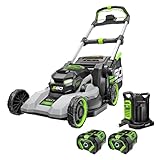
For most lawns with hills or thick grass, the best self-propelled electric lawn mower in 2026 is the EGO Power+ LM2156SP — a 21-inch rear-wheel-drive mower with a dual-blade system, roughly 75 minutes of rated runtime, and a 0.9–3.1 mph drive range that holds traction on slopes where front-wheel-drive models slip. Below it, the Toro 60V Super Recycler, Ryobi 40V HP, and Milwaukee M18 FUEL each win specific situations, which is what the rest of this comparison breaks down.
As an Amazon Associate we earn from qualifying purchases at no extra cost to you.



Quick picks by situation
- Best overall for hills and thick grass: EGO Power+ LM2156SP (56V, RWD, dual-blade Select Cut)
- Best pace-matched drive for uneven terrain: Toro 60V Super Recycler with Personal Pace
- Best mid-range value: Ryobi 40V HP Brushless 21″ (often sold with two batteries)
- Best for heavy, wet, commercial-style cutting: Milwaukee M18 FUEL 21″ — steel deck, very heavy, very capable
- Best budget self-propelled option: Greenworks 60V 21″ or Worx Nitro 80V, typically $150–250 less than the flagships
Head-to-head: the best cordless self propelled lawn mowers compared
| Model | Drive | Deck | Drive speed range | Battery | Rated runtime | Weight | Typical price range |
|---|---|---|---|---|---|---|---|
| EGO LM2156SP | Rear-wheel | 21″ polymer | 0.9–3.1 mph | 56V, 10.0Ah (560Wh) | Up to ~75 min | ~75 lb | $700–800 |
| Toro 60V Super Recycler | Rear-wheel, Personal Pace | 21″ aluminum | Pace-matched, up to ~4 mph | 60V, 7.5Ah (~450Wh) | Up to ~60 min | ~72 lb | $700–850 |
| Ryobi 40V HP 21″ (RY401210) | Rear-wheel | 21″ composite | ~0.8–3.0 mph | 40V, 2×6.0Ah (~480Wh total) | Up to ~70 min | ~77 lb | $500–650 |
| Milwaukee M18 FUEL 2823 | Rear-wheel | 21″ steel | Up to ~4 mph | 2×18V 12.0Ah (~432Wh) | Up to ~60 min | ~95 lb | $900–1,100 |
| Greenworks 60V 21″ | Rear-wheel | 21″ steel | ~0.9–3.0 mph | 60V, 5.0Ah (300Wh) | Up to ~60 min | ~66 lb | $400–550 |
| Worx Nitro 80V WG761 | Rear-wheel | 21″ steel | Variable, up to ~3.2 mph | 4×20V 5.0Ah (~400Wh) | Up to ~55 min | ~82 lb | $450–550 |
Rear-wheel vs front-wheel drive on slopes — the spec that actually matters
When a mower climbs a hill, weight shifts onto the rear axle. A front-wheel-drive mower loses grip exactly when it needs it — the drive wheels lighten, spin, and you end up pushing anyway. That’s why nearly every serious self-propelled cordless electric is rear-wheel drive, and it’s the first filter you should apply if your lawn has any real slope.
Front-wheel-drive electric mowers still exist, mostly in entry-level 40V lines. On flat ground they have one genuine advantage: you can pivot the mower for turns by pressing down on the handle, lifting the driven front wheels off the grass. With RWD you must feather the drive bail or drag the drive wheels through the turn. But on a 10–15° slope, FWD traction loss outweighs the convenience. Cross-slope mowing is the worst case — FWD mowers tend to crab downhill as the front axle slips sideways.
Toro’s Personal Pace deserves a separate note: instead of a thumb dial or lever, the handle slides forward as you walk, so ground speed matches your pace automatically up to about 4 mph. On rolling terrain where you’re constantly speeding up on flats and slowing into climbs, it removes the constant speed-dial fiddling that fixed-range drives require.
Runtime per charge: what the numbers look like on thick grass
Rated runtimes assume maintained grass. In dense, tall, or damp turf — think spring fescue or fertilized bermuda — current draw spikes and real-world runtime drops to roughly 60–70% of the sticker number. Here’s the math that actually predicts your result:
- Battery energy = volts × amp-hours. The EGO’s 56V × 10Ah pack = 560Wh. A mower under heavy load pulls roughly 500–700W, so 560Wh ÷ ~600W ≈ 0.9 hours of hard cutting — about 55 minutes in thick grass versus the 75-minute rating.
- Coverage check: at 2.5 mph with a 21″ deck (~19″ effective cut width), you cover roughly 0.4 acres per hour at realistic overlap. A quarter-acre lawn needs ~35–40 minutes — comfortable for any 7.5–10Ah kit. A half acre of thick grass pushes past one charge on the smaller packs in this table.
- Practical rule: for lawns over a third of an acre or grass you regularly let get tall, buy the kit with the biggest battery, or a platform where a second pack costs under ~$150.
Mulching thick clippings costs more power than side-discharging or bagging, and cutting more than a third of the blade height at once can stall even brushless motors. Slowing ground speed to the bottom of the drive range (~1 mph) is the correct fix — it keeps blade tip speed up while the deck clears clippings, which is why a wide 0.9–3.1 mph range like the EGO’s is more useful than a fast top speed.
Model notes
EGO Power+ LM2156SP
The most complete package here: the Select Cut dual-blade setup genuinely mulches heavy growth better than single-blade decks, the 10Ah battery gives the largest energy reserve in the group, and RWD traction is confident on wet slopes. Downsides are price and a polymer deck that flexes if you hit a stump.
Toro 60V Super Recycler
The aluminum deck and Personal Pace drive make this the pick for uneven, bumpy yards where you’re changing pace constantly. The Recycler mulching system is proven; battery capacity is the weakest in the group relative to price.
Ryobi 40V HP self-propelled lawn mower
The ryobi 40v self propelled lawn mower line (RY401210 and related SKUs) is the value sweet spot: rear-wheel drive, cross-cut dual blades on HP models, and kits frequently bundled with two 6Ah packs — effectively doubling usable runtime to over an hour of real mowing. It’s the best cordless self propelled lawn mower under $650 for quarter-acre lots with moderate slopes.
Milwaukee M18 FUEL
A steel-deck bruiser. At ~95 lb it’s the heaviest here, which is a real trade-off on slopes — gravity helps RWD traction but the weight makes turnarounds work. Best for buyers already holding M18 batteries, or for rough grass where deck rigidity and torque matter more than handling.
Decision matrix
| Your situation | Pick | Why |
|---|---|---|
| Flat, under ⅓ acre, tightest budget | Greenworks 60V or a 40V self-propelled kit | Best cheap electric lawn mower tier that still self-propels; RWD included |
| ¼–½ acre, moderate hills | Ryobi 40V HP or Toro 60V | RWD traction, enough runtime, mid-range price |
| ½ acre+, thick or fast-growing turf | EGO LM2156SP | Largest battery, best mulching, widest speed range |
| Wet climate, tall grass between mows | Milwaukee M18 FUEL or EGO | Steel deck / dual blades handle heavy loads |
| Already own M18, Ryobi 40V, or 60V batteries | Buy tool-only in that platform | Saves $150–300 and doubles as a spare pack |
Can you get stripes? (The “electric lawn mower with roller” question)
In the US market, essentially no mainstream self-propelled cordless mower ships with a rear roller — rollers live on corded and UK/EU cylinder mowers (the battery-powered Allett Liberty range being the niche exception). If striping matters, the practical route is a bolt-on striping kit: Toro sells an official Lawn Striping System kit, and third-party roller kits fit EGO, Ryobi, and Greenworks decks for roughly $80–130. They add drag, which costs a few minutes of runtime and slightly reduces hill traction, but produce real stripes on fescue and rye.
Durability and ownership realities
- What wears first: plastic drive wheel treads (2–4 seasons on slopes), the drive engagement cable or bail spring, and blades — sharpen or replace once or twice per season, more on sandy soil.
- Battery aging: expect ~80% capacity after roughly 500 cycles / 4–6 years. Store packs at 40–60% charge indoors over winter, never in a freezing or 100°F+ shed, and don’t leave them on the charger for months.
- Cleaning: scrape the deck after wet mows — packed clippings rust steel decks and add drag that eats runtime. Hose ports help but don’t replace scraping.
- Common mistakes: buying an underpowered budget 40V for bermuda or zoysia, mowing soaked grass, and running the drive on pavement at top speed, which grinds the wheel treads down fast.
Finding the best deals on electric lawn mowers
Self-propelled electrics follow a predictable price cycle. The best deals on electric lawn mowers land in three windows: early-spring promos (March–May, often a free extra battery), Father’s Day sales, and fall clearance (September–November), when last year’s kits drop 20–35%. The best budget electric lawn mower strategy is usually a previous-generation kit — e.g., last cycle’s EGO or Ryobi SKU — rather than a no-name brand, because you keep the battery platform and parts support. Tool-only versions save meaningfully only if you already own packs at 5Ah or above.
FAQ
Is front-wheel or rear-wheel drive better for hills?
Rear-wheel drive, clearly. Uphill weight transfer unloads the front axle, so FWD mowers spin their drive wheels on slopes steeper than about 10°. FWD is acceptable only on flat lawns.
How steep a slope can a self-propelled electric handle?
Most handle 15° comfortably; beyond ~20°, traction — not motor power — becomes the limit, and manufacturer guidance for any walk-behind typically caps at 15° for safety anyway.
Do thicker grass and hills cut runtime a lot?
Yes — expect 60–70% of rated runtime. Steep climbs also add drivetrain draw. If your lawn is both large and demanding, size the battery by watt-hours (aim for 450Wh+) rather than trusting the minute rating.
Which is the best electric lawn mower overall?
For mixed terrain, the EGO LM2156SP remains the best electric lawn mower for most buyers in 2026; the Ryobi 40V HP is the smarter buy if budget matters more than peak capability, and the Toro wins if your yard has constant elevation changes.