What's inside
As an Amazon Associate I earn from qualifying purchases. This post may contain affiliate links at no extra cost to you.
The best electric lawn dethatcher for most homeowners is the corded Sun Joe AJ801E, a 12-amp, 13-inch model with five depth settings and a collection bag, while the Greenworks 40V 15-inch brushless and Worx WG855 are the top cordless picks for lawns too far from an outlet, and the Greenworks 27022 is the simplest low-cost option for smaller yards.
An electric dethatcher uses a spinning reel of spring tines to rake out the layer of dead grass, stems and moss (thatch) that builds up between the soil and the green blades. Once that layer passes about half an inch, it blocks water and fertilizer and invites disease. A powered dethatcher does in an hour what would take a full weekend with a hand rake.
As an Amazon Associate we earn from qualifying purchases at no extra cost to you.

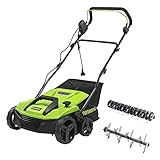
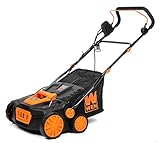

Electric Dethatchers Compared
| Model | Power | Working width | Depth settings | Collection bag | Typical price range |
|---|---|---|---|---|---|
| Sun Joe AJ801E | 12 A corded | 13 in | 5 | Yes, about 8 gal | $100-$150 |
| Greenworks 27022 | 10 A corded | 14 in | 3 | Varies by bundle | $90-$140 |
| Worx WG850 | 12 A corded | 14 in | Multiple | Yes | $130-$180 |
| Greenworks 40V 15-inch brushless | 40V, 5.0Ah kit | 15 in | 5 | Yes | $250-$300 |
| Worx WG855 Nitro | 40V (2 x 20V PowerShare) | 14 in | 3 | Yes, plus scarifier reel | $250-$330 |
| Makita 40V max XGT 15-inch dethatcher/scarifier | 40V XGT | 15 in | Multiple | Yes | $400-$550 (kit) |
Choosing by Lawn Size and Power Source
Best overall: Sun Joe AJ801E
The AJ801E has been a reference corded dethatcher for years because it combines a 12-amp motor, five depth positions and an included collection bag at a low price. The fine depth adjustment matters: you can start shallow for a light spring pass and drop lower for a heavy fall clean-up. The bag is small, so on thick thatch you will empty it often.
Budget pick: Greenworks 27022
A 10-amp motor and 14-inch path make this one of the simplest ways into powered dethatching. Its three depth settings and lighter build suit small, mostly level lawns with moderate thatch. Expect to replace tines every couple of seasons in heavier use.
Heavier corded option: Worx WG850
At roughly 32 lb, the WG850 is heavier than most push dethatchers, which helps the tines stay in contact with uneven turf and reduces bouncing. The handle folds for storage.
Best cordless: Greenworks 40V 15-inch brushless
Greenworks’ brushless model gives a slightly wider 15-inch path, five depth positions and a rated runtime of up to about 45 minutes on its 5.0Ah battery. That covers a typical quarter-acre lawn on one charge if thatch is moderate.
Best two-in-one cordless: Worx WG855 Nitro
The WG855 includes both a spring-tine dethatching reel and a bladed scarifier reel, so one machine handles a light thatch rake and a more aggressive scarifying pass before overseeding. It runs on two 20V Worx PowerShare batteries.
For Makita battery owners: Makita 40V max XGT dethatcher
Makita’s XGT unit is a premium option that makes sense mainly for existing Makita 40V users. It also offers interchangeable dethatching and scarifying functions.
Dethatcher vs Scarifier
| Feature | Dethatcher (spring tines) | Scarifier (fixed blades) |
|---|---|---|
| Action | Rakes loose thatch and moss from the surface | Slices into thatch and top 1/8-1/4 in of soil |
| Best for | Annual maintenance, thatch under 3/4 in | Heavy thatch, moss, seedbed prep |
| Lawn recovery time | A few days | 2-4 weeks |
| Follow-up | Optional overseeding | Overseeding recommended |
Corded or Cordless? A Coverage Check
A 13 to 15-inch dethatcher walking at about 2 mph covers roughly 11,000 to 13,000 sq ft per hour in theory. With overlap, turns and bag emptying, real coverage is closer to 5,000 to 8,000 sq ft per hour.
- Lawn under 5,000 sq ft: Corded is simplest and cheapest. One 100-foot cord usually reaches the whole yard.
- 5,000-10,000 sq ft: Cordless with a 4 to 5Ah battery typically finishes in one charge on moderate thatch; heavy thatch may need a second battery.
- Over 10,000 sq ft: Consider a tow-behind dethatcher for a lawn tractor, or plan on two batteries.
For corded models over 50 feet from the outlet, use a 14-gauge extension cord; for 100 feet, use 12-gauge to avoid voltage drop that weakens the motor.
How to Dethatch Without Damaging the Lawn
- Check thatch depth. Cut a small wedge of turf. If the spongy brown layer is under half an inch, you may not need to dethatch at all.
- Time it to active growth. Early fall or spring for cool-season grasses; late spring to early summer for warm-season grasses.
- Mow low first. Cut about one notch lower than normal so tines reach the thatch.
- Start shallow. Use the highest depth setting first and lower it only if little material comes up.
- Make two passes at right angles on heavy thatch rather than one deep, damaging pass.
- Rake, overseed and water. Remove debris, overseed thin spots and keep the soil moist for two to three weeks.
Wear Parts and Maintenance
- Tines bend or break on stones and sprinkler heads. Replacement tine reels or individual tines are available for the major brands.
- Collection bags tear at the seams after several seasons of heavy use.
- Belt-drive models may need a belt after years of use; direct-drive models avoid that.
- Clean the reel after each use and store the machine dry. Do not hose down the motor housing.