
Our Top Picks
What's inside
- U1 vs. U1R: Same Case, Mirrored Posts
- U1 and U1R Specs at a Glance
- How Much CCA Does Your Mower Actually Need?
- Flooded vs. AGM vs. Lithium: Picking the Chemistry
- Match the Battery to Your Situation
- Getting the Install Right
- What Actually Kills These Batteries
- Reading the Battery Label: Group Size, CCA, and Date Codes
- Warranty Tiers and What They Actually Cover
- Charging Voltage Compatibility: Flooded, AGM, and Lithium
- Cold Weather and Cranking Power: What the Numbers Mean Outside
- Where Else a U1 or U1R Battery Shows Up
- Seasonal Storage and Battery Tender Use
- Terminal Corrosion: Why It Happens and How to Prevent It
- Mower Charging System Checks Before You Blame the Battery
- Vibration and Mounting: A Risk Automotive Batteries Rarely Face
- Battery Recycling and Core Exchange: What Happens Next
- Jump-Starting a Mower Battery Without Damaging Anything
- Why Group Size Alone Does Not Guarantee a Drop-In Fit
- How Often to Check a Mower Battery During the Season
- Brand Tiers Within the Same U1 Group Size
- Returning or Exchanging a Mower Battery: What to Expect
- Frequently Asked Questions
- Related Guides
As an Amazon Associate I earn from qualifying purchases. This post may contain affiliate links at no extra cost to you.
The short answer: at O’Reilly, an o reilly lawn mower battery is almost always either a BCI Group U1 or U1R, and the two are physically identical in every dimension except one — the position of the positive terminal — so the group code printed on your old battery’s label is the single piece of information you need before you order.
As an Amazon Associate we earn from qualifying purchases at no extra cost to you.
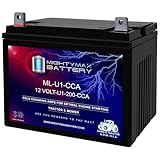


U1 vs. U1R: Same Case, Mirrored Posts
Both group sizes share the exact same footprint, height, and 12-volt electrical system. The “R” stands for reversed polarity: with the battery sitting upright and the front label facing you, a U1 has its positive (+) post on the left corner and a U1R has it on the right.
Why it matters in practice: mower battery cables are cut to length and routed to reach one specific corner. Buy the wrong orientation and you’ll either come up short on cable reach or be tempted to twist the battery around — which can stretch a cable, rub it against a sharp edge, or worst case, connect it backwards. Reversed polarity on a mower typically blows the main fuse instantly, and on machines with a regulator/rectifier it can cook the charging circuit or the ignition module. That’s a $30 battery choice turning into a $150 repair.
How to confirm yours in 30 seconds: look at the label or embossed code on your old battery — it will read U1, U1R, or sometimes “U1-9” style brand codes. If the label is gone, note which corner the red/positive cable reaches when the battery sits in the tray. Take a photo before disconnecting anything.
U1 and U1R Specs at a Glance
| Spec | Group U1 | Group U1R |
|---|---|---|
| Positive terminal position (facing label) | Left corner | Right corner |
| Voltage | 12 V | 12 V |
| Approx. dimensions (L × W × H) | 7.75 × 5.13 × 7.25 in | 7.75 × 5.13 × 7.25 in |
| Typical CCA range | ~160–350 CCA | ~160–350 CCA |
| Weight (flooded lead-acid) | ~13–17 lbs | ~13–17 lbs |
| Terminal style | Bolt/L-type posts | Bolt/L-type posts |
| Typical price range | ~$35–$55 flooded; ~$60–$90 AGM | ~$35–$55 flooded; ~$60–$90 AGM |
O’Reilly’s house line, Super Start, is the brand you’ll see most often on the shelf, and a refundable core charge applies at checkout — bring the old battery and you get that deposit back. Because U1/U1R is an industry-wide BCI standard, you’re never locked into one brand; the group code is what guarantees fit.
How Much CCA Does Your Mower Actually Need?
Cold cranking amps measure how much current the battery can deliver at 0°F for 30 seconds. For lawn equipment, CCA is really a proxy for “how easily does this spin a big engine on a cold spring morning.” Going higher than required is always safe — the starter only draws what it needs — but you’ll pay for capacity you don’t use.
| Mower / engine type | Minimum sensible CCA | Comfort zone |
|---|---|---|
| Single-cylinder rider or zero-turn (under ~15 hp) | 150 CCA | 180–230 CCA |
| V-twin lawn/garden tractor (17–24 hp) | 230 CCA | 250–350 CCA |
| Cold-climate use, hard-starting engines, infrequent starts | — | Top of range (300+ CCA) |
| Diesel subcompact tractor | 400+ CCA | Usually a different group size entirely — check manual |
One caveat: some budget lawn batteries are rated in “cranking amps” (measured at 32°F) rather than true CCA. The CA number always looks bigger. If a box only advertises a vague “amps” figure, assume it’s the warmer-temperature rating and buy a notch higher.
Flooded vs. AGM vs. Lithium: Picking the Chemistry
- Conventional flooded lead-acid is what most U1/U1R batteries on the shelf are. Cheapest option, proven, and fine for seasonal use — as long as you keep it charged over winter. This is what kills them early, not miles or hours.
- AGM (absorbed glass mat) versions cost roughly 50–70% more but are fully sealed, spill-proof, tolerate vibration better (relevant on rough-cutting zero-turns), self-discharge slower in storage, and typically deliver more CCA from the same case size.
- Lithium (LiFePO4) drop-in replacements exist in U1-size cases — a fraction of the weight (3–4 lbs) with strong cranking specs — but they want a lithium-compatible charger and can underperform in deep cold. Verify charging compatibility before going this route.
Match the Battery to Your Situation
| Your situation | Best pick | Why |
|---|---|---|
| Standard rider, mild climate, used weekly in season | Flooded U1/U1R, ~200 CCA | Cheapest path; regular use keeps it healthy |
| V-twin tractor or big zero-turn | 300+ CCA flooded or AGM | Larger engines need the extra cranking reserve |
| Mower sits for weeks between cuts | AGM, or flooded + maintainer | Slow self-discharge prevents sulfation damage |
| Winters where the shed drops below freezing | Remove battery indoors on a maintainer | A discharged battery freezes and cracks; a charged one doesn’t |
Getting the Install Right
- Disconnect negative first, reconnect it last. This prevents a wrench shorting the positive post to the frame.
- Clean the cable ends with a wire brush before attaching — green crust adds resistance and mimics a weak battery.
- Seat the battery fully and re-secure the hold-down strap. A loose battery bounces, cracks its case, and shakes plates apart internally.
- Check height clearance under the seat or hood. U1 cases run about 7.25 inches tall; some aftermarket AGM versions sit slightly taller at the terminals.
- Charge before first use if it sat on the shelf. Fresh stock is usually charged, but a battery that’s been sitting months benefits from a slow top-off.
What Actually Kills These Batteries
Replacement listings won’t tell you this: most mower batteries don’t wear out — they’re murdered by storage. Leaving a battery partially discharged for a winter lets sulfate crystals harden on the plates, permanently cutting capacity. Expect 3–4 seasons from a maintained flooded battery; one that sits dead all winter may not survive a single year.
A $15–25 float maintainer (1–1.5 amp) plugged in through the off-season pays for itself in one avoided replacement. Also worth knowing: if your new battery dies within weeks, suspect the charging system, not the battery. With the engine at full throttle, a healthy mower should show roughly 13.5–14.5 volts at the battery posts. Anything under ~13 volts means the stator or regulator isn’t charging — and a new battery will just die again. Many O’Reilly locations can test a 12-volt battery in-store before you buy, which is a free way to confirm the diagnosis.
Reading the Battery Label: Group Size, CCA, and Date Codes
Beyond the group size and CCA figures, most lead-acid batteries carry a manufacture date code stamped on the top or side, near the handle or terminal. The common industry format uses one letter for the month and one digit for the year: A is January, B is February, and so on through M for December, skipping the letter I to avoid confusion with the number 1; the digit that follows is simply the last digit of the production year. A code reading “D4,” for example, decodes as April of a year ending in 4.
Format is not universal across every brand, so treat the letter-then-digit pattern as a starting point rather than a guarantee, and look for a dedicated date-code sticker if the main label format does not match. The date matters because a battery that has sat on a shelf for many months before its first charge can already be partially sulfated even though it has never been “used” – as a rule of thumb, a battery with a date code more than about a year old is worth asking the counter staff to load-test or top off before you leave the store, rather than installing it straight from the shelf.
Warranty Tiers and What They Actually Cover
Auto parts retailers commonly structure lead-acid battery warranties in two phases: a free-replacement period, where a failed battery is swapped at no cost, followed by a longer prorated period where the credit toward a replacement shrinks the further the battery is into its service life. Entry-level batteries typically carry a shorter free-replacement window with a shorter total term, while mid-tier and premium batteries extend both numbers – more months of no-questions-asked replacement, and a longer prorated tail after that.
The free-replacement period is the number worth weighing most heavily when comparing two batteries, since a prorated credit late in a long warranty term often amounts to a small fraction of a full replacement. A battery with a shorter total warranty but a longer free-replacement window can be the better practical choice over one advertising a longer headline number that is mostly prorated coverage.
Charging Voltage Compatibility: Flooded, AGM, and Lithium
Flooded and AGM lead-acid batteries both charge in stages: a bulk/absorption stage commonly in the 14.1-14.8V range tops off the battery, followed by a float stage, typically around 13.2-13.8V, that holds the battery at full charge indefinitely without excess water loss or gassing. A smart charger set correctly for flooded or AGM chemistry will automatically step down from absorption to float.
Lithium (LiFePO4) swap batteries do not follow that same curve and must not be charged with a charger’s temperature-compensated lead-acid profile, since lithium charge voltage needs to stay constant regardless of ambient temperature. Lithium packs also carry their own protection circuit that blocks charging outright below freezing – commonly cutting off charge acceptance at or near 32°F and not resuming until the pack warms back into the upper 30s to low 40s °F – while still allowing the battery to discharge and start the engine in much colder conditions. Mixing chargers between chemistries, or assuming a “12V charger is a 12V charger,” is one of the more common ways an otherwise healthy lithium swap battery gets damaged.
Cold Weather and Cranking Power: What the Numbers Mean Outside
A lead-acid battery’s usable capacity drops noticeably as temperature falls, which is exactly why the CCA rating exists: cold cranking amps is defined as the current a battery can deliver for 30 seconds at 0°F while holding at least 7.2V, a deliberately harsh benchmark compared to room-temperature testing. At a milder 32°F, a healthy lead-acid battery still delivers roughly 80% of its rated capacity; by the time the thermometer reaches 0°F, that figure falls to around 50%.
In practical terms, a battery that starts a mower easily on a 70°F afternoon in the shed can struggle on a 30°F morning even with no change in the battery itself, simply because of how lead-acid chemistry behaves in the cold. This is why matching or exceeding the mower manufacturer’s specified CCA – rather than buying the lowest CCA rating that technically fits the group size – gives more margin on cold mornings early and late in the mowing season.
Where Else a U1 or U1R Battery Shows Up
BCI Group U1 and U1R are not exclusive to walk-behind and riding mowers. The same compact case size commonly turns up in snow blowers, smaller zero-turn mowers, ATVs and UTVs with smaller engines, and mobility scooters or power wheelchairs that call for a compact 12V battery. If a U1-size battery is pulled from any of that equipment rather than a mower, the same terminal-position rule still applies: check whether the positive post sits on the U1 side or the mirrored U1R side before ordering a replacement, since the case dimensions are identical either way.
Seasonal Storage and Battery Tender Use
Lead-acid batteries self-discharge even sitting idle, and sulfation – the buildup of lead sulfate crystals on the plates that permanently reduces capacity – begins once a battery sits below full charge for an extended stretch, which is exactly what happens to a mower battery left in an unheated shed over winter. A float-style maintainer, holding the battery at its float voltage (roughly 13.2-13.8V for flooded or AGM chemistry) rather than cycling on and off, prevents that slow discharge-and-sulfate cycle without overcharging the battery.
Lithium swap batteries self-discharge far more slowly and most do not need a maintainer for seasonal storage at all, but the cold-weather charging cutoff described above still applies: do not connect a maintainer to a lithium battery sitting in a below-freezing garage expecting it to accept a top-off charge, since its own protection circuit will simply refuse the current until temperatures climb back above the low-30s to low-40s °F range.
Terminal Corrosion: Why It Happens and How to Prevent It
Flooded lead-acid batteries vent a small amount of hydrogen gas during normal charging, and that gas reacting with moisture and trace sulfuric acid at the terminal posts is what produces the white or blue-green crust many mower owners notice building up around the terminals over a season. That crust is mildly corrosive and increases resistance at the connection, which can mimic a weak battery by causing a slow or hesitant crank even when the battery itself is fine.
A thin coat of dielectric grease or a petroleum-jelly-based terminal protectant applied after cleaning, along with felt anti-corrosion washers sized for the post, slows this buildup noticeably. Existing corrosion cleans off with a mix of baking soda and water, which neutralizes the acid residue, followed by a stiff brush on the post and clamp before reconnecting; always disconnect the negative terminal first and reconnect it last to reduce spark risk while working.
Mower Charging System Checks Before You Blame the Battery
A U1 or U1R battery that will not hold a charge for more than a few days of sitting is not always a battery problem – the mower’s own charging circuit, typically a small stator coil paired with a voltage regulator/rectifier, can fail in ways that either undercharge or overcharge the battery during normal running. Chronic undercharging shows up as a battery that starts fine right after a manual charge but goes flat again after just a few short mowing sessions, since the charging system is not replacing what the starter motor draws down.
Vibration and Mounting: A Risk Automotive Batteries Rarely Face
A battery sitting under a car’s hood experiences road vibration dampened by the vehicle’s suspension and a chassis mount designed specifically for that battery’s case size. A battery sitting on or near a mower deck experiences a more direct, higher-frequency vibration from the engine and cutting blades, with far less dampening between the engine and the battery tray. Over repeated seasons, that vibration can fatigue internal plate connections inside a battery that was not built with mower-specific vibration resistance in mind, occasionally causing an internal short or a loose element well before the battery’s rated life would otherwise suggest.
A snug, correctly sized hold-down bracket matched to the U1 or U1R case dimensions matters more here than it would in a car: a battery that can shift even slightly inside a loose or mismatched bracket absorbs far more of that vibration directly into its internal plates. Confirming the replacement battery’s case height, width, and length match the original, not just the group letter, is what makes an existing hold-down bracket continue to do its job correctly.
Battery Recycling and Core Exchange: What Happens Next
Lead-acid batteries are widely reported as one of the most recycled consumer products in everyday use, since nearly every component – the lead plates, the plastic case, and the sulfuric acid electrolyte – can be reclaimed and reused in a closed-loop process rather than landfilled. A recycler cracks the case, neutralizes and treats the acid, and smelts the lead plates and grids down for reuse in new batteries, while the plastic case material is typically reprocessed into new battery cases.
The core exchange system that most retailers use when selling a replacement battery exists specifically to feed this recycling loop efficiently: handing over the old battery at the time of purchase ensures it enters the recycling stream promptly rather than sitting in a garage indefinitely, where a cracked or leaking old case can release corrosive electrolyte onto a concrete floor or storage shelf.
Jump-Starting a Mower Battery Without Damaging Anything
A completely dead U1 or U1R battery can sometimes be brought back long enough to start the engine using jumper cables from another 12V source, but the small case size and lighter internal construction compared to a full automotive battery make a few precautions worth following. Always connect positive to positive first, then negative to a solid metal ground point on the mower’s frame rather than directly to the dead battery’s negative terminal, which limits spark exposure right next to the battery’s vent openings.
Match the jump source’s voltage and avoid using a source clearly built for a much larger engine, since a high-output jump pack or a vehicle’s running alternator can push a surge of current into a small U1-size battery that its thinner internal plates were not built to absorb. If the mower has any onboard electronics – a digital hour meter, fuel-injection control module, or similar – disconnect or avoid jump-starting through that circuit where the manual allows, since a voltage spike during jump-starting is a more common way to damage small electronics than it is to damage the battery itself. Once started, let the mower run for several minutes before shutting it off again, since a battery weak enough to need a jump start is unlikely to restart on its own immediately after.
Why Group Size Alone Does Not Guarantee a Drop-In Fit
Group size, including the U1/U1R distinction, standardizes case length, width, and height along with general terminal position, but it does not standardize every mower manufacturer’s battery tray and hold-down hardware exactly. Some mower battery trays include a raised lip, a side bracket, or a specific hold-down bolt pattern designed around the exact battery that originally shipped with the machine, and a same-group-size replacement from a different brand can sometimes sit a few millimeters differently than expected even though the case dimensions match on paper.
Checking the terminal style – top post, side post, or recessed – against the original before ordering avoids a second, more common fit problem than case size itself: a battery with the right group size and the right U1-versus-U1R terminal position can still use a different terminal connector style than the mower’s factory cable ends expect, which sometimes requires an adapter or a different cable end rather than being a sign the wrong battery was ordered.
How Often to Check a Mower Battery During the Season
A battery used through a regular mowing season benefits from a brief voltage check every few weeks rather than only when a problem shows up, since a slow decline is far easier to catch early than to diagnose after a complete failure on a morning you actually need the mower running. A resting voltage check with the engine off, taken at least a few hours after the last run so the reading reflects true resting state rather than a residual charge, is enough to flag a battery that is trending down before it leaves you stranded.
At the start and end of each season specifically, a full charge followed by a load test – most auto parts counters offer this free – gives a clearer picture than a resting voltage reading alone, since a battery can show a normal resting voltage while still lacking the current delivery needed to actually crank a cold engine. Scheduling that seasonal check around the same two points every year, rather than only after the mower already struggled to start, is the simplest habit that extends a U1 or U1R battery’s useful life closer to its full potential.
Brand Tiers Within the Same U1 Group Size
Auto parts stores typically stock more than one battery line under the same BCI group size, and the differences between tiers are real even though the case dimensions are identical. An entry-level U1 or U1R usually uses fewer, thinner lead plates and a shorter warranty, which is fine for a mower that starts easily and gets used a few months a year. A mid-tier or premium line in the same group size generally adds thicker plates, higher reserve capacity, and a longer free-replacement warranty window, which matters more for commercial-duty mowers or machines that sit for long stretches between uses.
Because the external case is the same across tiers, the group code on the shelf tag will not tell you which internal construction you are getting. The CCA rating and the length of the warranty printed on the label are the two numbers worth comparing side by side before choosing a tier, since a higher CCA number paired with a short warranty often signals a budget build rather than a genuinely stronger battery.
Returning or Exchanging a Mower Battery: What to Expect
Most auto parts retailers test a battery on a load tester before approving a return or warranty exchange, rather than accepting a return on the customer’s word alone. A battery that reads fully charged and holds voltage under load will usually be judged as working, even if it is not performing the way the customer expected in the mower itself — which is why confirming the mower’s charging system first, as covered above, avoids a wasted trip.
Core exchange policies typically require the old battery to be returned at the time of purchase or within a short window afterward, and failing to return the core usually adds a deposit-style charge to the transaction rather than blocking the sale outright. Keeping the original receipt and bringing the old battery back on the same visit is the simplest way to avoid that extra step, and it also gives the counter staff the chance to confirm the group code match before you leave the store.
Frequently Asked Questions
Can I use a U1R if my mower takes a U1?
Only if both cables genuinely reach their correct posts without stretching, crossing, or resting against anything sharp — and usually they won’t, which is why the reversed version exists. Never rotate or force it to make it work.
Is a higher-CCA battery harmful to a small engine?
No. CCA is available capacity, not forced output. The starter draws what it needs. The only real cost of overspeccing is the price difference.
How do I know the battery — not the mower — is the problem?
Slow cranking, clicking solenoids, and needing a jump every start point to the battery. If it cranks fine with a jump but won’t hold charge overnight, the battery or charging system is at fault — a quick voltage test separates the two.
What happens to my old battery?
Hand it over at the counter — you get the core charge refunded and the battery gets recycled properly. Lead-acid batteries shouldn’t go in household trash anyway.
Related Guides
- Ryobi Electric Lawn Mower: How to Choose, Use, and Maintain It
- Bosch Cordless Lawn Mower: How to Choose, Use, and Maintain the Right Model
- Best Lightweight Cordless Lawn Mowers for Small Yards
- Ryobi Battery Weed Eater: How to Choose, Use, and Maintain One
- How to Choose a Cordless Tool Battery Platform (20V vs 18V)
Related guides
More from Amazon
Programs that pair well with the guide above. Offers and eligibility are set by Amazon and may change.
A free business account with business pricing and bulk-buying tools for work, shop or home office.
Create a business accountFree shipping on eligible items, Prime Video and more. Eligible new members can start with a free trial.
Start a Prime free trialAudiobooks and podcasts to listen to on the go. Eligible new members can start with a free trial.
Try Audible freeAd-free music streaming. Eligible new subscribers can start with a free trial.
Try Music Unlimited freeAs an Amazon Associate we earn from qualifying purchases.










Write Your Review
No reviews yet. Be the first to share your experience!